Saiful Islam Sazid
Some writers build their fiction out of imagination, while others draw their narratives from the intellectual and social terrain they inhabit. Sumon Rahman (1970–) belongs to that limited group whose work moves effortlessly between ideas and lived experience. With roots in philosophy, development studies, and cultural inquiry, and teaching media and journalism at the university, he brings to his writing a mind attuned to both theory’s abstractions and life’s raw immediacies. His essays gather material from politics and pop culture; his stories distil that material into scenes widened to an unbounded horizon.
Niraparadh Ghum (Innocent Sleep [2018]) is one such short story that efficiently solidifies an author’s status in the contemporary literary canon. Shortlisted for the Commonwealth Short Story Prize in translation and later lending its name to an award-winning collection, it captures a distinctly contemporary Bangladeshi unease with precise, steady tension.
Rahman’s fiction emerges from a close engagement with language and lived experience. In Niraparadh Ghum as in his other stories, he writes not merely to tell a tale but to craft what might be called a ‘life-commentary’. Rahman’s prose brings the resonance of poetry yet holds itself within the discipline of restraint. His narratives often begin from familiar points—sometimes entrancing poetry, at other times, quotidian language from a news report or casual banter—and then proceed against their grain, shedding layers of public rhetoric to reveal unanticipated areas of shadow, silence and vulnerability. In this motion, the individual figure—wounded, dispossessed or silenced—emerges against the exalted rhetoric of state and society.
Rahman opens Niraparadh Ghum with a detour; not in plot, but in poetry. The story begins beneath the penumbra of Jibanananda Das’s Shikar (The Hunt), as a stricken deer forays forth at dawn, its terror unleashed upon the night, and descends into riverbeds poised to break in a flash from a hunter’s rifle.
The storyteller then cites a clichéd Bangladeshi television news report: terrorist (–) taken by RAB to recover arms; accomplices fire; RAB retaliates; the terrorist falls dead. The crisp banality of this format—the script of crossfire—reveals what Giorgio Agamben has named a ‘state of exception’: a codified suspension of law under the guise of order. In Bangladesh, particularly during the late 2010s, the so-called war on drugs and terrorism allowed extrajudicial killings to become a methodical way of governance. Rahman’s story intervenes directly in that legal, judicial, social, and political crisis, inserting literature into the heart of lived, state-sanctioned violence.
Rashed, the protagonist, returns from prison to a home already wounded by absence, with a dead father and a younger brother, Shahed, whose life went off track thanks to false charges and forced exile. Shahed’s trajectory, including counterfeit visa, suffocating warehouse, dry breads, and finally an unclaimed corpse abroad, unfolds allegorically. These fragments condense the precarious condition of Bangladeshi workers, trapped between systemic corruption at home and abject labour exploitation abroad. This is naked ‘necropolitics’—the deliberate relegation of certain lives to zones of expendability—as Achille Mbembe describes. Here, absence becomes as tangible as presence, death as ordinary as bread, and exile as inevitable as the shadow that follows those whom the state abandons.
Rahman’s handling of time is as striking as it is unsettling. Through Bakhtin’s ‘chronotope’—the intertwining of time and space in narrative—we see the prison cell, the police night raid, and the riverside dawn not as moments that pass, but as zones where time coagulates, thick and suspended. The story here becomes a site of ‘aporia’, a paradox that disrupts the linear march of events (Ricoeur, Time and Narrative, 1983). Rahman wields this with uncanny skill. By the final dream, when Shahed reappears, memory, hallucination, and the spectral temporality of the dead hovering over the living converge, leaving past and present entangled and the reader suspended in a tense, in-between realm.
The story resists sentimentality at every turn. Rashed’s ‘innocent sleep’ is not simply rest but a haunting awareness. He contemplates, “Sitting beside my sleep, I myself guard my innocent sleep.” This sleep is speculative, regulated, and interrupted. When plainclothes police burst in, setting fabricated grenades, yaba, and jihadi books, the reader senses not just an instance of repression but a machinery of labelling—extremist, jongi, jihadi—rendering the subject ‘killable’. In this way, the story relates Michel Foucault’s vision of power as mastery over life and death, where sovereignty reveals itself in deciding who may live and who is condemned to die.
Dawn on the riverbank resurfaces, haunted by Jibanananda’s deer, its tension lingering like a memory. Rashed breathes briefly as if released, yet the allegory insists otherwise. His walk to freedom is actually a prelude to execution. Rashed’s ‘go home’ is not a homecoming but a ruthless disposition of the corpse. At last, when late Shahed and his father knock on the door one after the other, the lines of reality blur and dissolve, and past and present, life and death, converge in an uneasy, spectral suspension.
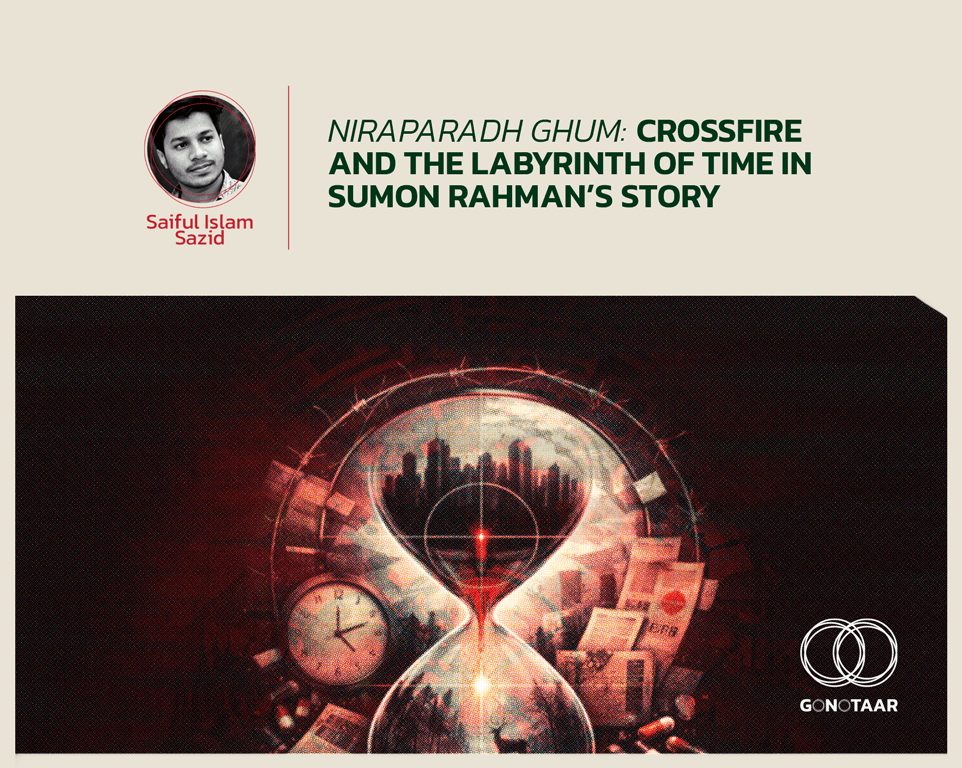
In confronting the crisis of crossfire Rahman constructs a labyrinth of time. The story’s temporality thickens and coils back on itself and the reader gradually relinquishes the ability to separate dream from waking, memory from event, aftermath from occurrence. Christopher Nolan’s sci-fi film Tenet (2020) reimagines time through the physics of inversion, where effects flow backwards into causes. In distinction, Niraparadh Ghum enacts a vernacular inversion, where the dead do not return by rewinding entropy, but by rupturing the living present. The story thus becomes, in the terms of Borges’ ‘the garden of forking paths’, where contradictory realities exist at once, and every line of time is haunted by what lingers beyond it.
Fiction, at its most incisive, becomes a mirror for society, the state, and the spirit of its time. Such stories unsettle, question, and lay bare the forces and figures shaping an era—its institutions, laws, and authorities alike. Let sharp, fearless, and critical literature continue to flourish in the hands of our most promising writers.
Saiful Islam Sazid enjoys alternative narratives. He welcomes recommendations at saifulislamszd@gmail.com.