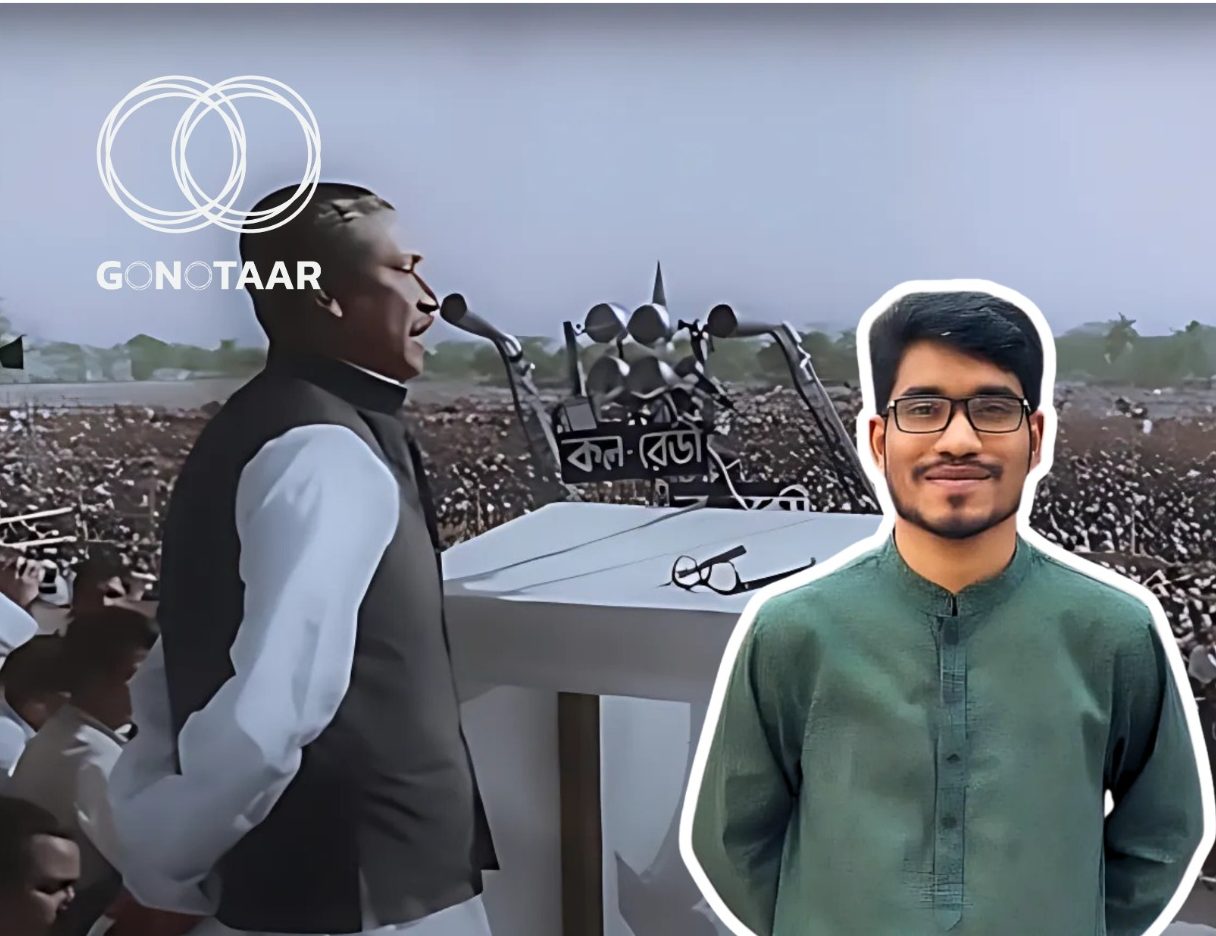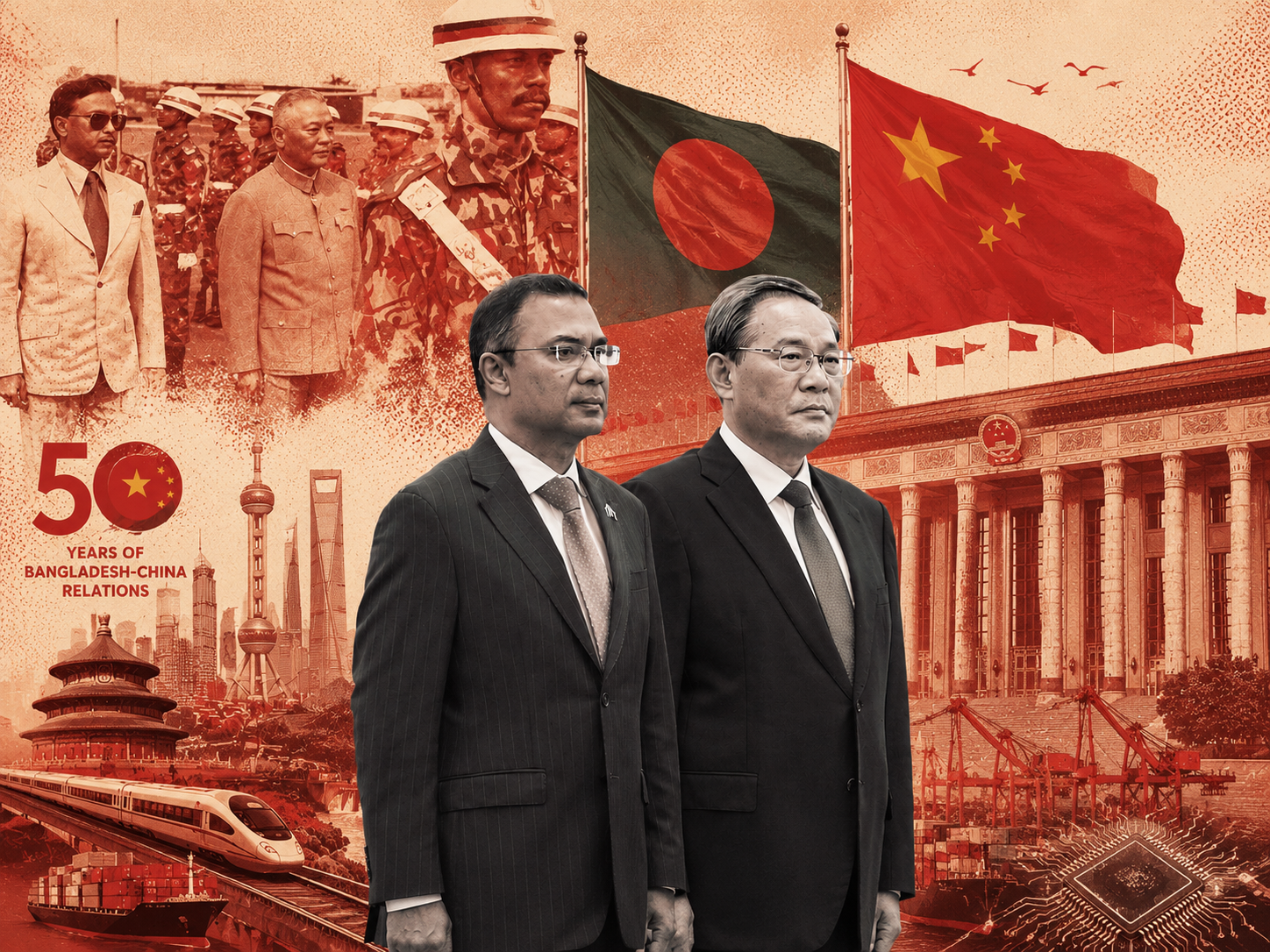
In 1977, Ziaur Rahman went to China and opened a door. This week, his son walked through it — carrying a longer wish list, a bigger stage, and the same fundamental question Bangladesh has never quite answered: what do we actually want from this relationship?
By Gonotaar Desk | June 25, 2026
There is a photograph that Bangladeshi foreign policy officials are fond of citing this week. It shows President Ziaur Rahman in Beijing, 1977 — young, military-straight, shaking hands with Chinese leadership in the careful, formal manner of a new government trying to establish itself on the world stage. Bangladesh was six years old. The wounds of 1971 had not fully healed. The ink on the country’s foreign policy doctrine was still wet.
Nearly fifty years later, his son arrived at Dalian Zhoushuizi International Airport on the night of June 22, descended onto a red carpet rolled out by Chinese protocol, and was driven to the Shangri-La Hotel in a ceremonial motorcade. Tarique Rahman — Prime Minister since February, BNP chairman since long before that, and the first member of his family to hold executive power since his father was assassinated in 1981 — had come to Beijing to do what his father did: reset Bangladesh’s relationship with China, signal a new era, and ask for things.
Today, June 25, he sat across from Chinese Premier Li Qiang at the Great Hall of the People, with Tiananmen Square’s western edge decorated in the green and red of both nations’ flags. Fifteen MoUs are expected to be signed before the day is out. Tomorrow he meets President Xi Jinping. The pageantry is considerable. The substance, as always with Bangladesh-China summits, is what requires scrutiny.
1977: What Zia Actually Did
To understand what Tarique’s visit means, it helps to understand what his father’s meant — and to resist the temptation to romanticise it.
Ziaur Rahman came to power in a Bangladesh that was economically devastated, politically fractured, and diplomatically isolated. The Mujib years had anchored Bangladesh firmly in the Indian-Soviet orbit. China had opposed Bangladesh’s independence in 1971, supporting Pakistan at the UN. The relationship between Dhaka and Beijing in the immediate post-independence years was, to put it mildly, poisonous.
Zia changed that — not out of sentiment but out of calculation. He needed to diversify Bangladesh’s foreign relationships, reduce dependence on India, and signal to the international community that his government represented a genuine break from the Awami era’s alignment. China was the obvious counterweight. His 1977 Beijing visit established diplomatic normalcy and opened trade channels that had been closed since independence. It was, by any measure, a significant act of foreign policy realism.
But it is worth noting what that visit did not produce: it did not produce an economic transformation, a technology partnership, or a strategic framework that changed Bangladesh’s development trajectory. It produced normalisation. It opened a door. What Bangladesh chose to do with the open door over the next five decades is the more complicated story — and it is the story Tarique now inherits.
Golden 50 Years — and the Ledger
Official communications from both sides have been enthusiastic about the “Golden 50 Years” of Bangladesh-China relations that this visit is said to commemorate. The phrase deserves examination against the actual record.
China is Bangladesh’s largest source of imports — machinery, textiles, industrial inputs — by a considerable margin. The trade deficit between the two countries has grown consistently and is now structurally embedded in Bangladesh’s economy. Chinese companies have invested in Bangladesh’s infrastructure, garments, and manufacturing; China ranked second after Saudi Arabia in private FDI inflows between 2019 and 2024, contributing $4.38 billion over that period. The Chinese Economic Zone in Anwara, Chattogram — long discussed, long delayed — has still not broken ground.
Bangladesh has $9 billion in financing proposals pending with Chinese government institutions, the AIIB and the NDB. The Teesta River project, which China has been offering to fund for years, remains entangled in the India-Bangladesh-China triangle that makes its implementation politically fraught regardless of which government is in Dhaka. Mongla Port modernisation is on the list. So is the Bangladesh-China FTA — which has been stalled since the fall of the Hasina government and which, as analysts note, countries that have it with China attract dramatically higher investment than those that don’t.
During Sheikh Hasina’s 2024 Beijing visit, Bangladesh expected $5 billion in budget support and received the equivalent of roughly $136 million. The gap between the ambition of Bangladesh-China summits and their concrete yield is, to be fair, not unique to Bangladesh — it is a general feature of how China conducts investment diplomacy. But it is a pattern that Dhaka’s foreign policy establishment has consistently failed to learn from, approaching each new summit as though the previous ones did not happen.
What Tarique Brought to Beijing
Against that backdrop, the agenda of this visit is genuinely more structured than its predecessors — and that is worth acknowledging.
The centrepiece announcement is Bangladesh’s first-ever Investment Office in China, to be operated by BIDA and staffed with Chinese nationals who can engage investors in their own language, resolve queries in real time, and reduce the gap between investor interest and actual commitment. The idea is not new — it was first proposed eighteen months ago — but the announcement from the PM’s own mouth in front of 125 Chinese business executives at the Diaoyutai State Guest House carries different weight than a BIDA press release.
The sectors BIDA is targeting for Chinese investment are also, for the first time, meaningfully forward-looking: electronics, semiconductors, electric vehicle batteries, advanced textiles, medical devices, renewable energy. These are not the garments-and-infrastructure asks of previous visits. They reflect an understanding — imperfect, bureaucratically filtered, but real — that China is itself moving up the value chain and shedding lower-value manufacturing, and that Bangladesh has a window to catch that overflow if it moves quickly and credibly.
The 180-day action plan to reform investment facilitation — digitising approvals, creating a specialised Chinese investor desk at BIDA, promising new business registration in under 15 days — is an attempt to demonstrate that the reforms are not merely rhetorical. Whether a government promising 15-day business registration in a country where investors routinely cite law and order, banking sector dysfunction, and VAT policy instability as the real barriers will be taken seriously by Chinese industrialists is a separate question.
The water cooperation dimension broke new ground today in a meeting between Tarique and Chinese Water Resources Minister Li Guoying, where both sides reached consensus on the Teesta Master Plan, flood-risk mitigation, river dredging, and inland navigation. This is politically significant because the Teesta question has been the most sensitive node in the Bangladesh-India-China triangle. A government that is already managing a strained relationship with Delhi will need to handle Chinese involvement in Teesta carefully — not because the water management is wrong but because the optics of Chinese engineers working on a river that India considers within its sphere of influence requires diplomatic precision that Dhaka has not always demonstrated.
Tarique also held a party-to-party meeting with Liu Haixing of the Communist Party of China’s International Department — and signed an MoU between the BNP and the CPC. That is an unusual move, and its significance should not be understated. Party-to-party ties give a bilateral relationship a channel that survives government changes. The Awami League’s relationship with China was always somewhat state-to-state; BNP has now formalised an institutional link at the party level that could prove durable.
Summer Davos and the Bigger Stage
Before the Beijing bilateral, Tarique spent two days at the World Economic Forum’s Summer Davos in Dalian — attending a plenary session alongside Chinese Premier Li Qiang, South Korean Prime Minister Kim Min-seok, and the heads of government of Kazakhstan, Mongolia, Montenegro and Guinea. He addressed a session on climate leadership, met the WEF President, and attended a state dinner hosted by Li Qiang.
His father never appeared at Davos. He never had the opportunity to present Bangladesh’s economic ambitions to an audience of 1,700 representatives from over 90 countries. The global platform that is now available to a Bangladeshi prime minister is structurally different from what was available in 1977, and Tarique used it — pitching Bangladesh as a green industrialisation story, a climate-resilient economy in transformation, a destination for the next wave of manufacturing investment.
Whether the pitch is credible is another matter. Bangladesh’s climate record is genuinely impressive in adaptation terms; its green industrialisation record is not. Presenting both as part of the same coherent agenda requires a kind of selective framing that experienced Davos audiences will notice. But the attempt to position Bangladesh in the global conversation about economic transformation — rather than purely as an aid recipient or a garment supplier — is itself a shift worth marking.
The Question the Flags Don’t Answer
Tiananmen Square’s western edge was hung with Bangladeshi and Chinese flags for Tarique Rahman’s arrival at the Great Hall of the People. The Chinese Premier hosted a state banquet. Fifteen MoUs are being signed today; Xi Jinping follows tomorrow.
The ceremony is impeccable. The question it cannot answer is the same one Zia’s 1977 visit left open: what does Bangladesh actually want to become, and is the China relationship a means to that end or a substitute for having one?
Zia opened the door to China because he needed to rebalance Bangladesh’s foreign alignments. That was correct. But rebalancing alignments is not a development strategy. The fifty years since have produced a relationship that is deeply asymmetric in trade, productive in some infrastructure, erratic in investment, and perpetually promising in diplomatic language. The “Golden 50 Years” framing implies that what has been built is worth celebrating. It is also worth auditing.
If Tarique Rahman’s Beijing visit produces the investment office, the semiconductor pipeline, the Teesta water framework, and meaningful FTA progress — not as communiqué language but as implemented policy — then it will have done something his father could not have imagined doing in 1977, because the tools did not exist. If it produces the usual stack of MoUs that are never operationalised, the familiar gap between summit ambition and institutional follow-through, and another bilateral relationship that looks better in photographs than in trade statistics, then it will have repeated a pattern that fifty years of Bangladesh-China “golden relations” have made all too familiar.
The son arrived in Beijing with more resources, a bigger stage, and a more sophisticated agenda than the father had. Whether he also arrives with the institutional machinery to convert a relationship built on goodwill and geopolitical positioning into one built on actual industrial partnership — that is the question the flags on the Great Hall cannot answer.
Bangladesh has been asking China for things since 1977. The more interesting question, and the one this visit has begun to ask for the first time, is what Bangladesh is prepared to offer in return — not in diplomatic language, but in reforms, in policy consistency, in a credible investment environment that does not require a prime minister to personally reassure investors at every summit that this time, the promises will be kept.