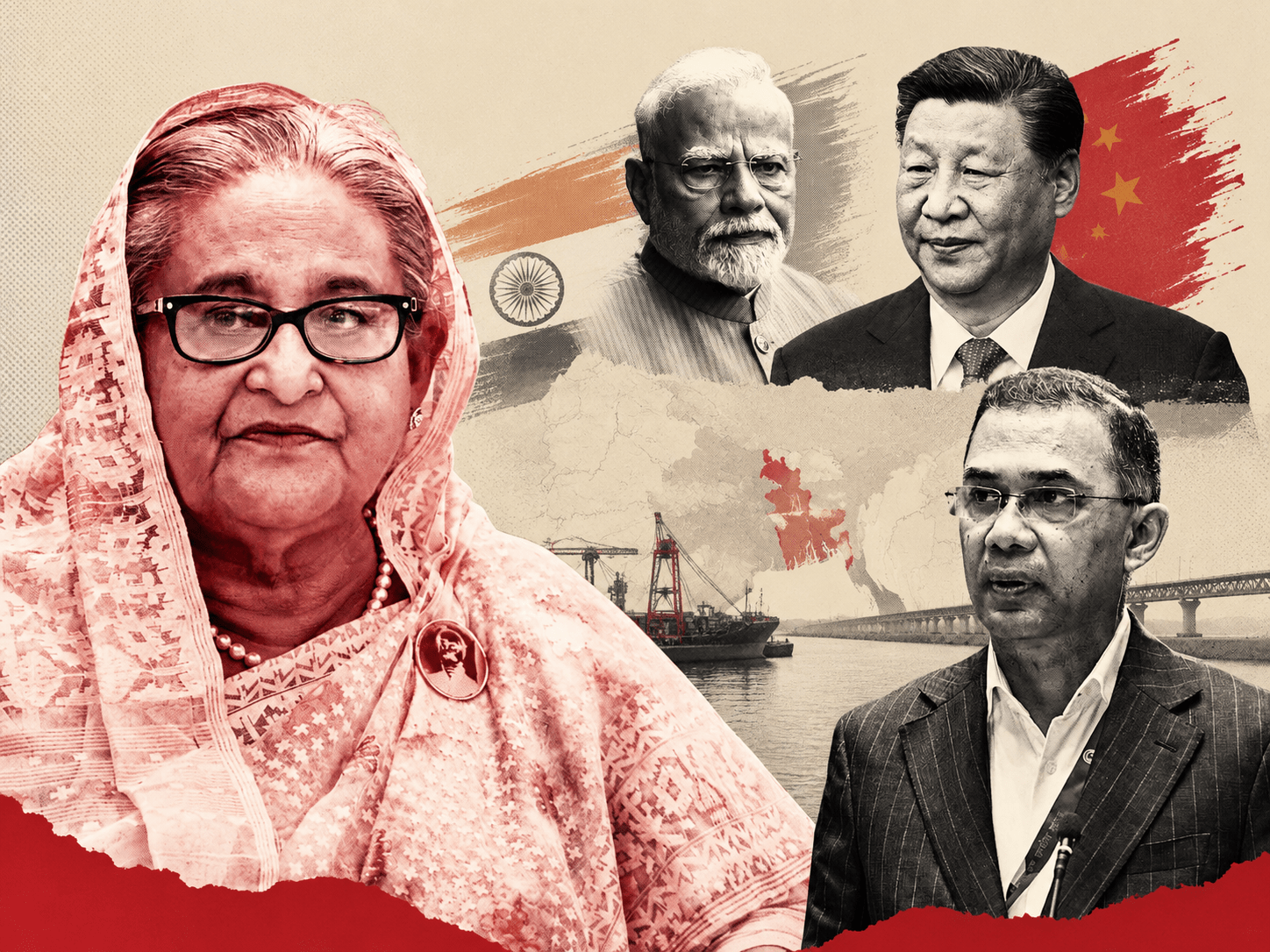
Eleven days before telling Reuters she would surrender in December, Sheikh Hasina made nearly the same vow to Indian television. In between, Dhaka signed seventeen agreements with Beijing that have quietly made New Delhi’s hospitality look less like an alliance and more like a liability.
GONOTAAR ANALYSIS | July 2026
On July 10, Sheikh Hasina told Reuters, in her first interview since fleeing to India two years ago, that she and senior Awami League leaders plan to return to Bangladesh around December and surrender in court. She said she is prepared to be arrested. She said she is prepared to die on her own soil rather than in exile.
It is a striking quote. It is not a new one.
On June 29, eleven days earlier, Hasina told NDTV almost the identical thing: that she would return to Bangladesh “this year,” overcoming “every obstacle and every conspiracy.” Indian media called it the first time she had given any timeline for her return. Reuters is now calling its own interview a first too, this time for naming a month and describing an organised surrender. Two firsts, eleven days apart, from a woman who has not left New Delhi since August 2024. That is not how genuine plans usually announce themselves. That is how a message gets tested, refined, and reissued.
Gonotaar has covered the deeper currents running underneath Dhaka’s foreign policy this year, the widening China corridor, the Teesta project, the steady erosion of India’s old economic footholds in Bangladesh. Read against that backdrop, Hasina’s December promise looks less like a woman finally choosing justice and more like a signal aimed at an audience that is not in Bangladesh at all. It is aimed at Delhi.
A Pattern, Not a Plan
Since her ouster, Hasina has made variations of this promise before, always vague, always safely far off, always unfulfilled. What changed in the space of eleven days this summer was not her resolve. It was the news cycle. The NDTV interview landed days after Bangladesh’s own Home Minister marked the second anniversary of the uprising by calling her a mass murderer with no remorse, and declaring the Awami League “eliminated and buried in Delhi.” The Reuters interview landed as international coverage of that same anniversary was still circulating. Both times, Hasina answered public humiliation with a bigger, bolder claim about coming home. That is a defensive reflex, not an itinerary.
Tellingly, Bangladesh’s own government does not appear to be preparing for a December arrival. State Minister for Foreign Affairs Shama Obaed Islam, asked recently about the extradition push, described it as an ongoing “process,” language that suggests years, not months. If Dhaka genuinely believed its most wanted fugitive was walking into a courtroom in five months, the tone from government spokespeople would likely carry more urgency than another round of insults.
What Changed in Beijing
The more interesting story is what has actually shifted since Hasina’s last vague promise of return, and it has nothing to do with her.
In late June, Prime Minister Tarique Rahman spent four days in Beijing and came home with seventeen signed agreements. The two governments elevated the relationship to a “comprehensive strategic cooperative partnership” and revived the long-dormant China-Bangladesh-Myanmar Economic Corridor. Two projects inside that package matter more than the rest. The first is the modernisation of Mongla port. The second is the Teesta River Comprehensive Management and Restoration Project, a river engineering initiative that puts Chinese state enterprises to work a short distance from India’s Siliguri Corridor, the narrow strip of land connecting the Indian mainland to its northeast. Indian security planners have treated that corridor as sacred ground for decades. Chinese excavators working near it is the kind of development that keeps a defence ministry up at night.
What makes this sting more for Delhi is that Mongla was India’s to lose. Under a 2015 agreement, Dhaka had already set aside land there for an Indian-developed special economic zone. The Indian developer never delivered. Beijing simply walked into the vacancy. This is not a story of Bangladesh abandoning India for China. It is a story of India failing to show up, and China being the only power left standing when Dhaka went looking for a partner.
For a government in New Delhi already absorbing that loss, image matters. Every month that Sheikh Hasina remains a guest in Delhi, wanted for crimes against humanity by a neighbour that is visibly drifting toward Beijing, is a month that costs India credibility it can no longer spend freely. Dhaka’s Foreign Ministry has already called her continued shelter “a grave act of unfriendly behaviour” and warned that any country hosting her is committing “a travesty of justice.” Those are not private diplomatic notes. They are public statements, designed to be read in Beijing, Washington and everywhere else that watches how India treats its neighbours.
Delhi’s Quiet Calculation
It would be convenient for this piece to say India is now actively pushing Hasina out the door toward a Bangladeshi courtroom. The evidence does not support that, and Gonotaar will not pretend it does.
What regional analysts describe instead is more careful. India is expected to keep refusing formal extradition, citing the political-offence clause in its 2013 extradition treaty with Bangladesh, a clause built for exactly this kind of situation. Privately, however, the calculation inside India’s foreign policy establishment appears to be less about honour and more about exit costs, and the preferred exit is widely believed to be a third country, not a Bangladesh death sentence. Sending her home to be hanged does nothing for India’s standing with the current Bangladeshi government, and everything to damage its standing with the wider world that watched the July 2024 crackdown unfold.
That distinction matters for how you read Hasina’s own words. In the Reuters interview, she is careful to say two things at once. She insists Dhaka is the one applying pressure, sending “repeated letters” to India demanding her return. She insists, just as firmly, that she has not consulted any government, including India’s, about the timing of her own plan. Read literally, that is a claim of complete independence from Delhi. It is also, notably, a claim that leaves open exactly the possibility this piece is exploring: that India has communicated its discomfort in ways too informal to be called consultation, and Hasina’s sudden urgency to announce a homecoming is the public performance of a private nudge.
There is also a detail that cuts against a clean “China is squeezing India” narrative, and it deserves honest mention. Relations between Dhaka and Delhi have been quietly thawing since February, not collapsing. Bangladesh’s new intelligence chief made an unannounced trip to New Delhi within days of the current government taking office. India has continued supplying diesel through the Bangladesh-India Friendship Pipeline, even fielding requests for more as fuel markets tightened elsewhere. None of that looks like a relationship in crisis. It looks like two governments managing an awkward situation while keeping the lights on. The China corridor complicates that management. It does not necessarily blow it up.
The Silence That Matters
What Hasina did not say to Reuters is as revealing as what she did. She gave no date. She named no court. She offered no explanation for why December, specifically, and not any of the eighteen months that preceded it. She described online meetings covering 125 of Bangladesh’s 300 constituencies, evidence that her real project is not repatriation but reorganisation, rebuilding a banned party’s shadow structure from a borrowed flat in Delhi. A woman planning to surrender to a death sentence in five months does not typically spend her final months of freedom running a virtual election campaign for a party that cannot legally contest one.
What This Is Actually For
Put together, the December vow reads less like a confession of guilt and more like a negotiating position dressed up as one. It gives Hasina a martyrdom narrative to feed her scattered, harassed party base at home, most of whom are in hiding or facing cases of their own. It gives her leverage over a Bangladeshi government that has spent two years demanding her extradition and now has to publicly weigh whether it actually wants her walking into a Dhaka courtroom the way it always said it did. And it gives India a talking point, evidence it can quietly wave at anyone asking why its most controversial houseguest is still living rent free in the capital: she says she is leaving anyway.
Whether any of that survives contact with December is a separate question, and on the evidence of the last two years, the honest answer is that it probably will not. Hasina has now promised her return twice inside a single month. Bangladesh has heard variations of this promise since the week she fled. What has actually moved, in the meantime, is not her. It is the ground under India’s feet, one Chinese-backed port and one Chinese-backed river project at a time. That, and not a courtroom in Dhaka, is the story worth watching this December.