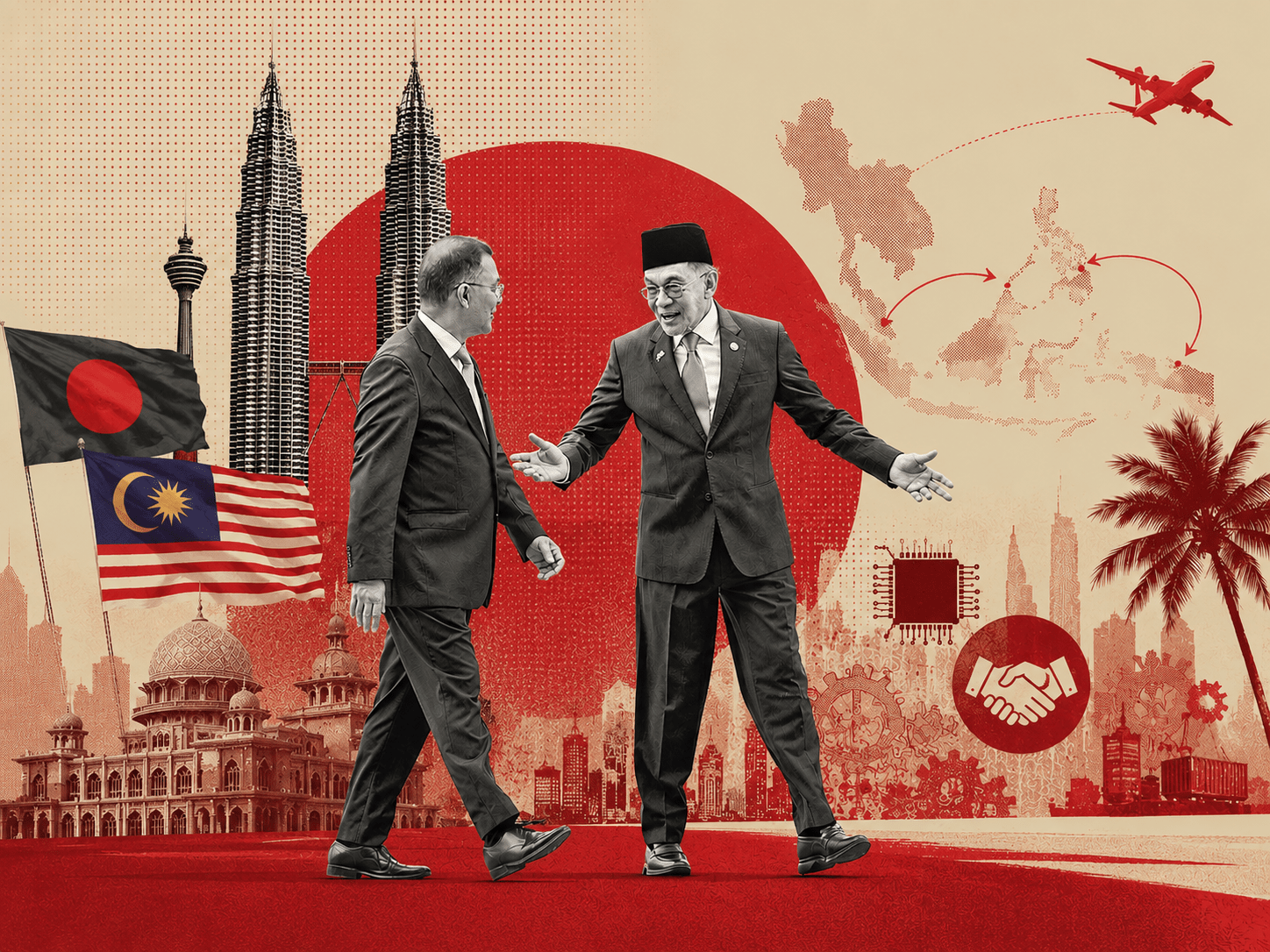
Tarique Rahman chose Malaysia as his first foreign destination. That choice is either the smartest thing the new government has done, or it will be remembered as the moment Bangladesh stared at its own future and blinked.
By Gonotaar Desk | June 24, 2026
There is a version of the Bangladesh-Malaysia relationship that everyone already knows. It goes like this: desperate men pay loan sharks to pay recruiting agents to pay bribes to get on a plane to Kuala Lumpur, where they spend three to five years doing work Malaysians will not do, sending money home through hundi, and praying they don’t get swept up in a RELA raid. That relationship — one-directional, exploitative, and dressed up in official language as “manpower export” — has defined how Dhaka thinks about Kuala Lumpur for three decades.
When Prime Minister Tarique Rahman landed at KLIA on June 21, he became the first Bangladeshi head of government to choose Malaysia as his very first foreign destination. He did not go to Delhi. He did not go to Beijing. He went to Kuala Lumpur. And if the agenda of that visit means what it appears to mean, Bangladesh may finally be asking a different question about Malaysia — not how many workers can we send but how did you pull this off, and can we do the same?
The Deliberate Snub That Wasn’t
Let us clear something up first, because the geopolitics of the visit sequence — Malaysia first, then China, India not yet — has generated the predictable commentary.
A senior Bangladesh government minister, speaking to The Wire on condition of anonymity, put it plainly: Malaysia invited first, China second, India third. That sequencing is “one parameter, although not the most important one.” But from the perspective of maintaining balance in foreign relations, he said, it was “the correct decision.” An Indian diplomat, also unnamed, called it “understandable” given domestic political considerations and said the choice of Malaysia sent a reassuring signal — not a hostile one.
So no, this is not Bangladesh pivoting away from India or into China’s orbit. It is Bangladesh choosing a partner that carries no toxic political charge at home, while still signalling economic intent and regional ambition. Malaysia was, as the minister noted, simply “much more pragmatic and realistic” as a first stop — partly because it is one of the largest destinations for Bangladeshi migrant labour, and partly because choosing Nepal or Bhutan first “could have appeared somewhat calculated.”
The political optics were clean. The substantive agenda, however, was anything but routine.
What Actually Happened in Putrajaya
The standard readout of a bilateral visit sounds like this: leaders met, cooperation was discussed, documents were signed, both sides expressed satisfaction. The Tarique-Anwar summit produced all of that. But the specific sectors on the table tell a more interesting story than the joint statement’s diplomatic boilerplate suggests.
The two prime ministers agreed on cooperation across ICT, energy, infrastructure, the halal industry, agro-processing, education, skills development, defence, the digital economy — and semiconductors. They signed an MoU on cultural cooperation and two Exchanges of Notes covering counter-terrorism research and investment promotion. They committed to advancing negotiations on a Bangladesh-Malaysia Free Trade Agreement with a 2027 target. A joint business council was established to formalise private-sector engagement. Malaysia pledged to support Bangladesh’s bid for ASEAN Sectoral Dialogue Partner status, and backed Dhaka’s aspiration to join the Regional Comprehensive Economic Partnership — the world’s largest free trade bloc.
Labour migration was also on the table, as it always is. PM Tarique asked for the labour market to be reopened, raised the issue of regularising undocumented workers, and pushed for transparent, affordable recruitment that cuts out intermediaries. Malaysia responded by acknowledging the contribution of Bangladeshi workers while noting that new foreign worker quotas will continue to be assessed case by case. A joint working group will review the existing MoU. That is diplomatic language for: not yet, but the door is open.
The labour piece matters. Bangladesh currently sends workers to Malaysia in conditions that are frequently described by rights organisations as modern servitude — high recruitment costs, debt bondage, wage theft, and passport confiscation are documented and persistent. Any updated MoU that genuinely reduces these abuses would be substantive. But the labour agenda, important as it is, is not the most significant thing that happened in Putrajaya.
The most significant thing was the semiconductor conversation.
Bangladesh Is at the Crossroads Malaysia Stood at in 1985
Here is the context that most coverage of this visit has not bothered to provide.
In the mid-1980s, Malaysia was a lower-middle-income country whose economy ran on rubber and palm oil, with a garment sector and a government determined to industrialise. Mahathir Mohamad launched the Look East Policy — explicitly directing Malaysia to study Japan and South Korea, not Britain or America. The country invited semiconductor manufacturers, built the Multimedia Super Corridor, invested heavily in technical education, and over the next three decades turned itself into a globally significant node in the semiconductor supply chain. Today Malaysia handles roughly 13 percent of global semiconductor packaging and testing. Penang is sometimes called the Silicon Valley of the East.
Bangladesh in 2026 is not exactly where Malaysia was in 1985 — the political economy is different, the institutional quality is weaker, the infrastructure deficit is larger. But the structural parallel is real: a garment-dependent, labour-exporting economy staring at a post-LDC cliff, looking for the next ladder. The question Bangladesh has not been able to answer for twenty years is what comes after ready-made garments. The question Malaysia answered with semiconductors, palm oil downstream processing, and services.
When Anwar Ibrahim said at the joint press conference that cooperation must extend to “semiconductor, digital economy, energy, advanced manufacturing” — that this agreement covers combining Malaysia’s expertise in semiconductor packaging and testing with Bangladesh’s engineering talent pool — he was not reading from a script about friendship and goodwill. He was describing a real industrial opportunity.
Bangladesh proposed joint skills-development programmes to train engineering graduates for high-value industries. Malaysia has the facilities, the global supply chain relationships, and the technical ecosystem. Bangladesh has relatively cheap, relatively educated engineering graduates and a government desperate to diversify beyond apparel. The fit is not imaginary.
The question is whether Dhaka has the political will and institutional capacity to convert a line in a joint statement into an actual industry pipeline — and whether Malaysia’s interest is genuine partnership or the same polite diplomatic language that gets recycled every few years and leads nowhere.
The RCEP Question Nobody Is Taking Seriously Enough
Bangladesh formally asked Malaysia to support its accession to RCEP — the Regional Comprehensive Economic Partnership, which links ASEAN’s eleven members with China, Japan, South Korea, Australia, and New Zealand. Malaysia said yes.
This is a bigger deal than it has been reported as.
With LDC graduation deferred but inevitable — the formal request was just submitted for a three-year extension — Bangladesh faces the loss of preferential market access in the EU, the UK, and other major export destinations. The entire economic model of Bangladesh’s export sector depends on those preferences. RCEP membership does not replace that, but it provides a different kind of market access: the Asia-Pacific’s integrated production network, where supply chains are regional rather than solely western-export-dependent.
Bangladesh cannot join RCEP unilaterally. It needs champion states. Malaysia, as a founding RCEP member and one of ASEAN’s more influential economies, is now on record supporting Bangladesh’s accession. If that support is operationalised — if it means Malaysia actually lobbies inside the ASEAN framework on Dhaka’s behalf — it is potentially worth more than any single bilateral investment deal.
ASEAN Sectoral Dialogue Partner status is the prerequisite for that relationship to deepen. The precedent countries are Pakistan, which has had observer status, and Sri Lanka, which has long sought engagement. Bangladesh is now formally in the queue, with Malaysia’s backing. Whether ASEAN accepts this — and on what timeline — is not within either government’s control. But the application has been made, and it has been made with a sponsor.
What Malaysia Gets From This
Good foreign policy is not charity. Malaysia’s enthusiasm for this visit — Anwar personally extended the invitation shortly after Tarique took office in February, decorated the airport road with both countries’ flags, and hosted a state luncheon — reflects a calculation on Kuala Lumpur’s side as well.
Bangladesh is Malaysia’s second-largest trading partner in South Asia after India, with total bilateral trade of RM 12.18 billion in 2025. Malaysian exports to Bangladesh — overwhelmingly petroleum products — stood at USD 2.35 billion. Bangladeshi exports to Malaysia — mostly garments — were USD 500 million. That asymmetry is enormous and it will not narrow quickly. But a Bangladesh that grows faster, industrialises more, and integrates into RCEP is a larger market for Malaysian exports, a more credible investment destination, and a more useful partner in multilateral forums where Malaysia has its own agenda — particularly on Palestine, the OIC, and Myanmar-Rohingya, where both countries take the same position.
Malaysia also benefits from a functioning Bangladeshi labour relationship. The undocumented worker crisis — hundreds of thousands of Bangladeshis in irregular status in Malaysia — is a problem for both governments. A proper, transparent, lower-cost recruitment framework serves Malaysia too: it reduces dependency on syndicates, lowers reputational risk with international labour monitors, and gives the Malaysian government cleaner data on its own workforce.
The interest is mutual. The depth of that mutuality, and whether it survives the transition from summit communiqué to implementation, is what will determine whether this visit was a turning point or a photo opportunity.
The Labour Question: Can Bangladesh Stop Being Exploited By Its Own Partner?
It would be negligent to frame this as a story of strategic optimism without confronting the existing relationship’s ugliness directly.
As of 2026, hundreds of thousands of Bangladeshis are working in Malaysia in conditions that do not meet Malaysia’s own stated labour standards. Recruitment costs that should legally not exceed a few hundred dollars have routinely run to BDT 3–5 lakh per worker, financed by debt. Passport confiscation is common. The Kafala-adjacent sponsorship structure gives employers near-total power over workers’ legal status. Bangladeshi workers have been detained, deported, and in some cases killed in detention. Malaysia’s immigration enforcement operations have swept up legal and undocumented workers alike.
The government claims it raised regularisation of undocumented workers in the bilateral talks, and pushed for fair, affordable, intermediary-free recruitment. The joint statement says a joint working group will produce a new MoU. This is the fourth time in roughly fifteen years that a Bangladesh-Malaysia labour agreement has been renegotiated, each time promising transparency, each time producing a system that quickly returned to exploiting the workers it was designed to protect.
The difference, if there is one this time, would have to come from Bangladesh’s own enforcement mechanisms — not Malaysia’s goodwill. Malaysia’s labour market needs workers. Its incentive to clean up recruitment is limited as long as the supply keeps flowing regardless of conditions. Bangladesh’s leverage is in credible regulation of its own recruiting industry: licensing, fee caps with real criminal penalties, direct government-to-government channels that cut out the syndicate layer. Whether the new government has either the will or the capacity to enforce that is the question no joint statement will answer.
Beyond the Manpower Bracket
For fifty years, Bangladesh has understood the word “Malaysia” to mean one thing: a place to send workers. That frame has been so dominant that almost nothing else has been visible through it.
What the Putrajaya visit proposes — tentatively, imperfectly, surrounded by the usual diplomatic noise — is a different frame: Malaysia as a development model, a technology partner, a gateway to Southeast Asian economic architecture, and an advocate in multilateral forums where Bangladesh needs friends.
Malaysia graduated from being a labour-exporting economy to a semiconductor hub. It did it through deliberate industrial policy, sustained investment in technical education, and a government willing to bet on its own engineering class rather than indefinitely exporting them. Bangladesh has not done those things. The garment sector’s dominance has crowded out almost every other industrial conversation for two decades. The LDC graduation pressure — and the loss of preference access that comes with it — is the forcing function that could change that, if the government is willing to be changed.
The question Tarique Rahman should be returning from Malaysia asking is not “how many more workers can we get approved?” It is: “In thirty years, when Malaysia’s semiconductor workers want somewhere cheaper to set up a packaging facility, will Bangladesh be ready to receive them — or will we still be sending people to work on their production floors?”
That question will not be answered by the joint statement signed in Putrajaya. It will be answered by what the ministry of education does with technical curriculum, what the Bangladesh Investment Development Authority does with semiconductor park proposals, and what the labour ministry does with recruiting syndicates.
The runway has been laid. Whether Bangladesh uses it to take off, or just to taxi in circles, is the story that will matter.