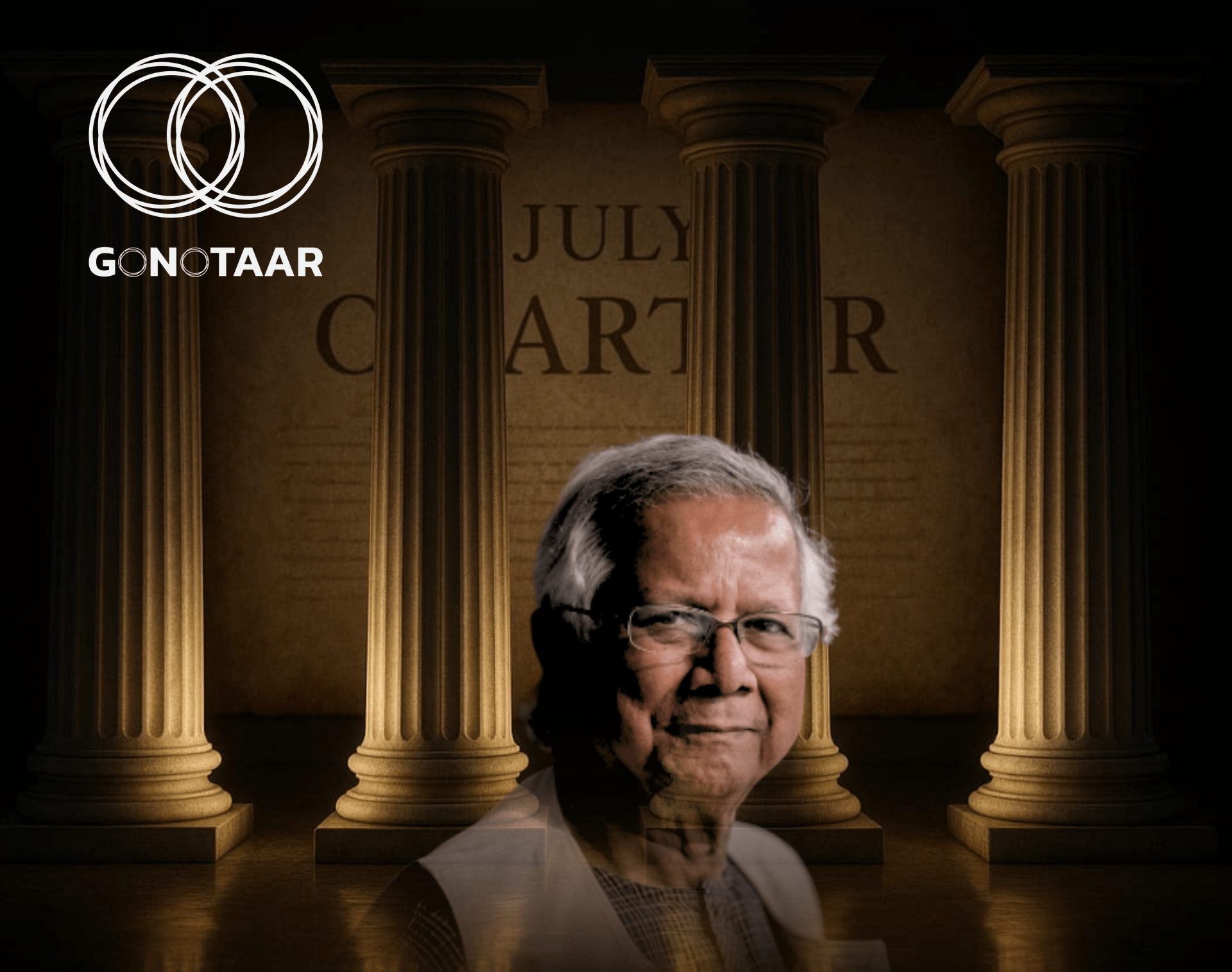
Chief Adviser Professor Muhammad Yunus today announced that a national referendum on four critical constitutional reform proposals will be held on the same day as the upcoming National Parliamentary Elections, expected in the first half of February.
The landmark decision, aimed at implementing the foundational ‘July National Charter (Constitutional Reform) Implementation Order, 2025,’ was conveyed by the Chief Adviser in a televised address to the nation at 2:30 PM on Thursday. The Implementation Order was approved earlier by the interim government’s Advisory Council.
In his address, Chief Adviser Professor Muhammad Yunus stated, “Having considered all matters, we have decided that the referendum will be organised on the same day as the upcoming national parliamentary election. This means that, like the national election, the referendum will also be held on the same day in the first half of February. This will not hinder the goal of reform in any way.” He confirmed that necessary legislation for conducting the referendum will be enacted in due course.
One Question, Four Core Issues
The Chief Adviser revealed that the public will cast a single ‘Yes’ or ‘No’ vote on the ballot question, which will cover four major points of constitutional reform agreed upon in the July National Charter.
The comprehensive question presented to the electorate will be: “Do you consent to the July National Charter (Constitutional Reform) Implementation Order, 2025 and the following constitutional reform proposals enshrined in the July National Charter?”
The four key areas of reform are:
- A. The formation of a Caretaker Government, Election Commission, and other constitutional institutions according to the procedures outlined in the July Charter for the election period.
- B. The next parliament will be bicameral, featuring an Upper House of 100 members. This Upper House will be constituted based on the proportion of votes received by political parties in the general election, and a constitutional amendment will require the approval of a majority of its members.
- C. The winning parties in the upcoming election will be obligated to implement 30 proposals, which were agreed upon by political parties in the July Charter. These include increasing women’s representation, electing the Deputy Speaker and parliamentary committee chairmen from the opposition, limiting the Prime Minister’s tenure, increasing the President’s power, expanding fundamental rights, and ensuring the independence of the judiciary and local government.
- D. Other reforms outlined in the July Charter will be implemented in accordance with the commitments of the political parties.
Path to Constitutional Reform
Chief Adviser Professor Muhammad Yunus outlined the process that will follow if the majority vote is ‘Yes.’
Should the referendum receive majority affirmative support, a Constitutional Reform Council will be formed with representatives elected in the next general election. These representatives will simultaneously serve as members of the National Parliament.
The Council will be tasked with completing the constitutional reform within 180 working days from the commencement of its first session. Following the completion of the constitutional amendments, the new 100-member Upper House will be formed within 30 working days, proportional to the votes received by parties in the parliamentary election.
The Chief Adviser reiterated the pledge to incorporate the July National Charter into the Constitution as per the commitment made to the nation.