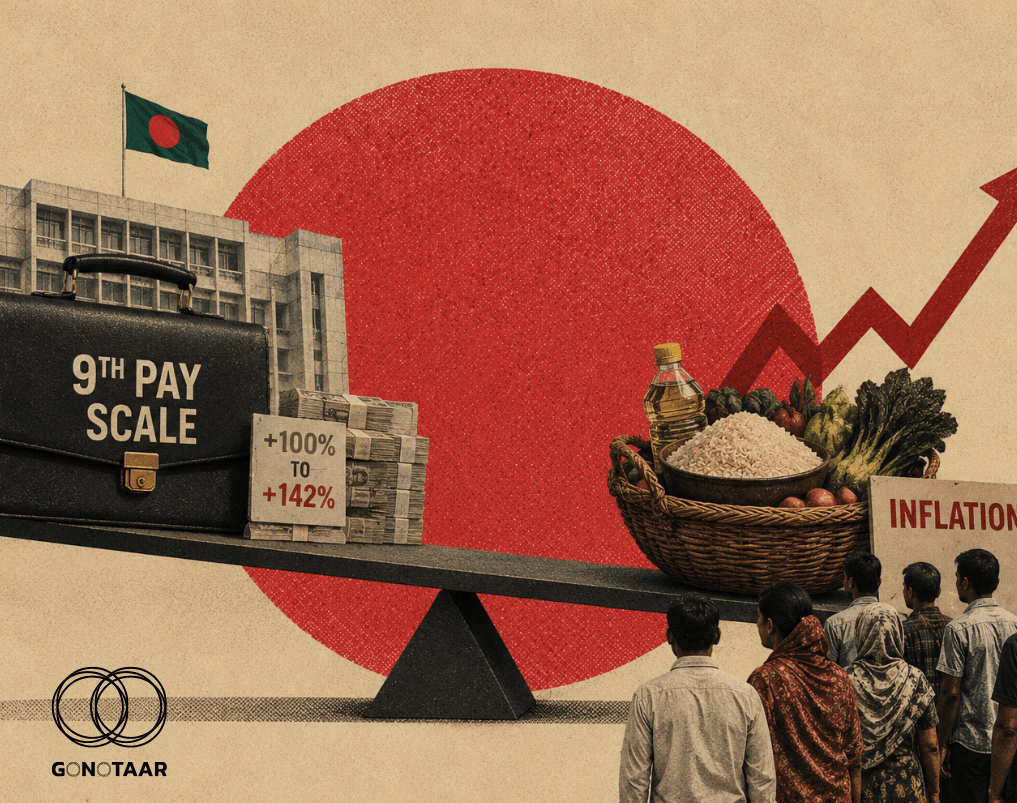
On August 31, the cabinet approved the Ninth National Pay Scale, raising basic salaries for roughly 24 lakh government employees and 9 lakh pensioners by 100 to 142 percent, the first such revision in eleven years. It was framed as overdue correction: public servants had watched their real income erode for over a decade while their pay structure stood still. But the government approved this raise while describing the broader economy in the language of crisis, citing energy-driven production disruptions, weak revenue collection, and years of high inflation as the conditions it is simultaneously trying to manage. That contradiction is the story.
The pay scale will cost the government an additional Tk 1,05,580 crore a year once fully implemented, phased in through July 2027, with allowances held back until January 2028. The question worth asking is not whether public servants deserved a raise. It is whether the way this one is being financed will make the inflation squeezing everyone else worse.
Two ways to raise wages, one of them dangerous
Fahmida Khatun, distinguished fellow at the Centre for Policy Dialogue, has offered the clearest framing of the risk. A salary increase does not automatically translate into higher inflation, she has argued. What matters is how it is financed, how large it is, whether the market has enough goods and services to absorb the new demand, and how well fiscal and monetary policy are coordinated. If the increase is paid for through higher tax revenue, the inflationary effect can be contained. If it is paid for through bank borrowing, money creation, or cuts to development spending, it adds pressure to an economy that is already strained.
That is precisely the fork the government is standing at. The National Board of Revenue has been handed a collection target of Tk 6.04 lakh crore for the current fiscal year, nearly 46 percent above what it actually collected the year before, with explicit instructions from the Prime Minister’s Economic and Planning Adviser to hit that number “at any cost.” Bangladesh has never once, since independence, achieved year-on-year revenue growth above 27 percent. Meanwhile, early data for the new fiscal year point the wrong way: VAT collection in July came in at Tk 9,301 crore, down from Tk 11,547 crore the year before, and preliminary August figures show a similar decline. Khatun has been blunt about what that means: the NBR carries structural weaknesses, its tax base hasn’t been meaningfully widened, and businesses already squeezed by high costs and a fresh energy crisis are in no position to generate the tax receipts the government is counting on.
If the revenue doesn’t materialise, the pay scale gets financed some other way, and every option left on the table is the kind Khatun warned about.
The central bank already flagged this
This isn’t a risk economists are inventing after the fact. Bangladesh Bank’s Monetary Policy Committee identified the new pay scale as a near-term inflation risk months before cabinet approval, alongside the national election and Ramadan-season demand. The MPC’s own resolution noted that if the salary increase were implemented without a significant rise in revenue collection, the government would have to turn to deficit financing, which would put pressure on the money market and could push interest rates higher across the financial system. Governor Ahsan H Mansur has been explicit that excessive government borrowing already keeps money-market rates elevated and complicates the central bank’s job. The Bangladesh Bank’s own prescription was for the government to take real revenue measures to offset the pay scale’s monetary impact, precisely the measure that is now, based on the NBR’s July and August numbers, struggling to show up.
Business is already saying it will pass the cost on
Bangladesh Chamber of Industries president Anwar-Ul Alam Chowdhury Parvez has warned that the pay scale will fuel demands for wage increases across the private sector, a demand he calls understandable but one that industry, hit by gas and electricity shortages, high lending rates, and law-and-order instability, may not have the capacity to absorb. His concern is a competitiveness spiral: if companies are forced to raise wages to keep pace, their production costs rise, they lose competitiveness, and the resulting struggle to sell their products becomes a drag on industry rather than a lift to workers.
A gap that predates the raise
There’s a harder number underneath all of this. National wage growth hit just 8.22 percent in July, still trailing an 8.32 percent inflation rate, a gap that has persisted for close to four years. The Ninth Pay Scale doesn’t close that gap so much as redraw who is inside it and who is outside it. Public servants at the bottom of the scale get a 142 percent jump in basic pay; the top gets 100 percent. But nearly six lakh MPO-listed teachers, along with employees at autonomous institutions, state-owned enterprises, and outsourced or project-based government positions, are not on the same clock. Government employees are paid first, “as per previous practice,” with teachers following at an unspecified later date, a sequencing that has already provoked protests and threats of nationwide human chains from teachers’ alliances earlier this year. Private-sector and informal workers, who make up the overwhelming majority of the country’s labour force, aren’t covered by this pay scale at all. Khatun’s own warning was about exactly this: raising public servants’ pay while leaving journalists, private-sector workers, and outsourced staff untouched risks widening a disparity that already existed, at a moment when the country’s wage-setting mechanisms for those other groups, like the Wage Board for journalists, are, by her own description, irregular, outdated, and weakly enforced.
What to watch next
The test of whether this becomes an inflation story rather than a welfare story will play out over the next two fiscal years, in numbers that are trackable: whether NBR revenue collection actually closes in on its Tk 6.04 lakh crore target or falls short and forces the government toward borrowing; whether Bangladesh Bank holds its policy rate or is forced to tighten further; and whether food and non-food inflation, already sticky and driven largely by food prices that carry roughly 85 percent of any price shock into the following month, ticks upward as the first phase of raised salaries lands in bank accounts. The government has framed this pay scale as an act of fairness delayed by eleven years. Whether it also becomes a tax on everyone who didn’t get one is a question the next two budget cycles will answer, not this one.