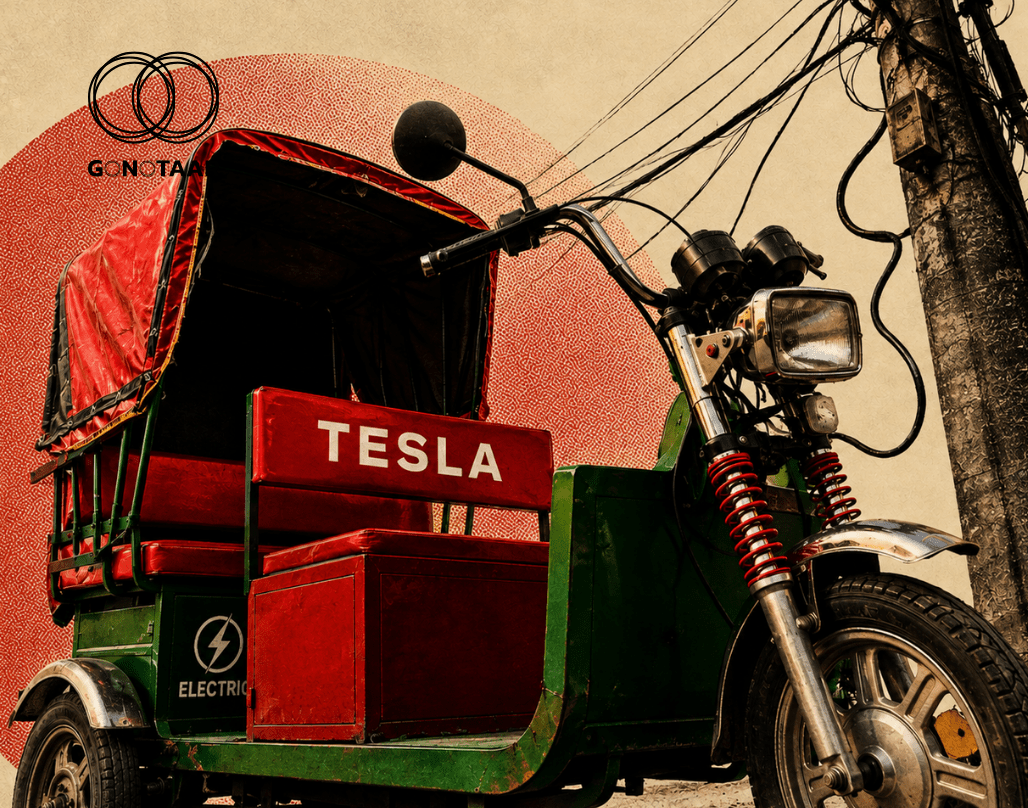
Bangladesh is living through its worst power crisis in years. On August 9, loadshedding broke every national record, crossing 3,700 megawatts in a single stretch. Villages went dark for ten to twelve hours at a stretch. Factories stopped mid-shift. And into that fury walked a convenient villain: the battery-run auto-rickshaw, mocked and cursed across the country as the “Tesla.”
The nickname was a joke first. It has become an accusation. Government officials, industry voices and a large section of the furious public now blame these three-wheelers for eating the country’s power at exactly the hour it can least afford to lose any. A recent itvbd investigation gave that accusation real numbers for the first time, and the numbers are genuinely bad. But read carefully, they also tell a very different story than the one being shouted on social media, and Gonotaar thinks that difference matters.
What the data actually says
According to the itvbd report, citing Centre for Policy Dialogue (CPD) research and Bangladesh Passengers’ Welfare Association figures, somewhere between 45 lakh and 60 lakh battery rickshaws now operate nationwide, roughly 20 lakh of them in Dhaka alone. Charging them consumes close to 800 megawatts a day, close to five percent of national generation, almost entirely at night, precisely when the grid should be resting.
The theft is not incidental. Most of this charging happens through illegal lines tapped directly off electricity poles, bypassing meters entirely. CPD puts the resulting annual revenue loss to the state at around 4,000 crore taka. Layered on top of that is a parallel cash economy built around illegal garages, roughly 20 lakh rickshaws in Dhaka alone paying an average of 100 taka a day for garage space and charging, which CPD estimates adds up to 21,000 crore taka a year moving through unregistered hands nationwide. None of these vehicles pay road tax. A BUET transport expert quoted in the piece is blunt about it: drivers pay chadabaji, informal tolls, at every checkpoint just to stay on the road, and that extortion economy is now entrenched enough that any crackdown will require real political will to dismantle.
The safety picture is worse. Road Safety Foundation data cited in the report puts rickshaw-related road deaths at 1,376 in a single year, driven largely by the fact that roughly 75 percent of these drivers have no prior driving experience and no meaningful knowledge of traffic law.
None of that should be waved away. A feature that pretends otherwise would not be honest, and Gonotaar has no interest in being a cheerleader.
But look at who is actually driving these things
Here is what gets lost when “Tesla” becomes shorthand for theft. Bangladesh’s garment sector, the country’s largest source of formal low-skill employment, has been shedding jobs for years now, with factory after factory shutting down or downsizing. Tens of thousands of workers, many with no other trade, have been pushed out with nowhere formal to land. The itvbd report itself notes that this is exactly the population now filling the rickshaw seat: workers with no capital and no other opening, absorbing themselves into an industry that asks for no prior experience.
The economics explain why. A battery rickshaw costs 70,000 to 72,000 taka to build. A CNG auto-rickshaw costs 10 to 15 lakh taka, a price tag that puts it entirely out of reach for anyone who just lost a garment-floor job. The battery rickshaw demands less physical labor than a pedal rickshaw and pays roughly double. It is, in the most literal sense, the only self-employment ladder available to a huge number of people the formal economy has already failed. By the report’s own count, close to 60 lakh families now depend on this sector directly or indirectly, and 82 percent of passengers choose it over any alternative because it is faster and cheaper.
There is a second layer to this that the electricity-theft framing conveniently erases: where the money goes. A rickshaw driver’s daily earnings get spent the same day, on rent, food, a child’s school fee, in the same neighborhood market. It is not the kind of money that leaves the country. Compare that to the capital flight and money laundering that Bangladesh’s wealthier and more politically connected have run for years, documented repeatedly by CPD, the Anti-Corruption Commission and international financial watchdogs, moving far larger sums out of the economy entirely through channels no rickshaw driver has access to or knowledge of. A driver without a bank account cannot open one abroad either. Measured strictly by what stays inside Bangladesh’s economy and keeps circulating, the “Tesla” driver is doing considerably less damage to the country than the class of people currently loudest in condemning him.
The real culprit has a name, and it isn’t the driver
The itvbd investigation’s own reporting points at the actual mechanism: an entrenched syndicate of illegal linemen, garage operators and local power brokers who control the illegal connections and collect the chada that keeps this system running. The driver pays into that system because he has no legal alternative, not because he is choosing to steal. Treating tens of lakhs of poor drivers as the enemy, while the syndicate profiting 21,000 crore taka a year off their backs stays untouched, is not a policy. It is a scapegoat.
What would actually fix this
- Formalize charging, don’t ban the vehicle. Metered, licensed charging stations, run through legal connections and priced fairly, would end the pole-tapping overnight and bring real revenue to the state instead of a syndicate.
- Go after the syndicate, not the driver. Raids on illegal garages, prosecution of the linemen enabling the bypass, and enforcement against the parts importers assembling unregulated vehicles, exactly what CPD’s own research director recommends, would hit the actual theft at its source.
- A phased, low-cost registration and licensing path. A driver who can build a rickshaw for 70,000 taka cannot absorb a CNG-scale registration cost. Government needs a route to bring these vehicles into a legal tax bracket without pricing out the people who depend on them.
- Mandatory basic driver training tied to licensing, to address the 75 percent of drivers with no traffic law grounding, which is the single most fixable driver of the death toll.
- Coordinated ministry action, as CPD’s Dr. Khondaker Golam Moazzem argues, since power, transport and local government are currently working in silos on a problem that spans all three.
Bangladesh’s electricity crisis is real, and so is the theft happening through these vehicles. But the anger has been pointed at the wrong end of the syndicate. Fix the wiring, prosecute the men collecting the chada, and the “Tesla” stops being a symbol of everything wrong with the grid and starts being what it actually is: one of the only jobs this economy has left to offer.