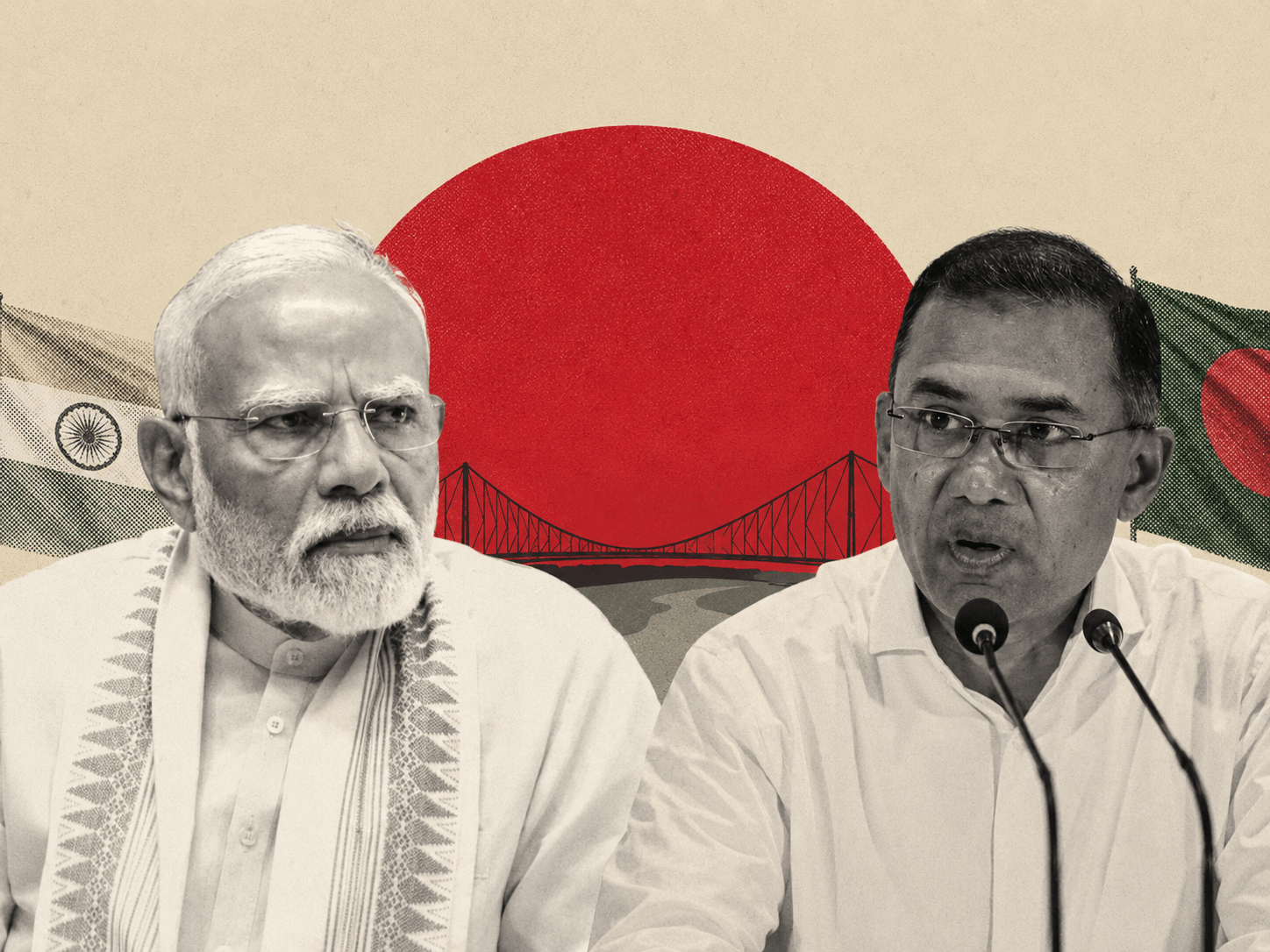
For six days running, Dhaka and New Delhi have performed the same ritual. A visit is “likely.” A schedule is “close.” An envoy says the prime minister wants it to be “memorable.” Then a state minister says nothing is “finalised.” Then, on the afternoon of August 21, Rashtrapati Bhavan briefly announced that Saturday’s ceremonial Change of Guard was cancelled to make way for a full dress rehearsal of a ceremonial welcome for Bangladesh’s prime minister, before withdrawing the statement within the hour, calling it premature. Neither government had actually confirmed the trip. As of this writing, Prime Minister Tarique Rahman’s first visit to India since taking office in February remains unconfirmed, undated, and increasingly symbolic of something larger than a travel itinerary.
The easy explanation making the rounds is that the Hasina issue is holding everything hostage. That is true, but it is not the whole truth. What is actually unfolding between Dhaka and New Delhi is a five-front negotiation happening under the cover of one delayed handshake: a fugitive former prime minister who won’t stay quiet, a water treaty with a countdown clock, a Chinese corridor India cannot ignore, and a new Islamic defence architecture that Bangladesh is publicly flirting with while India watches from the sidelines. Each of these would be significant on its own. Together, they explain why a visit that both sides claim to want keeps failing to happen.
How we got here
The current chapter opens on February 17, 2026, the day Tarique Rahman was sworn in as prime minister after the BNP-led alliance’s landslide win in the February 12 election, the first since Sheikh Hasina’s ouster in August 2024. India sent Lok Sabha Speaker Om Birla to Dhaka for the ceremony, along with a personal letter from Narendra Modi inviting Rahman to visit India “at his earliest convenience.” It was, on paper, a warm opening.
What followed for months looked like conventional diplomatic choreography. Indian High Commissioner Pranay Verma called on Rahman in April. Days later, Foreign Minister Khalilur Rahman travelled to New Delhi for three days of talks with S. Jaishankar, Ajit Doval and Hardeep Singh Puri, the first ministerial-level visit since the new government took office. The agenda read like a checklist of unfinished business: visa services, energy supply, border management, river water sharing, trade.
Then, in June, Tarique Rahman chose to make his first overseas trip not to India but to Malaysia and China, breaking with the customary practice of an incoming Bangladeshi leader visiting New Delhi first. The Beijing leg, from June 22 to 26, produced 15 memorandums of understanding, two agreements, roughly $300 million in Chinese grant assistance, an elevation of ties to a “China-Bangladesh community with a shared future,” and a proposal that landed hardest in New Delhi: a China-Myanmar-Bangladesh Economic Corridor.
By August, the temperature had risen sharply. On August 5, the second anniversary of Hasina’s fall, she appeared by videolink at a press conference organised by the Foreign Correspondents’ Club of South Asia in New Delhi, alongside her son Sajeeb Wazed Joy. It was her second such appearance from Indian soil (the first came in January, ahead of the election) and by far the more provocative one, with both Hasina and Joy taking live questions. Dhaka’s foreign ministry called it “an affront to the sovereignty of Bangladesh” and summoned India’s acting high commissioner in protest. Bangladesh’s government had, in fact, pre-emptively banned domestic broadcasters from airing the speech at all.
It is against that backdrop that the visit talk restarted, and immediately snagged. Diplomatic sources told Bangladeshi and Indian outlets that Dhaka wanted assurance India would not let Hasina “engage in activities from its territory that could create instability in Bangladesh” before Rahman would commit to travelling. State Minister for Foreign Affairs Shama Obaed put the domestic political constraint in blunt terms: with the memory of last year’s uprising still raw, she said, the Bangladeshi public would not take it well if a convicted figure kept speaking from Indian soil while their prime minister smiled for cameras in Delhi. Days later, Foreign Affairs Adviser Humayun Kabir went further in an interview, saying there was “no justification” for rushing into a top-level visit “by going beyond the national interest,” and, separately, that Bangladesh was open to joining a defence pact involving Saudi Arabia, Pakistan and Turkey. By August 20, ThePrint was reporting, citing sources, that Rahman had “no plans” to visit India soon and would skip the BRICS Leaders’ Summit in New Delhi in September as well. The next day, Outlook India was reporting the opposite: that the visit was likely “next week.” Then came the Rashtrapati Bhavan announcement-and-retraction on August 22.
This is not indecision. It is two governments negotiating in public, through leaks, envoys and press briefings, because neither wants to be seen conceding first.
The Hasina question: obligation, or excuse?
Start with what’s undeniable. Bangladesh has formally sought Sheikh Hasina’s extradition from India multiple times since December 2024, and with rising intensity since November 17, 2025, when Dhaka’s International Crimes Tribunal convicted her in absentia of crimes against humanity over the deadly crackdown on the 2024 uprising and sentenced her to death. Bangladesh’s foreign ministry has repeatedly called her return an “obligatory responsibility” under the 2013 India-Bangladesh Extradition Treaty, amended in 2016.
The treaty is real, and it does create a general obligation to extradite for qualifying offences. But it is not the blank cheque Dhaka’s rhetoric sometimes suggests. Article 6 contains a political offence exception, allowing India to refuse extradition if the underlying offence is considered political in character. There are further grounds for refusal where a request is not judged to have been brought in good faith, or where fair treatment cannot be assured. India’s Ministry of External Affairs told a parliamentary panel in July that Bangladesh’s request is still “being examined by the competent authorities in accordance with applicable law and established procedures,” and Indian officials have since told reporters that the matter will ultimately be decided by India’s courts, not by the executive. Former Indian High Commissioner to Bangladesh Pinak Ranjan Chakravarty has pointed out an additional legal wrinkle: when Hasina was flown to India in August 2024, it was for her safety, not in response to any pending case, which complicates treating the request as a straightforward judicial handover.
So India has not refused extradition. It has also not moved toward granting it. That studied ambiguity is itself the story: it lets New Delhi avoid the diplomatic cost of an outright no to Dhaka, while never actually surrendering someone who was, for fifteen years, its most reliable regional partner.
What has genuinely inflamed things is not the extradition request itself but Hasina’s continued political voice from Indian soil. Two virtual press conferences in seven months, interviews with international outlets, a public claim to Reuters that she intends to return to Bangladesh by December and face trial in person, an accusation that Yunus is a “murderous fascist,” a claim that the Dhaka court verdict is “biased and politically motivated” — each of these has produced a formal protest note, a summoned diplomat, or both. India has publicly maintained it played no role in organising the Foreign Correspondents’ Club events and has called the August 5 appearance a “private” matter. Dhaka does not accept that framing, and has begun treating Hasina’s continued media access as the real precondition for the Tarique visit, arguably more than the extradition request itself. Shama Obaed’s comment about a “conducive environment” and analysts quoted in the Bangladeshi press have made the same point: the uncertainty around the visit is now less about whether India will hand Hasina over than about whether New Delhi will simply stop giving her a stage.
That is a much more achievable ask than extradition, and also a more revealing one. It suggests the extradition demand functions partly as leverage and partly as domestic political necessity for the Rahman government, while the actual, negotiable diplomatic irritant is Hasina’s platform, not her physical custody.
The clock that matters more than any single visit: Ganga, and the ghost of Teesta
If Hasina is the emotional flashpoint, the Ganga Water Sharing Treaty is the structural one, and it has a deadline no amount of diplomatic stalling can avoid. Signed on December 12, 1996 by Prime Minister H.D. Deve Gowda and Sheikh Hasina, the treaty governs dry-season water sharing at the Farakka Barrage for a fixed 30-year term. It expires on December 12, 2026, less than four months from now.
India’s position, as MEA spokesperson Randhir Jaiswal has stated repeatedly, is that renewal will proceed only through existing bilateral channels, principally the Joint Rivers Commission, among the 54 rivers the two countries share. Technical teams from both sides have already conducted joint measurements at Farakka and Padma. But a parliamentary standing committee in India, in its most recent action-taken report tabled in July, criticised the External Affairs Ministry for offering no substantive update on renewal talks, noting only that an Inter-Ministerial Committee formed back in 2023 is still conducting an “internal review.” The committee had urged New Delhi to begin negotiations “at the earliest” to avoid a vacuum once the treaty lapses.
The unresolved variable, as it has been for fifteen years, is West Bengal. Any new water-sharing arrangement, particularly one that might finally also settle the long-stalled Teesta River agreement, requires the cooperation of the state government under Mamata Banerjee, who blocked the 2011 Teesta deal and has continued to object to Ganga treaty negotiations she says were conducted without adequate consultation. BNP Secretary-General Mirza Fakhrul Islam Alamgir has publicly linked Bangladesh’s broader trajectory with India to how seriously New Delhi treats this renewal, telling a Dhaka audience that Bangladesh expects negotiations that reflect “the expectations and needs of the Bangladeshi people,” not a rollover of a treaty many in Bangladesh have long argued was tilted in India’s favour from the start.
This is why commentary in both capitals has argued that Rahman’s visit, whenever it happens, cannot be only about Hasina. A piece published this month in StratNews Global put it plainly: a Delhi visit would let Rahman negotiate energy supply, trade terms and the Ganga renewal from a position of strength, arguing he could put Hasina “on the table” without letting her “become the entire agenda.” Whether that argument wins out inside the Bangladeshi government by December, when the treaty simply ceases to exist absent an agreement, is the real test of this relationship, not any single ceremonial welcome in Delhi.
The China question: not a pivot, but a hedge that India can’t shrug off
The Beijing leg of Rahman’s June trip did more than annoy New Delhi’s protocol office by breaking precedent. It produced, and later saw floated more formally, a proposal for a China-Myanmar-Bangladesh Economic Corridor, connecting China’s Yunnan province to the Bangladeshi ports of Chattogram and Mongla via Myanmar. The idea is explicitly a workaround: the older Bangladesh-China-India-Myanmar corridor, discussed since the 1990s under a regional forum framework, was shelved years ago because of Sino-Indian strategic competition and New Delhi’s own reluctance. By routing entirely around India, the new proposal removes the friction of Indian participation altogether, while achieving much of what China wants: overland access to the Bay of Bengal that bypasses the Strait of Malacca chokepoint.
Two concrete projects announced during the visit have drawn particular Indian anxiety: a modernisation and expansion plan for Mongla Port, roughly 80 kilometres from the Indian border, and a Chinese role in the Teesta River Comprehensive Management and Restoration Project, a river Bangladesh and India have failed for over a decade to agree on sharing. The two governments also agreed to explore a “2+2” dialogue mechanism bringing together their foreign and defence ministries, a step short of a formal alliance but a more structured and durable channel for security cooperation than Dhaka and Beijing have had before.
For India, the geography here is inseparable from the politics. Bangladesh sits along the flank of India’s most sensitive piece of territory: the narrow Siliguri Corridor, sometimes called the “chicken’s neck,” which is the only land link between mainland India and its northeastern states. Analysts writing in Indian outlets have connected growing Chinese, and now Turkish and Pakistani, engagement with Dhaka directly to anxieties about that corridor’s vulnerability. It is worth noting, however, that Bangladeshi officials, including Foreign Minister Khalilur Rahman, have publicly said Dhaka has “taken no position” on the corridor proposal and is still “examining” it, and Bangladeshi commentators, including at The Daily Star, have pointed out that Myanmar’s ongoing civil war makes the corridor’s near-term viability genuinely doubtful regardless of anyone’s strategic calculations. There is also a domestic political throughline worth naming for readers less familiar with BNP history: the party’s foreign policy instincts here echo those of Tarique Rahman’s father, General Ziaur Rahman, whose 1977 outreach to Beijing helped define Bangladesh-China ties in the first place. Framing the China trip purely as a reaction to India misses that this is also a return to an old BNP foreign-policy identity, not only a response to present grievances.
Even so, “examining” and “no position” have done little to calm Indian coverage, which has largely treated the June visit and its aftermath as evidence that Dhaka is building leverage against New Delhi, whether or not Beijing’s overland corridor is ever actually built.
The newest complication: Mecca, and the question of whose bloc Bangladesh belongs to
The most recent thread, and the one Sadman’s question specifically raised, is the Mecca Joint Defence Agreement. Signed on August 7, 2026 in Mecca by Saudi Crown Prince Mohammed bin Salman, Turkish President Recep Tayyip Erdogan and Pakistani Prime Minister Shehbaz Sharif, the pact commits the three states to treat an armed attack on any one of them as an attack on all three. It builds on the September 2025 Saudi-Pakistan Strategic Mutual Defence Agreement, and arrived amid a security environment reshaped by eighteen months of war involving the United States, Israel and Iran, which has visibly eroded Gulf confidence in Washington as an automatic security guarantor.
Two weeks later, Bangladesh’s Foreign Affairs Adviser Humayun Kabir told Bangladesh Sangbad Sanstha that Dhaka maintains “a positive approach towards the possibility of joining an economic or defence framework involving Saudi Arabia, Pakistan and Turkey,” citing Bangladesh’s own interests and the shifting dynamics of global trade. Asked about it directly at a briefing, MEA spokesperson Randhir Jaiswal offered India’s now-standard formula for developments it does not like but cannot openly oppose: “We continue to closely follow developments that are happening in West Asia. This is what I have to say at this point in time.” It is, almost word for word, the same line India used when Pakistan and Saudi Arabia signed their bilateral pact in September 2025, and again when the trilateral version was announced this month.
Read on its own, Kabir’s comment is closer to an open door than a commitment; Bangladesh has not signed anything, and a Riyadh visit for Rahman, at the invitation of the Saudi crown prince, is reportedly still being arranged rather than finalised. But the timing is not incidental. Kabir made the remark in the same interview in which he questioned whether a Rahman visit to India was currently “justified,” pairing a public warming toward an Islamic-world defence architecture with public coolness toward the traditional India-first posture of Bangladeshi foreign policy. Commentary in the Middle East Forum has gone further, arguing that Pakistani, Turkish and Chinese inroads into Bangladesh, compounded by what it characterises as intensifying Islamist currents and anti-India sentiment there, could specifically complicate India’s position on its northeastern flank in any future confrontation with Pakistan. That is a contested, editorially loaded reading rather than settled fact, but it captures why New Delhi is watching Dhaka’s Mecca-pact signalling as more than a rhetorical aside.
So: is it only about Hasina?
No. The extradition dispute is the loudest and most emotionally charged item on the table, and it is the one both governments can most easily use as public cover for delay. Shama Obaed’s remark about the “blood stains” of July still being fresh is not spin; the political cost of Rahman being photographed shaking Modi’s hand while Hasina broadcasts from Delhi is genuinely difficult for the BNP to absorb domestically, especially with the Awami League banned and public memory of the 2024 crackdown still raw.
But the water treaty deadline in December, the China corridor and port questions, and now the Mecca pact signal together describe something more structural: a Bangladeshi government testing, in its first year, how much independent room it actually has to manoeuvre between India, China and the Gulf-Turkey-Pakistan axis, at the exact moment India is least equipped to simply wait Dhaka out. The Ganga treaty cannot be delayed past December without real consequences for both countries. The corridor and port questions will not disappear if Rahman visits Delhi for a single ceremonial trip. And Dhaka’s openness to the Mecca pact, however preliminary, is a signal aimed as much at India as at Riyadh, Ankara and Islamabad.
Hasina’s extradition is the visible wound. The treaty deadline, the ports, the corridor and the pact are the deeper condition. A single visit, whenever it finally happens, was never going to resolve any of it. What it will do, if and when it happens, is reveal how much of this Rahman is actually willing to put on the table, and how much India is willing to concede to get him there.
Sources consulted: The Daily Star, Outlook India, ThePrint, The Wire, StratNews Global, Al Jazeera, The Diplomat, Prothom Alo, South Asia Monitor, Foreign Policy, Deccan Herald, Eurasia Review, GKToday, Down To Earth, the Middle East Forum, MEPEI, and Indian government press releases via newsonair.gov.in, spanning reporting from February through August 22, 2026.