Sarwar Tusher
Writer & Politican
Recently, BNP Standing Committee member Salahuddin Ahmed stated that the July Proclamation has no constitutional or legal significance, viewing it as nothing more than a political document. His statement exposes the thought process and ideology of Bangladesh’s ruling class concerning the constitution, state, government law, and legitimacy. In this context, it felt appropriate to delve into the very emergence of the BNP and the political history of Bangladesh at that time.
Ziaur Rahman’s Fifth Amendment and Its Context
Let’s consider the Fifth Amendment introduced by the BNP’s founder, the heroic freedom fighter and martyred President Ziaur Rahman. This amendment was brought to the Parliament formed after the second general election on April 6, 1979. The core of this amendment was to legitimize all decrees and actions issued by the military government from August 15, 1975, until April 5, 1979 (prior to the formation of the second Parliament).
Ziaur Rahman’s advantage was that he was in power both before the formation of the ’79 Parliament and remained in power after its formation. Consequently, he was able to legitimize all his actions taken before April ’79. Among these were several significant military decrees that warrant separate attention.
For the purpose of this article, the focus is on how, after the August 15, 1975, change of power, Ziaur Rahman transitioned from Chief of Army Staff to Chief Martial Law Administrator, then President, eventually leading to the formation of the second Parliament in 1979. While in power, he also formed his political party.
He had to take many steps in response to the historical exigencies of the time, among which was the return to multi-party democracy from BAKSAL. It is noteworthy that military government’s adopted measures, Ziaur Rahman did not have to rely on anyone else for their legitimacy. He was in power before the ’79 Parliament was formed, and he continued to be in power after being elected through the formation of the Parliament.

The Interim Government’s Legality Dilemma
Now, let’s consider the predicament of the current interim government. This government is a peculiar amalgamation of forces. Beyond external conspiracies, internal tensions have largely prevented this government from consolidating its authority and power. In addition, there is widespread non-cooperation from the civil-military bureaucracy.
How will the actions taken by this government from August 8 until the formation of the next Parliament gain legality? It is common to hear the BNP and “mainstream” (read: pro-establishment) intelligentsia argue that the current government’s actions will need to be approved by the subsequent Parliament.
My contention is that this thought process has imposed a limit on reform. The ideology of “approval from an elected government” has become an impediment to fundamental reform aimed at dismantling the colonial, undemocratic, and fascist state structure and establishing a democratic state and constitution. Consequently, ignoring the people in the pursuit of reform has resulted in political parties holding the reform process hostage.
One hears statements like, “What reforms will you make if we don’t approve them in Parliament?” or “You will have to seek legitimacy for your actions from us (the elected Parliament)!” These kinds of remarks seem to have unsettled the current government. They appear to be thinking, “Indeed! There’s no benefit in implementing reforms without reaching an understanding with those who will form the next Parliament; for our safe exit, we must also agree to their demands!” The current government seems afflicted by such backward and conservative thinking.
The core question is: from where will the current government’s decisions, ordinances, and regulations derive their legitimacy? Many argue that the popular uprising itself grants this government legitimacy. This assertion, however, often raises eyebrows and irritation in many circles.
It is true that popular uprising confers legitimacy. But mere words won’t suffice. Nor can one progress much further by invoking Article 106 of the current constitution, which lacks legal enforceability.
A major problem for the interim government is that it will not form the next Parliament; thus, this government will not have the advantage that Ziaur Rahman had.
The Argument for Pre-Election Reforms and Referendum
So, what’s the solution? For both historical and procedural reasons, relying on the next Parliament for the legitimacy of current decisions would be a huge folly, with potentially dire consequences for the people of this country, especially the protesters.
This is why the demand has arisen that reforms should not happen in the next Parliament; rather, the next Parliament should be formed on the basis of reforms. Reform itself must be the foundation of the legitimacy of the upcoming Parliament. An election under the existing constitution is an election under a fascist system. This might temporarily secure an election in the country—though past history suggests it won’t be permanent—but it will by no means establish democracy.
Therefore, before the election, decisions must be made on the proclamation, constitution, reform, and charter. It goes without saying how severe the consequences of any delay or indecision in this regard will be.
So, what is to be done? The election should take place within the timeframe declared by the Chief Adviser. However, reforms must be implemented before that. All public-interest reform proposals, both those on which political parties have agreed and those on which they have not, must be included in the July Charter and then put to a referendum.
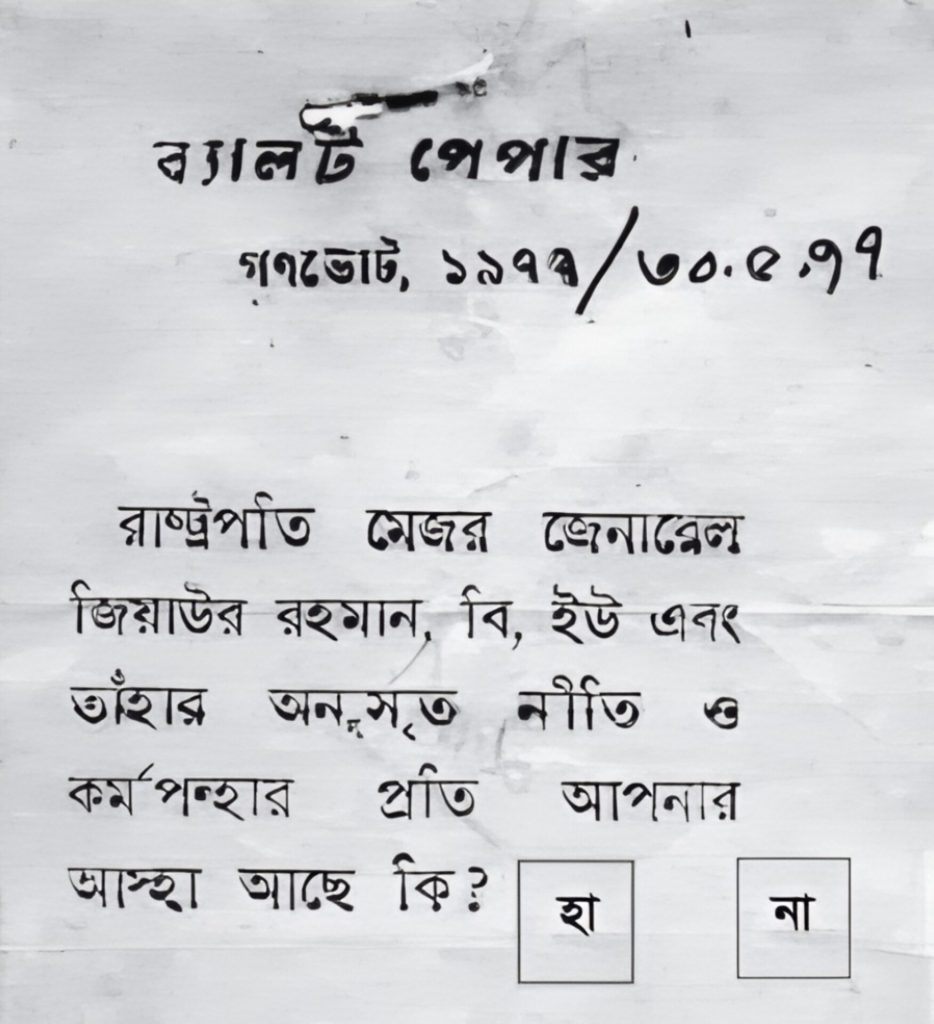
The referendum would contain two questions:
- Do you agree with the reform proposals on which political parties have reached a consensus? Yes/No.
- Do you agree with all reform proposals, both those on which political parties have agreed and those on which they have not? Yes/No.
In Bangladesh’s current reality, a referendum will be the most effective method to ascertain people’s mandate. What the people approve in a referendum, no parliament, no judiciary, no political party can overturn; rather, Parliament and the judiciary will operate under the purview of this people’s mandate.
Whichever question receives the highest number of votes from the people will constitute the July Charter and the reforms. There will be no need for these reforms to await parliamentary approval, as they would be sanctioned by people’s mandate. Hence, the next Parliament will not legitimize the reforms; instead, the reforms will be the basis of the next Parliament’s legitimacy.
The Significance of an Uprising Proclamation
Furthermore, the current government must issue a proclamation of the uprising, stating that all actions of the current government, from the July popular uprising until the formation of the subsequent elected Parliament, will be included as transitional and temporary provisions within the rewritten/reformed constitution. If they do this, they will not need to rely on the legitimacy of the next elected government. If they do not, while some members of this government might secure a safe exit through negotiations, the leadership, participants, and supporters of the July popular uprising will remain at risk of being labeled as “unconstitutional power grabbers” and facing punishment. The proclamation itself must be adopted as a schedule to the constitution, just as the Proclamation of Independence is included as a schedule in the current constitution.
The Problem with Amendments vs. Fundamental Reform
The problem with implementing reforms in Parliament is that they cease to be reforms and become mere amendments. With a change in political power, amendments can be annulled by either the judiciary or Parliament. The Awami League, upon coming to power, declared the Fifth Amendment illegal. To this day, the Fifth Amendment remains “illegal.” Now, the BNP is again having to say they will revert to the Fifth Amendment.
In other words, Ziaur Rahman’s foresight was also defeated by the politics of a two-thirds majority in Parliament. He probably anticipated that such a thing could happen. For this reason, on April 17, 1978, he issued the Twelfth Amendment to the Second Martial Law Proclamation, which stated that a directly elected National Assembly would first function as a Constituent Assembly and then as a Parliament. He did not implement this decision, but it remains intriguing and historical. Yet, the BNP is now often heard asking, “Why a Constituent Assembly again in an independent country?” Perhaps the current BNP has forgotten Ziaur Rahman’s history.
Many do not wish to understand the problem with amendments. Of course, this unwillingness to understand is not neutral to politics and group interests. Amendments are not the solution; they are part of the problem. There is nothing more dangerous than trying to bring about reform through amendments. It must be remembered that BAKSAL was established and the caretaker government system was abolished through amendments.
The Inevitability of Proclamations in Extra-Parliamentary Contexts
Upon hearing the word ‘proclamation,’ many become genuinely enraged. In reality, any extra-parliamentary government must issue a proclamation. Mushtaq, who assumed power after the August 15 change, took power through a military proclamation, which stated that martial law became effective from dawn on August 15, while the constitution also remained in force.
This means that, if necessary, a proclamation can be issued while keeping the constitution in force. A government that comes to power through a military coup can issue a proclamation, yet when a popular uprising government demands a proclamation, it is labeled as a “conspirator”!

Emotion, Trust, and the Fate of the People
Salahuddin Ahmed, a BNP Standing Committee member, stated that there is no place for emotion in politics. In a speech on National Consensus Commission, he urged the nation to place their trust in them (BNP). Salahuddin Ahmed is an experienced politician who understands law well. With due respect to him, it must be said that emotion holds immense importance in politics. Contemporary theorists show that emotion mobilizes vast numbers of people to make political decisions and take action. The type of politics emotion serves depends on the political context and skill. But it is undeniably true that reducing politics to merely the goodwill and trust in politicians has its own significant drawbacks. Why should such a major procedural debate be left to the goodwill of the next government? There is no room for that.
Not trust or belief, but method and process are crucially important in national issues concerning the fate of the people. The fate of the 1990 joint declaration of three alliances (Tin Joter Ruprekha) is before our eyes, and the problems with changes brought through amendments are clear to us. This time, the people of Bangladesh do not want to be deceived by trusting politicians.
Before the election, an uprising proclamation must be issued and incorporated into the rewritten/reformed constitution. The July Charter must receive public approval through a referendum, and similarly, the charter must be made part of the rewritten/reformed constitution.
Additionally, the proclamation must clearly state that the July uprising occurred in continuation of Bangladesh’s past historical struggles, including the Liberation War. This uprising and its leadership, participants, and supporters will receive legal and constitutional protection in future Bangladesh.