In 2013, the country stood at a historic political crossroads. Following the tribunal verdict sentencing convicted war criminal Quader Mollah to life imprisonment, a wave of outrage sparked what would become known as the Gonojagoron Mancha. Initially hailed as a people’s movement demanding capital punishment for war criminals, it soon became a heavily politicized spectacle — with widespread allegations that the ruling Awami League had covertly orchestrated it to bolster their grip on power.
Twelve years later, in post-uprising 2025, we may be witnessing déjà vu.
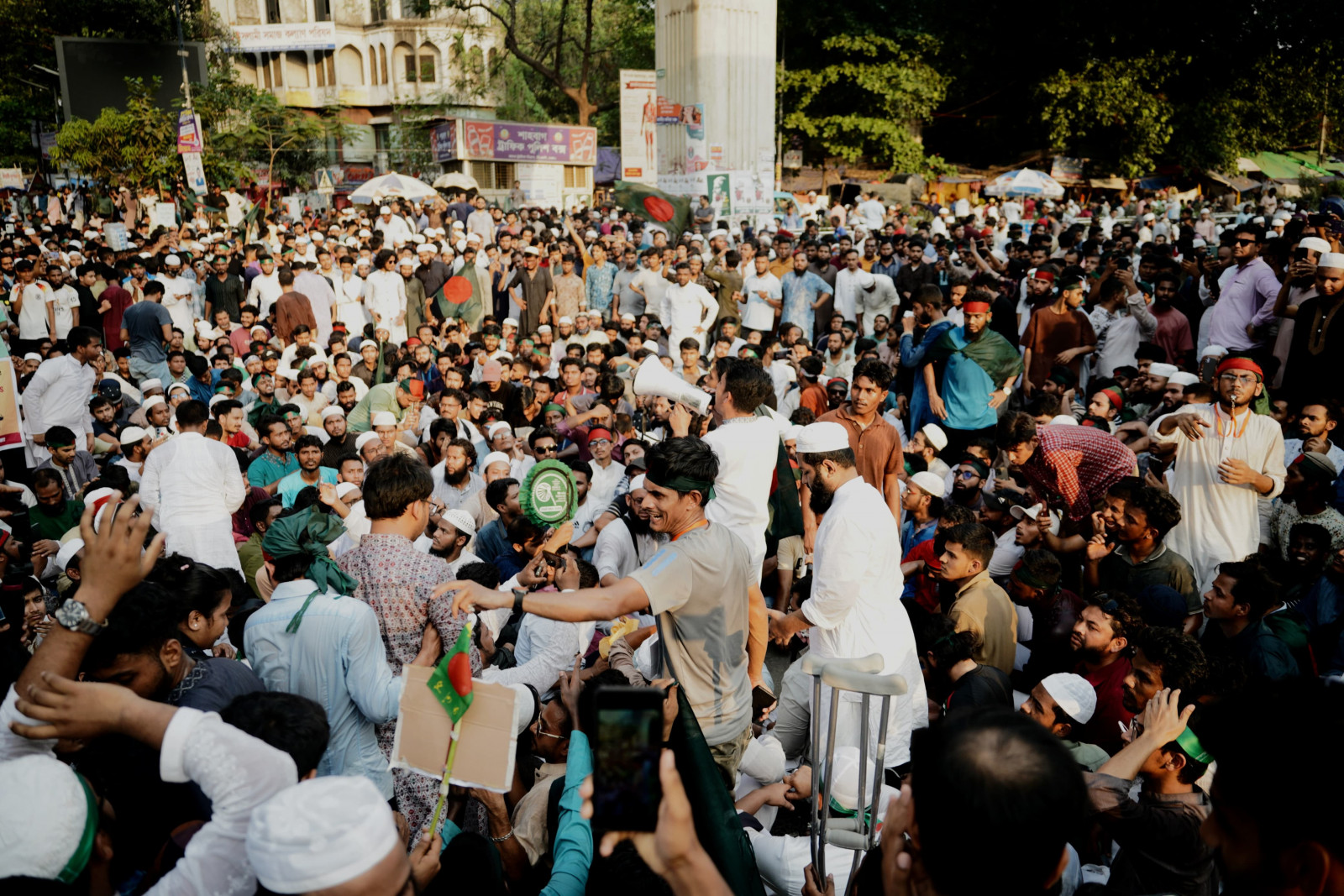
On May 9, a group associated with the National Citizen Party (NCP), born out of the July Uprising of 2024, erected a stage in Shahbagh named the Anti-Fascist Mancha. The group has laid out three primary demands: the banning of the Awami League as a terrorist organization, the trial of the party under the International Crimes Tribunal Act, and the official issuance of a “July Declaration.”
The “Biriyani Protest”
In 2013, reports and testimonies emerged of Shahbagh protesters being supplied food, water, and even transport by pro-government actors. Police provided cover, and state-owned media gave saturation coverage. Today, questions are being raised again. Witnesses at the May 9 Mancha report not just heavy police protection but also services from the City Corporation — mist-spraying to beat the heat, WASA-supplied drinking water, and even mobile toilets. There are even unverified reports of biriyani being distributed.
All of this happens while other movements — such as madrasa teachers protesting pay disparities or feminist groups marching to Jamuna — have been brutally repressed.
Witnesses at the May 9 Mancha report not just heavy police protection but also services from the City Corporation — mist-spraying to beat the heat, WASA-supplied drinking water, and even mobile toilets. There are even unverified reports of biriyani being distributed.
The Ethics of Mob Justice
Gonojagoron Mancha has gone down in history not as a symbol of justice, but as a cautionary tale of mob justice masquerading as activism. The movement weaponized popular emotion to pressure the judiciary, with political targets expanding beyond war criminals. Analysts argued that it eroded faith in due process, and instead of healing the wounds of 1971, it created fresh divisions.
Now, critics fear the Anti-Fascist Mancha may be sliding into the same moral trap — only this time in reverse.
Some supporters argue that this new mancha is different — that it reflects a genuine grassroots demand for accountability. But others note that its rise has been unusually smooth. No police crackdown. No media blackouts. Instead, subtle privileges echo the state-backed favor once enjoyed by Gonojagoron.
Even more troubling are the whisper campaigns: that the Mancha is being quietly facilitated by those in or near power — just as Gonojagoron was allegedly midwifed by the ruling party in 2013. If true, this would mean that once again, the language of revolution is being used to launder political agendas.
If we condemn the ethical failures of the Gonojagoron Mancha — the forced verdicts, the mob pressure, the political puppeteering — how can we, in good faith, applaud a new platform that seems to follow the same script