
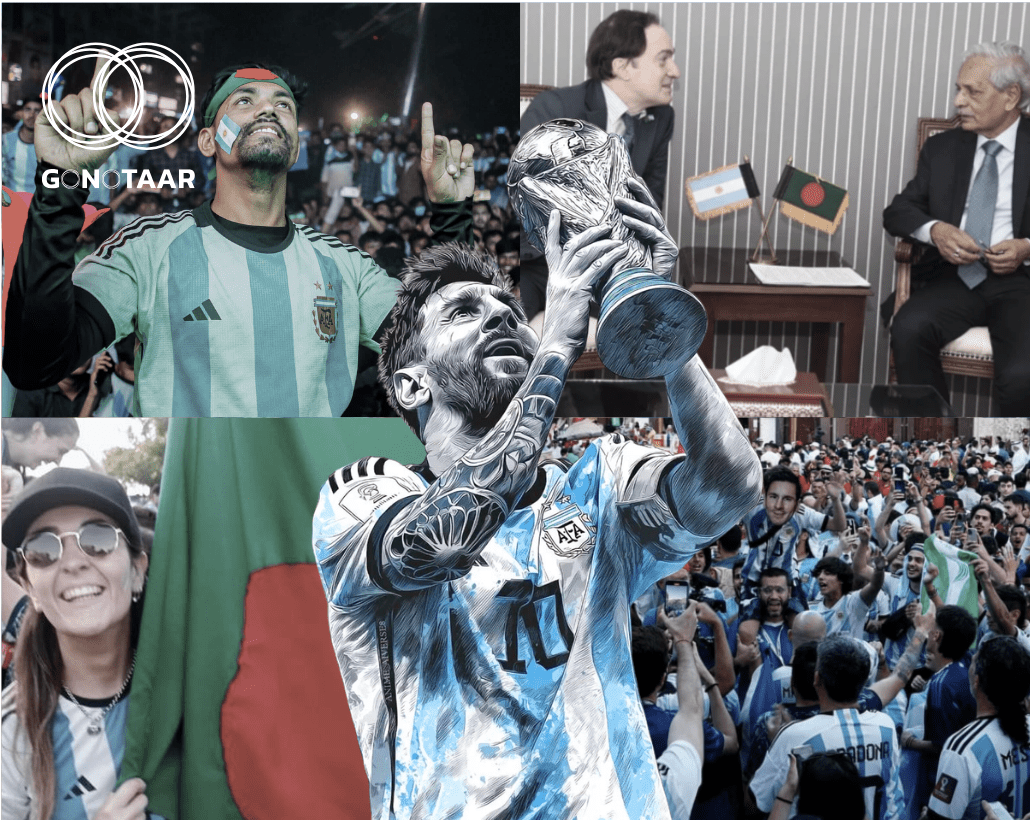
When viral celebrations in Dhaka reached an Argentine press conference in Qatar, something unprecedented began. Three and a half years later, Argentines are flying to Bangladesh to see it for themselves.
In the autumn of 2022, a video clip from Daffodil International University's main auditorium found its way to a Twitter account run by a Messi-obsessed Bangladeshi fan named Muhammad Sobug. He had not filmed it himself — he picked it up from a student's Facebook page and reposted it. What happened next would have been difficult to predict: FIFA's verified account retweeted it to millions of followers around the world.
The clip showed hundreds of Bangladeshi students erupting in delirious celebration the moment Lionel Messi scored against Mexico. They were thousands of miles from the stadium. They were watching on a screen. Most of them had never been to Argentina, could not name a Buenos Aires neighbourhood, and did not speak a word of Spanish. None of that mattered. The joy was unambiguous, total, and — to Argentine eyes — utterly astonishing.
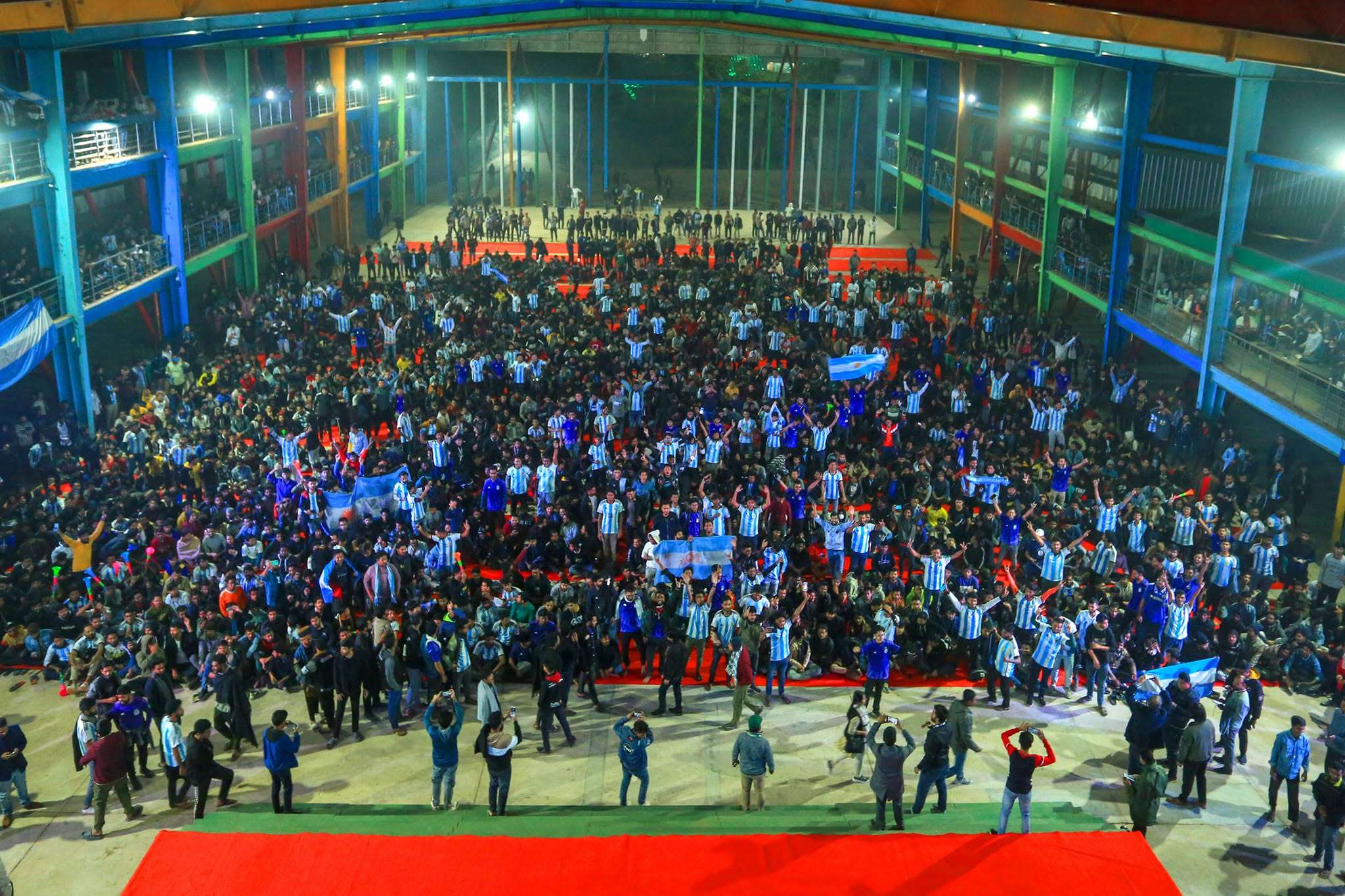
Argentina Fans celebrating Argentina National Football Team winning Football world cup 2022, Daffodil International University in Bangladesh
Within days, footage from Dhaka's Teacher-Student Centre at Dhaka University, from rooftops draped in sky-blue-and-white flags across Chittagong and Sylhet, from small-town processions in Munshiganj and Habiganj — all of it was circulating in Argentine media, Argentine television, and Argentine group chats. An Argentine journalist named Andrés Yossen wrote that the streets of Dhaka had overflowed with people "as if it were the Obelisk of the Federal Capital." Argentine social media lit up with a single bewildered, moved question: Who are these people, and why do they love us like this?
The answer, it turns out, is complicated, layered, and beautiful. And it is still being written.
A Question Asked at a Press Conference in Qatar
On the eve of Argentina's round-of-16 clash against Australia in Doha, a journalist from Argentine radio station D Sports asked manager Lionel Scaloni a question that no football press conference had ever quite needed to ask before: what did he make of the extraordinary fanbase Argentina had discovered in Bangladesh?
Scaloni did not deflect. He did not give a polished diplomatic non-answer. He leaned into it.
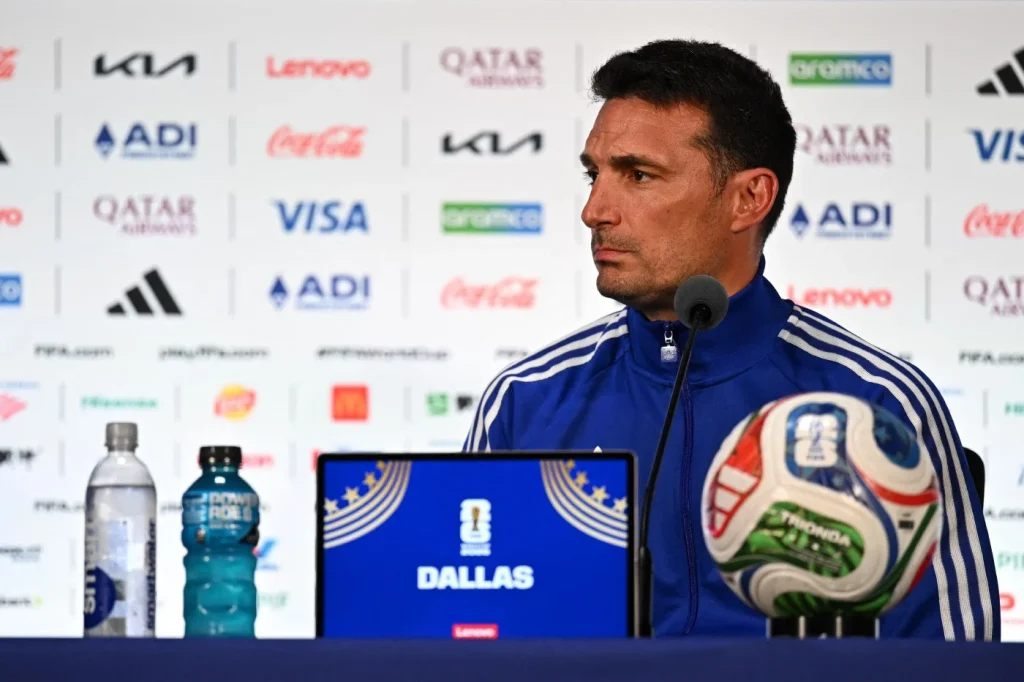
"For many years now, with Diego, with Leo, the jersey has always generated hysteria, for the colours, for the Argentine passion," he said. "It fills us with pride that a country like Bangladesh supports Argentina. Thanks to the people of Bangladesh."
The Argentine Football Association's official Twitter account posted three photographs of Bangladeshi crowds and wrote: "Thank you for supporting our team!!! You are crazy like us!"
Then came something even more personal. After Argentina lifted the trophy against France in one of the greatest World Cup finals ever played, Messi's mother, Celia Cuccittini, was leaving the stadium when a Bangladeshi journalist approached her. Her response, brief and unscripted, has since been quoted endlessly: "Thank you for loving Messi. I am so happy."
In Dhaka, they heard it.
Why Bangladesh? The Roots of a Devotion
To understand the fervour, you have to understand what football means in Bangladesh — a country that has never qualified for a World Cup, whose national team sits near the very bottom of FIFA's rankings. Football, for Bangladeshis, is not about their own team. It is about choosing sides in a global story.
The Brazil-Argentina rivalry has defined World Cup seasons in Bangladesh for generations. It is not a casual preference. It is tribal, ferocious, sometimes dangerously so. Studies have found that the rivalry has turned violent; people have died hanging flags from electrical wiring; young men in Shariatpur reportedly declared they would not marry until Brazil won another trophy. It is football fandom as total commitment, as identity, as something close to religious.
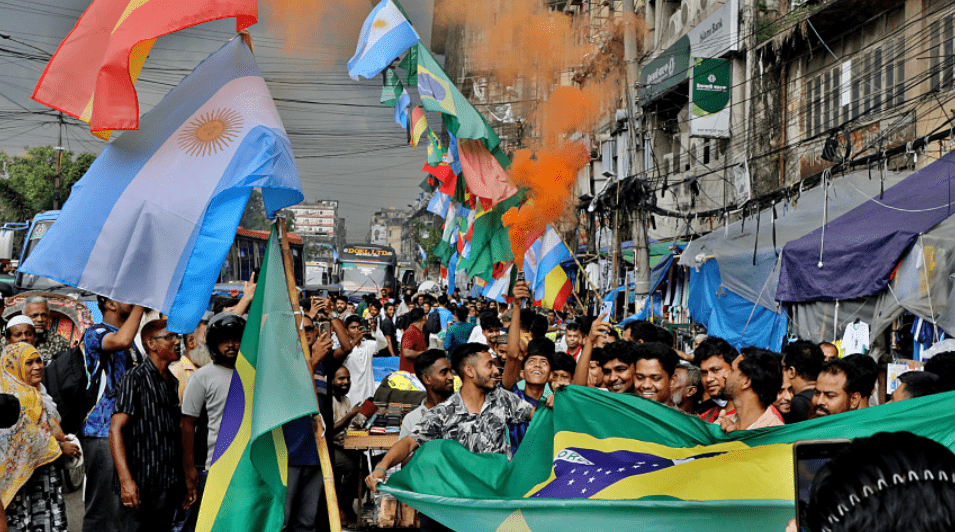
Within that world, Argentina's pull has always been tied to two names: Diego Maradona and Lionel Messi. Maradona's status in Bangladesh was not merely that of a great footballer. He was, for many older supporters, a symbol of defiance, of the impossible made real, of the underdog defeating the powerful. When Messi emerged as his heir — and when Messi's own desperate, decades-long wait for a World Cup became a kind of shared national project among Bangladeshi supporters — the emotional stakes only grew.
When Argentina finally won in Qatar, Swapan Mia, a tea-seller who has worked the TSC area of Dhaka University for 36 years, told reporters he had been waiting since Maradona lifted the cup in 1986. He had stopped selling tea for three hours after Argentina lost their first match to Saudi Arabia. On the night of the final, he wept.
That is the depth of what Argentina encountered in Bangladesh. It was not a trend. It was not a moment. It was three or four decades of accumulated longing, finally paid off.
The Reciprocal Gift
Argentina did not receive this love passively. What makes the Bangladesh-Argentina story genuinely remarkable — and different from the ordinary calculus of football fandom — is what happened next.
Argentine fans, moved by the footage from Dhaka, created a Facebook group: Fans argentinos de la selección de cricket de Bangladesh — Argentinian fans of the Bangladesh cricket team. The group, started almost spontaneously as a gesture of reciprocity, grew to well over 70,000 members within days and eventually crossed 200,000. Argentine journalists began tweeting in Bengali. One tweeted congratulations to the Bangladesh cricket team after they beat India in a bilateral ODI series.
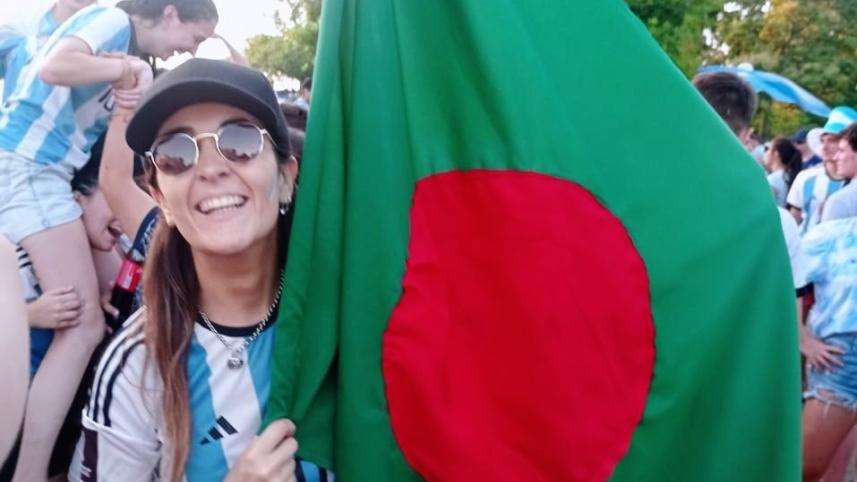
It was fans responding to fans. People who had never met, who shared no language, no geography, no history of contact, finding each other through a shared emotion. The anthropologists would call it "parasocial solidarity." Most people would just call it beautiful.
But it did not stop there. The reciprocity moved upward, from people to governments.
From the Terraces to the Secretariat
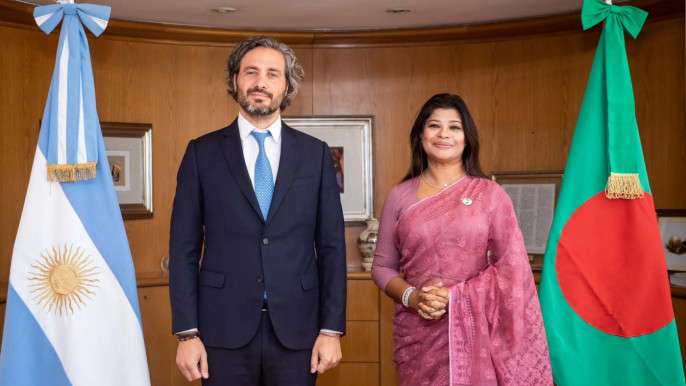
In December 2022, while Argentina were still celebrating in Lusail, Argentine Foreign Minister Santiago Cafiero announced on Twitter that his country would reopen its embassy in Dhaka. The embassy had been closed since 1978, when Argentina's military junta wound down its foreign postings. For 45 years, Bangladeshis who needed Argentine visas had to travel to New Delhi. The bilateral relationship had been, in diplomatic terms, almost dormant.
Football changed that. Not metaphorically — literally. The Argentine government cited the scenes of Bangladeshi support as a direct motivating factor. In February 2023, Foreign Minister Cafiero flew to Dhaka — becoming the first South American foreign minister ever to visit Bangladesh in an official capacity — and reopened the embassy with ceremony and dulce de leche. He called it "fulfilling a moral, ethical and historical duty."
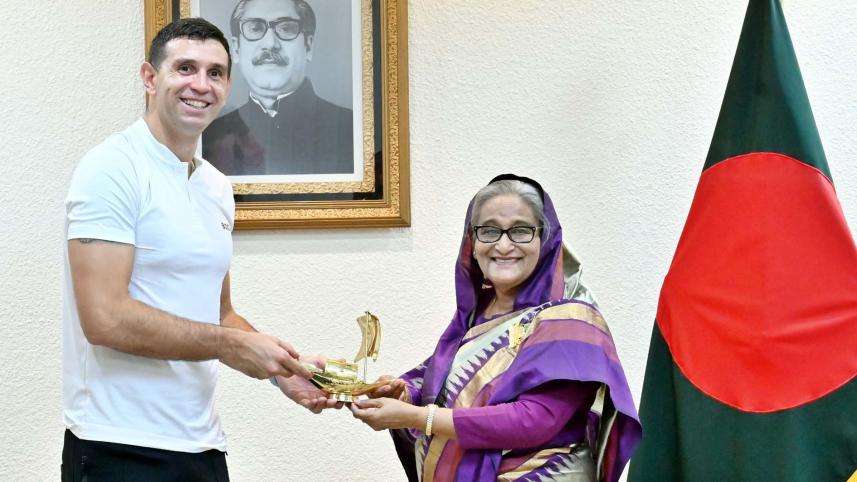
The following year, goalkeeper Emilio "Dibu" Martínez — the man who danced in front of penalty takers and became a World Cup icon — visited Bangladesh as a goodwill gesture. The AFA extended formal best wishes to Bangladesh's cricket team before their ICC ODI World Cup 2023 opener. Bangladesh's national team captain Jamal Bhuyan signed for Argentine club Sol de Mayo. A deal was put in place to allow young Bangladeshi footballers to train in Argentina.
Bilateral trade, which had stood at roughly $745 million in 2022 — mostly Argentine wheat feeding Bangladeshi mills — was formally identified as an area for expansion, with Bangladeshi RMG, pharmaceuticals, jute products, leather, and footwear flagged as export opportunities for the Argentine market.
Sports diplomacy had become economic diplomacy. The terraces had become the Secretariat.
2026: The Story Continues
Now, in June 2026, Argentina are at the World Cup again — this time hosted across North America — and Bangladesh has not changed. If anything, the fervour has deepened, carrying four years of accumulated affection and the memory of Qatar.
Streets across the country have filled once more with sky-blue-and-white. Towering Messi cutouts stand outside residential buildings. Replica Argentina jerseys sell for around Tk 500 in Gulshan's sports markets, queued up alongside Brazil shirts. The Daffodil International University auditorium, whose clip went global in 2022, has again become a watch-party venue. New clips have gone viral.
And this time, Argentina came to see it.
Dan Lande — known as Rulo — is an Argentine travel writer, content creator, and cultural ambassador who first gained recognition in Bangladesh during Qatar 2022, when he initiated the digital campaign in Argentina to support the Bangladesh cricket team. On 22 June 2026, he arrived in Dhaka with a team of Argentine creative professionals: Manuel Javier Ezquerra Ramon, Martín de Escalada, Martina Joye Gondel, and Santiago Conde.
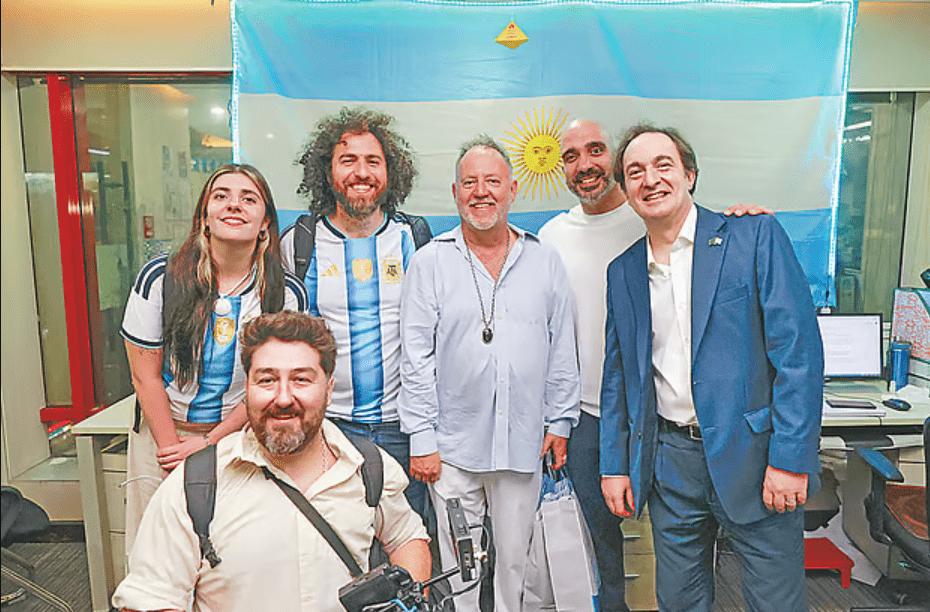
They are not tourists in any ordinary sense. They are here, as the Argentine Embassy put it, as "a sincere gesture of absolute gratitude from the people of Argentina towards the football supporters of Bangladesh." Their itinerary reads like a love letter: the lanes of Old Dhaka, the Dhaka University campus, Haji Muhammad Mohsin Hall, Aminbazar, Munshiganj. They will watch the matches on giant screens shoulder-to-shoulder with Bangladeshi fans. On 24 June — Messi's birthday — they will join in celebrations that no one needed to organise because they were going to happen anyway.
At the airport, driving into the city, Rulo looked out at the rooftops. Argentine flags, everywhere. He told reporters he was astonished. He said he had come to express gratitude. He said, in words that landed precisely: "Bangladesh deserves recognition for this affection."
The Older Bridge
What is happening now between Bangladesh and Argentina is not entirely new. There is an older thread, one that predates football fandom by almost a century.
In 1924, Rabindranath Tagore — the Bengali polymath, Nobel laureate, the defining literary and cultural figure of the subcontinent — fell ill while travelling to South America. He was taken in by Victoria Ocampo, one of Argentina's most celebrated intellectual figures, a writer, editor, and patron of arts whose magazine Sur was arguably the most important literary journal in Latin American history.
Tagore stayed in Buenos Aires for two months. Out of that visit came Purabi, a collection of poems he dedicated to Ocampo. The friendship between the two lasted for years. Ocampo became a champion of Bengali thought, philosophy, and literature in the Spanish-speaking world.
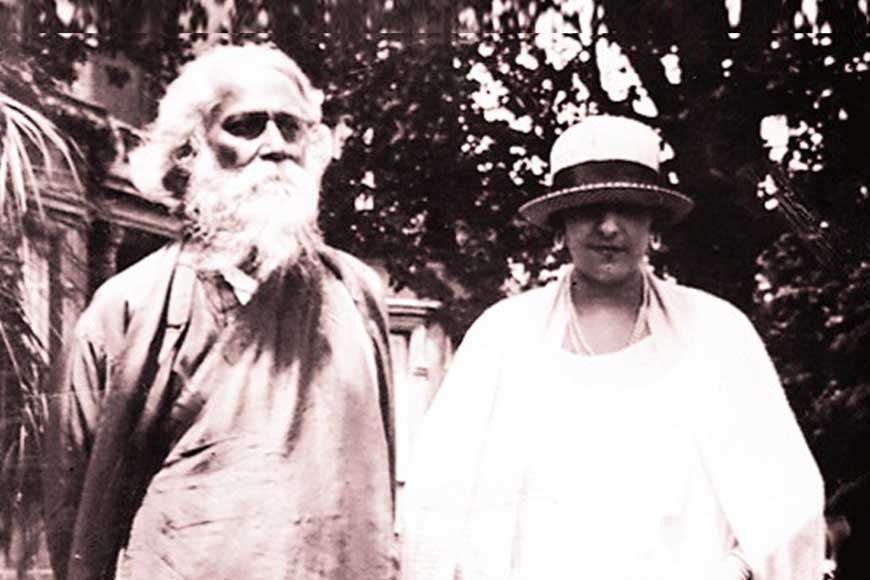
It is a founding act of cultural exchange between the two peoples, separated by ocean and continent, connected by the accident of a sea voyage and an illness. When Argentine Ambassador Marcelo Carlos Cesa sat down with Bangladesh's Cultural Affairs Minister Nitai Roy Chowdhury at the Secretariat on 18 June 2026, both men invoked Tagore and Ocampo almost immediately. There is, they seem to understand, a history here worth building on.
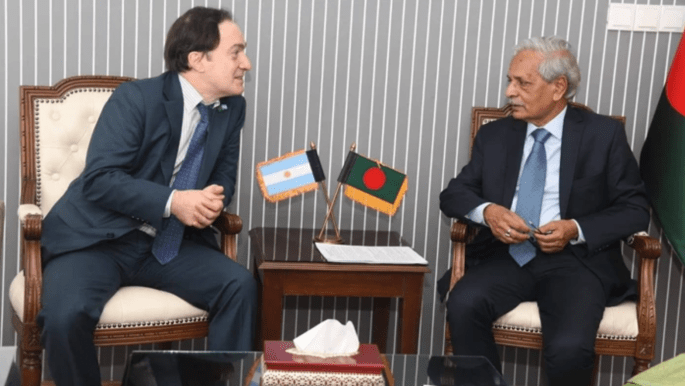
The ambassador went further. He praised the spiritual Lalon songs of Bangladesh — the baul tradition, rooted in mysticism and folk philosophy — and suggested translating Lalon Geeti into Spanish. He encouraged Bangladesh's participation in the Buenos Aires International Book Fair. He spoke of growing Argentine interest in contemporary Bangladeshi writers. The state minister proposed a joint "Cultural Evening" featuring performing artists from both countries.
These are not idle diplomatic pleasantries. They are threads being picked up, after a hundred years, by people who have realised they have more to talk about than they knew.
What Football Has Actually Done
It is worth pausing on what, exactly, football has accomplished here — because the story risks being flattened into a nice anecdote about sport and human connection, when what has actually happened is considerably more structural.
In the space of four years, Bangladeshi football fans generated enough global attention to prompt the reopening of an embassy that had been closed for 45 years. They drove a Latin American country to send its foreign minister to South Asia for the first time in history. They created the conditions for trade negotiations, sporting exchange agreements, and active discussions on cultural diplomacy. They did all of this without any institutional backing, without government coordination, without anyone planning it. They did it by caring deeply and publicly, by celebrating in the streets, by putting flags on their rooftops, and by filming it all.
It is, in the language of international relations, a textbook case of soft power — except it ran in a direction soft power is not supposed to run. Soft power is usually something larger, wealthier countries deploy toward smaller ones. Here, a country of 170 million people with no World Cup team and no particular geopolitical leverage used the sheer intensity of its public passion to alter its diplomatic relationship with a country 17,000 kilometres away.
There is something worth taking seriously in that.
What Comes Next
The potential is real, and some of it is already being pursued. Bangladesh is planning to open its own embassy in Buenos Aires. Football development cooperation — Bangladeshi players training at Argentine clubs, Argentine coaching expertise flowing to Dhaka — is on the table. RMG and pharmaceutical exports are under discussion. Literary translation, cultural festivals, artist exchanges: all proposed, all possible.
Tourism is the most visible frontier right now. Rulo and his team are creating content about Bangladesh that will reach Argentine audiences in ways no tourism board campaign ever could. They are not reviewing hotels. They are filming people: their joy, their hospitality, their uncanny passion for a team that plays its home games on the other side of the world. That content, when it lands in Argentina, will ask a question Argentine audiences have been half-asking since 2022: what is this country, and should we go see it?
The answer, for some of them, will be yes. It already has been. And the Bangladeshis who receive them — as Rulo discovered the moment he drove in from the airport and saw the flags — will not need to be told how to welcome them.
The invisible bridge runs both ways. It always did.


