
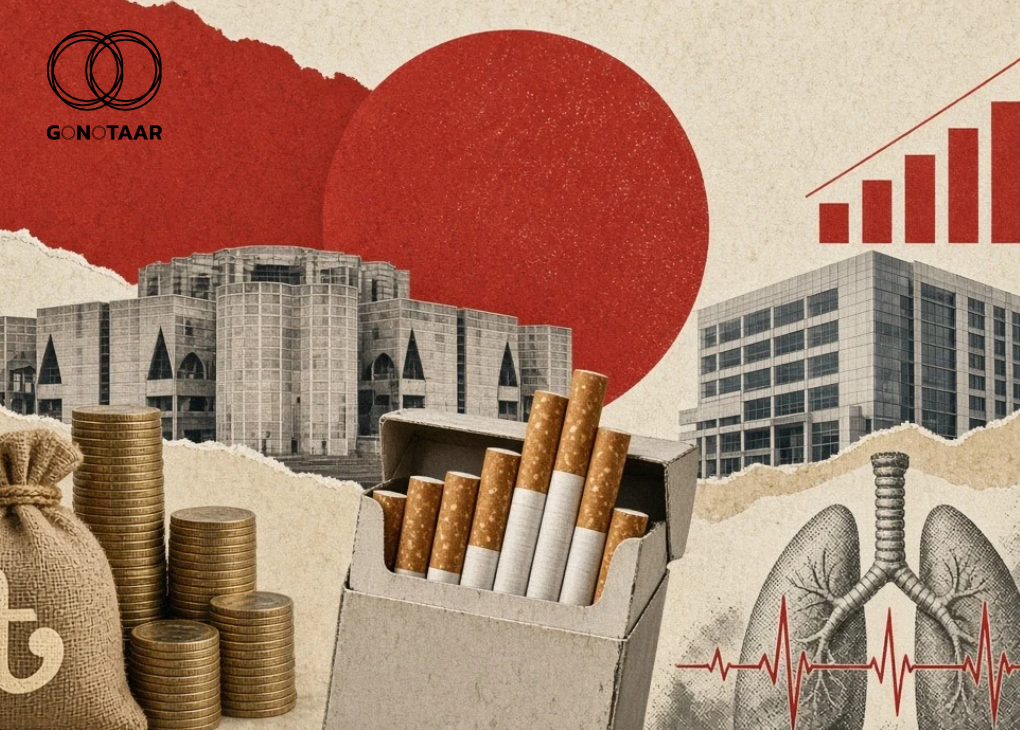
Macroeconomic Foundations and State Fiscal Reliance
In developing economies, the structure of public finance often reflects systemic vulnerabilities in domestic tax administration. In Bangladesh, where the tax-to-GDP ratio has historically stagnated between 7.45% and 7.8%, the National Board of Revenue (NBR) exhibits a heavy structural dependence on indirect taxation to meet annual revenue targets. For Fiscal Year 2024–25, the NBR was tasked with mobilizing a total tax revenue target ranging from BDT 4.80 lakh crore to BDT 4.99 lakh crore. Within this tax architecture, the tobacco sector—dominated by manufactured cigarettes—serves as the single largest contributor of indirect revenue, generating approximately BDT 40,000 crore annually.
This contribution accounts for roughly 8% to 10% of total NBR tax collections. In fiscal environments characterized by narrow direct tax bases and widespread informal economic activity, excise duties on inelastic consumer goods offer an efficient revenue pump. However, deriving nearly a tenth of national tax receipts from a single harmful commodity reveals a profound fiscal vulnerability and a paradoxical governance framework.
The state apparatus routinely frames tobacco taxation through a paternalistic, moral-ethical lens, asserting that elevated excise duties are calibrated to curb prevalence, reduce non-communicable disease burdens, and protect public health. Yet, the fiscal reality suggests a different dynamic: the tax authority relies on price inelasticity to maximize nominal revenue yields without driving total consumption below politically and fiscally catastrophic thresholds.
The economic cost of tobacco use in Bangladesh—measured through direct healthcare expenditures and indirect productivity losses—was estimated at BDT 305.6 billion (US$ 3.6 billion) in 2018 alone. This figure surpassed the tobacco industry’s total economic contribution of BDT 229.11 billion (US$ 2.7 billion) by BDT 76.54 billion (US$ 911 million), proving that tobacco generates a net economic drain on the national economy despite high tax yields.
Institutional Architecture and Corporate-State Symbiosis
The structural dynamics of Bangladesh’s tobacco market are defined by extreme corporate concentration and direct state equity participation. British American Tobacco Bangladesh (BATB) maintains a dominant position, commanding an estimated 84% market share as of 2024, up from 62% in earlier periods. Competitors such as Japan Tobacco International (JTI)—which entered the market through its 2018 acquisition of Akij Group’s tobacco business—hold roughly 11% of the market.
BATB’s operational scale makes it the largest corporate tax contributor in the country, delivering upwards of BDT 22,630 crore to BDT 30,000 crore annually to the exchequer through Supplementary Duties, Value Added Tax, Corporate Income Tax, and Customs Duties. Over 96% of total tax revenue derived from the tobacco sector originates from cigarette sales data associated with BATB products.
| Indicator / Metric | Value / Magnitude | Primary Source / Context |
| NBR Total Tax Target (FY25) | BDT 4.80–4.99 Lakh Crore | NBR / Budget Framework |
| Annual Tobacco Tax Yield | BDT ~40,000 Crore | Fiscal Estimates |
| Tobacco Share of NBR Revenue | 8.0% – 10.0% | National Revenue Breakdown |
| BATB Market Share (2024) | ~84.0% | Industry Analysis |
| Government Equity Stake in BATB | 9.21% – 9.90% | Ministry of Finance / BATB |
| Health Development Surcharge (HDS) | 1.0% (~BDT 600 Crore/year) | MoHFW / NBR |
| Annual Tobacco Healthcare/Economic Cost | BDT 305.6 Billion ($3.6B) | WHO / Tobacco Tactics |
| Bangladesh Tax-to-GDP Ratio | 7.45% – 7.80% | World Bank / IDLC / NBR |
A critical dimension of Bangladesh’s tobacco political economy is the state’s direct ownership stake in BATB, which sits at approximately 9.21% to 9.9%. Government representatives hold seats on BATB’s Board of Directors. This institutional setup produces three overlapping and conflicting mandates:
- Regulatory Role: As a signatory to the World Health Organization Framework Convention on Tobacco Control (WHO FCTC), the state is obligated to implement stringent tobacco control policies and reduce demand.
- Equity Holder: As a shareholder, the state profits directly from dividend payouts funded by commercial cigarette sales.
- Fiscal Collector: As the tax authority, the NBR relies on high market volume to satisfy national fiscal budget projections.
Attempts to earmark tobacco tax revenues for public health have faced institutional friction. In 2015, the government introduced a 1% Health Development Surcharge (HDS) across all tobacco products, generating over BDT 600 crore (US$ 71 million) annually. Although intended to fund non-communicable disease prevention and tobacco control initiatives managed by the Ministry of Health and Family Welfare (MoHFW), the revenue was historically routed into general treasury funds. Only after years of advocacy was a dedicated economic code created to facilitate soft earmarking, though administrative hurdles persist.
Microeconomic Mechanics: Deconstructing Premium Cigarette Pricing
To understand how revenue extraction operates at the point of sale, it is necessary to examine the cost breakdown of a single cigarette stick. In Bangladesh’s retail market, cigarettes are sold across four price tiers: Low, Medium, High, and Premium. Consider a premium brand such as Marlboro Advance, which retails at BDT 23.00 per stick (or BDT 230.00 per 10-stick pack).
Mathematical Breakdown of Tax Incidence
Where your Tk 23 goes
We broke down one Marlboro Advance, a premium cigarette that sells for Tk 23 a stick.
Tk 16.63 of it goes to the government.
Out of every Tk 100 a smoker pays, about Tk 72 is tax. The other Tk 28 has to cover the tobacco, the factory, the distributor, the shopkeeper and the company’s profit.
The tax has three parts
The biggest piece. A 67% duty the state adds on top of the price.
The standard 15% value added tax.
A 1% charge meant for health programmes. The smallest piece.
Buy a full pack of ten for Tk 230 and about Tk 166 of it is tax.
See how we worked this out
- Start with the shelf price: Tk 23.
- Take out the 15% VAT. What is left is Tk 20 (Tk 23 divided by 1.15). So the VAT is Tk 3.
- The supplementary duty is 67% of that Tk 20. That is Tk 13.40.
- The health surcharge is 1% of Tk 23. That is Tk 0.23.
- Add them up: 13.40 + 3.00 + 0.23 = Tk 16.63. That is about 72% of Tk 23.
This is Gonotaar’s estimate from the published tax rates (67% supplementary duty, 15% VAT, 1% health surcharge). It assumes Marlboro Advance sells in the premium tier at Tk 230 a pack. It is not an official NBR figure, and real shelf prices may differ slightly.
Regional and Global Comparative Analysis: South Asia and the United States
How Bangladesh compares
Tobacco brings in tax money everywhere. Only in Bangladesh does it carry this much of the budget.
How much government tax income comes from tobacco
Striped bars show the range between estimates.
- Bangladesh 9 to 11%
- Sri Lanka 3.5 to 6%
- Nepal 2.6%
- India 2.2%
- United States about 0.2%
Why: how much the whole government collects
Total government revenue as a share of the economy (GDP).
- India 20% or more
- Nepal 20% or more
- Sri Lanka 13.5%
- Bangladesh 8.2%
Bangladesh leans on tobacco more than any country shown here, and it collects the least overall. The two facts are linked. A state that cannot raise money elsewhere cannot afford to lose it from cigarettes.
How each country taxes cigarettes
- BangladeshFour price tiers. The tax is a percentage of a price the government itself sets, so tax only rises as fast as the declared price does.
- Sri LankaRaised cigarette excise four times since 2023, and production fell by about a third. But the tax share of the most popular brand slipped, and researchers say the treasury lost potential revenue.
- IndiaTaxes tobacco at the top rate of its national sales tax, plus extra levies. Tobacco is a small part of a much larger tax base.
- United StatesA flat federal tax of $1.01 a pack, plus state taxes from $0.17 in Missouri to $5.35 in New York. The amount per pack does not depend on the price.
Each country measures tobacco’s share differently: Bangladesh as a share of NBR revenue, India as a share of gross tax revenue (2023-24), the United States as a share of federal revenue (about $9 billion in 2024, per the GAO; our calculation). Sri Lanka and Nepal figures are estimates and less certain. Revenue-to-GDP figures: Bangladesh from the Finance Ministry (FY24), the others from Verité Research (2024).
Regional Comparisons
In India, taxes on tobacco and related products accounted for 2.2% of Gross Tax Revenue in FY 2023–24. India reformed its taxation model by integrating tobacco into the Goods and Services Tax (GST) framework at the maximum 28% slab, supplemented by a National Calamity Contingent Duty (NCCD) and a tiered Compensation Cess based on length and filter status. India’s total tax incidence averages ~58%, lower than Bangladesh’s top tier, but its direct tax base is considerably broader, preventing national revenue dependence on sin taxes.
Nepal maintains one of the lowest tobacco tax burdens in South Asia, with excise duties constituting roughly 41% of retail prices. Tobacco taxation contributes 2.59% to Nepal’s total tax collection. Policy discourse in Nepal centers on consolidating its complex 5-tier specific excise structure and raising tax rates to meet the WHO-recommended target of 75% retail tax incidence.
Sri Lanka operates an aggressive tobacco tax regime. The government enforces a specific excise system alongside a 45% corporate income tax rate on tobacco manufacturing—one of the highest corporate levies globally. Cigarette tax revenues reached LKR 102.7 billion. Sri Lanka’s strategy reduced total cigarette consumption by 53.1% over a decade (falling from 4.1 billion sticks in 2015 to 1.92 billion sticks in 2025). Despite this sharp decline in consumption, state tobacco revenues increased due to upward price adjustments, proving that specific tax hikes can reduce smoking rates while protecting overall revenue yields.
Industrialized Context: The United States
The United States demonstrates the fiscal profile of an economy with a diversified tax base. Federal excise taxes on tobacco generated $12.4 billion in FY 2020, declining to approximately $9 billion in subsequent years due to shifting consumption toward non-taxed or lower-taxed alternative nicotine products. The federal excise tax is fixed at $1.01 per 20-cigarette pack ($0.05 per stick). State-level excise taxes vary from $0.17 per pack in Missouri to over $4.35 in New York.
At the federal level, tobacco excise taxes account for less than 0.4% of total federal tax revenue ($3.4+ trillion), where individual income taxes (50.7%) and payroll taxes constitute the dominant revenue pillars. The US economy does not rely on sin taxes to fund core state operations, allowing public health agencies like the FDA to enforce regulatory mandates without risking sovereign fiscal destabilization.
Socio-Political Economy, Class Stratification, and Ethical Rhetoric
The persistence of Bangladesh’s multi-tiered ad valorem tax structure is tied to class dynamics and political economy constraints.
The Multi-Tier Tax Trap and Downward Substitution
Bangladesh operates a 4-tier price structure for cigarettes (Low, Medium, High, and Premium). Each tier carries distinct base prices and ad valorem Supplementary Duty rates. For instance, low-tier cigarettes are taxed at a lower excise rate (55% SD) compared to high and premium tiers (65% SD).
This tiering creates a market distortion. When the government raises tax rates or retail prices on high and premium tiers, price-sensitive middle- and lower-income smokers rarely quit. Instead, they exhibit downward substitution—switching their consumption down to cheaper, lower-taxed tiers. Corporate manufacturers actively exploit this mechanism. BATB and JTI expand their low-tier production portfolios to capture cost-conscious consumers, preserving overall stick sales volumes. Simulation models show that unifying the cigarette tax structure into a single specific tax tier would eliminate low-cost substitution options, driving down consumption while generating up to BDT 49.4 billion in additional annual revenue for the state exchequer.
Class Dynamics and Political Resistance
The political economy of tobacco taxation in Bangladesh reflects a clear class division across three distinct social strata:
- The Wealthy Stratum: Upper-income consumers purchase premium-tier cigarettes at BDT 23.00+ per stick. For this demographic, demand is highly price-inelastic. Price increases do not alter consumption habits, nor do high prices trigger political backlash.
- The Working Class: Low-income consumers smoke low-tier cigarettes or hand-rolled bidis. This demographic is politically disenfranchised and lacks lobbying infrastructure to challenge regressive indirect consumption taxes. They bear a disproportionate health burden from cheaper, unmeasured tobacco products.
- The Middle-Class Moral Dilemma: Middle-class consumers represent a large share of urban cigarette demand and face a distinct socio-ethical constraint. Because smoking is stigmatized as a moral vice, middle-class consumers experience social guilt regarding their addiction.
This moral stigma suppresses organized consumer advocacy or public protest against tax hikes. Unlike increases in fuel prices, utility tariffs, or staple food items—which trigger immediate civil society resistance and mass demonstrations—tobacco tax hikes occur without public opposition. The state capitalizes on this silence, using moral-ethical language (“protecting public health”) to justify tax increases while depending on the resulting revenue to balance national budgets.
Policy Recommendations and Strategic Conclusion
Bangladesh’s heavy dependence on tobacco revenue—representing 8% to 10% of total NBR tax collections—highlights a structural flaw in its public finance model. The state’s dual position as a public health regulator, an indirect tax collector, and an equity shareholder in the country’s dominant tobacco manufacturer creates an institutional conflict of interest that hinders long-term tobacco control. The current 4-tier ad valorem excise system preserves total market volume by allowing price-sensitive consumers to switch to low-tier products, sustaining industry profitability while extracting BDT 40,000 crore annually from an addictive commodity.
To address this fiscal dependence and align tax policy with long-term economic stability, policy reforms should focus on three specific strategic interventions:
- Divestment of State Equity: The Bangladeshi government should sell its 9.21% to 9.9% equity stake in BAT Bangladesh. Removing state representatives from corporate boardrooms is necessary to eliminate conflicts of interest and comply with Article 5.3 of the WHO Framework Convention on Tobacco Control.
- Transition to Unified Specific Taxation: The NBR should collapse the 4-tier ad valorem excise structure into a simplified, uniform specific tax system adjusted annually for inflation and income growth. Eliminating low-price tiers prevents downward brand switching, accelerates cessation rates, and secures higher tax revenues by raising base tax rates across all categories.
- Broadening the Direct Tax Base: Addressing fiscal dependence on sin taxes requires fundamental direct tax reform. Raising Bangladesh’s tax-to-GDP ratio from its current ~7.5% level toward the regional target of 10.5% through corporate tax enforcement, wealth surcharges, and expanded personal income tax filing will decouple national budget execution from tobacco consumption yields.
Sustained public health progress requires decoupling sovereign state finances from the tax yields of consumer addiction. Replacing indirect sin taxes with a modernized direct tax infrastructure is an essential step toward sustainable economic governance.


