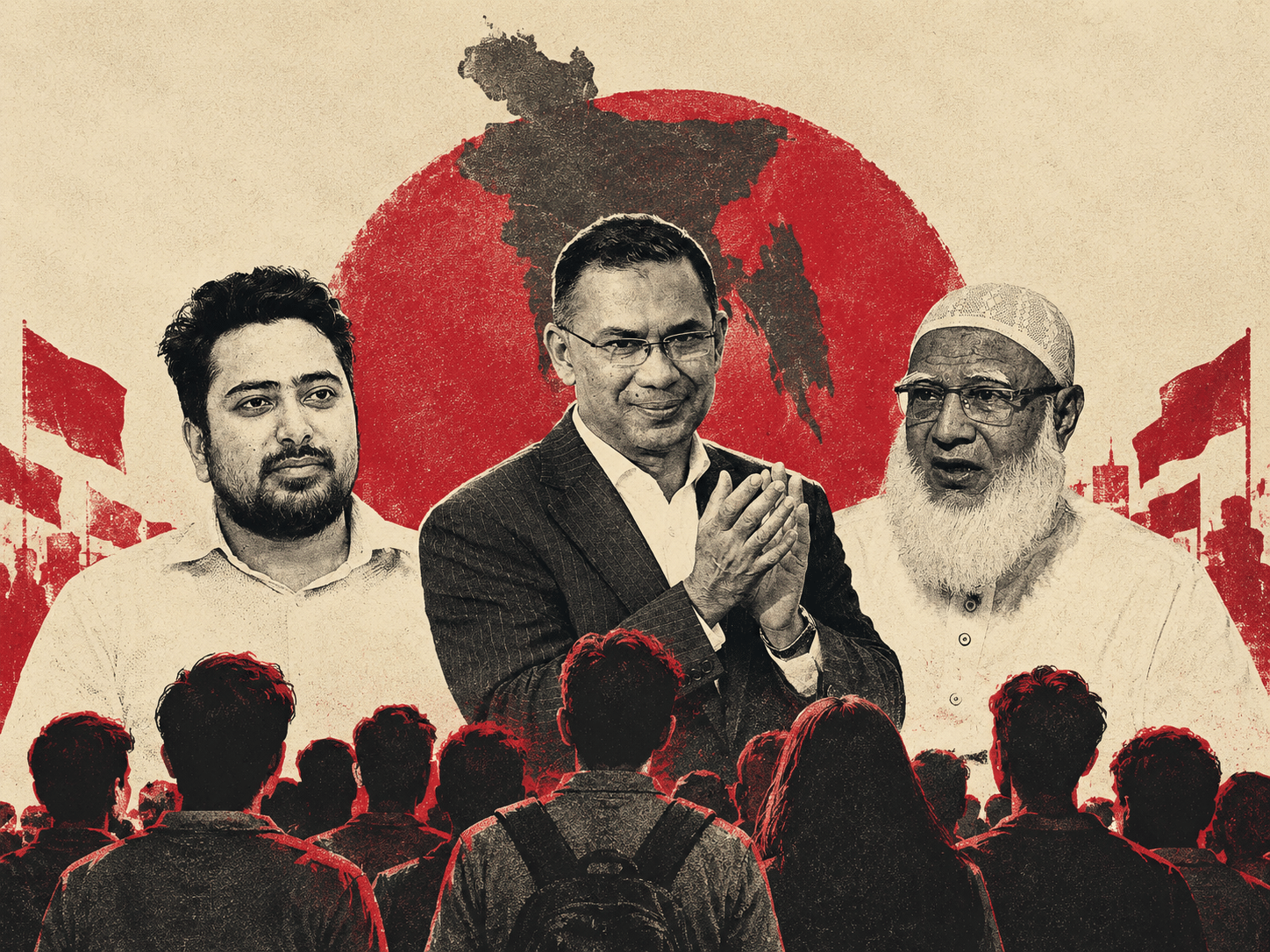
Bangladesh’s youngest voters have now been let down twice, and this time they have no obvious place left to go.
For most of the last sixteen years, a large part of this country did not vote in any meaningful sense. Elections happened on paper. Opposition parties boycotted or were boxed out, polling centers were reportedly filled overnight, and the phrase “রাতের আঁধারে ভোট” became shorthand for a ballot that had already been decided. A generation grew up learning that voting was a ritual, not a choice.
Then July 2024 happened. Sheikh Hasina fled, the Awami League was barred from political activity, and its leaders now face trials for crimes against humanity. In February 2026, Bangladesh held its first election in years without the party that had defined its politics since independence.
That absence created a vacuum, and the vacuum created a problem that nobody has properly named.
A two-party country, suddenly without one of its parties
Bangladesh has long been a two-pole state, the Awami League on one side and the BNP on the other. Remove one pole and everything else shifts. Two forces rushed toward the gap: Jamaat-e-Islami, and the National Citizens Party (NCP), built by the student leaders who fronted the uprising.
Neither could hold it alone.
Jamaat carries a weight it has never shed. It opposed Bangladesh’s independence in 1971, sided with the Pakistan army, and several of its senior leaders were later convicted of war crimes by the country’s tribunal. The party has been banned more than once. It has stayed relevant because it is the country’s most organized Islamist party in a Muslim-majority nation, but it has never been a mass party. Young, urban and liberal voters do not trust it. The families of the martyrs and anyone with a firm respect for the Liberation War do not either. Many Sunni, Hefazat and other religious constituencies distrust it for reasons of faith and practice, and Shibir’s alleged record of moral policing and online harassment of women did not help.
The NCP had the opposite problem. It had the moral authority of the uprising and the faces everyone remembered from the streets, but not the machinery. When mob violence and other abuses followed the uprising during the interim period, the NCP was widely blamed, fairly or not. Whether it was responsible is still debated. That it was framed as responsible is not.
Then came the alliance. The NCP, which calls itself centrist, joined Jamaat and nine other parties in an eleven-party bloc that most observers read as right-wing. NCP leaders have defended the decision in practical terms: the party did not yet have the organization to contest alone, and running alone, they argue, would have handed the BNP an even firmer grip on government. A strong opposition, in their telling, needed a coalition. It is a coherent argument. It was also, for many of the NCP’s natural supporters, the end of the conversation.
How the BNP won the people who didn’t want to vote for anyone
That left the BNP, and here the story turns on a group of voters that no party has a name for.
They are young, first-time or newly re-engaged voters, urban and middle class, liberal in outlook, respectful of 1971, and attached to no party. They could not vote for Jamaat. They could not vote for the NCP once it stood beside Jamaat. Everything about the BNP was uncomfortable too. Through the interim period the party’s leaders and activists were accused of extortion and other crimes, and those accusations were not marginal.
Yet a large number of these voters, by most accounts from social media, podcasts and everyday political conversation, ended up voting BNP. There is no survey we can point to that measures that shift precisely, and it would be dishonest to claim one. But the pattern was visible and consistent enough that it is hard to explain otherwise.
The reasons are not mysterious. Tarique Rahman ran a disciplined campaign. His speech after returning to the country, with its “I have a plan” refrain, echoed Martin Luther King’s “I have a dream” and was widely praised. The party’s 31-point manifesto and welfare promises, including the family card and the health card, gave voters something concrete. And there was an ideological pull that mattered as much as any policy: with the Awami League gone and Jamaat-linked voices questioning the Liberation War, and freedom fighters’ murals being torn down, the BNP took up the role of the pro-liberation force. Tarique himself hit Jamaat with the “Razakar” label. Voters who wanted a wall against Jamaat found one.
It was a vote against something, not for something. Most of these voters said so at the time.
Seven months later
The BNP has now been in government for more than seven months, and the gap between what was promised and what is delivered has become hard to ignore. Load-shedding is the worst many people can remember. Petrol and gas prices have risen. Election promises are unfulfilled. And extortion, the accusation the party most needed to bury, has not gone away.
The party does say it is acting on its own. It has expelled more than three thousand activists in the last two years, a number that suggests either a serious housecleaning effort or a problem far larger than admitted, and probably both. Either way, the voters who lent the BNP their support are not reassured by expulsion figures while the electricity is out.
So the question has come back, and it is harsher than before. Last time, these voters had bad options and picked the least bad. What do they do now, when the least bad has been tested and found wanting?
The real problem is not the voters
It is tempting to call this indecision, or political immaturity, or the fickleness of a generation that has never had to commit to anything. That reading is comfortable, and wrong.
These voters are doing exactly what a rational citizen does when every available party carries a disqualifying flaw. They are not clueless. They are unowned. A party that treats them as a guaranteed bloc because there is no alternative has misunderstood them. Their vote in February was a loan, not a gift.
And that is what makes this dangerous for everyone. The Awami League’s collapse showed that a party can take voters for granted for years and lose them all at once. A generation that has learned to vote strategically, holding its nose, is a generation with no loyalty to spend on anyone’s behalf.
The open question, then, is not whom they should vote for. It is whether Bangladesh’s political class is capable of building something worth voting for, or whether this electorate will keep choosing the least bad option until the options run out.