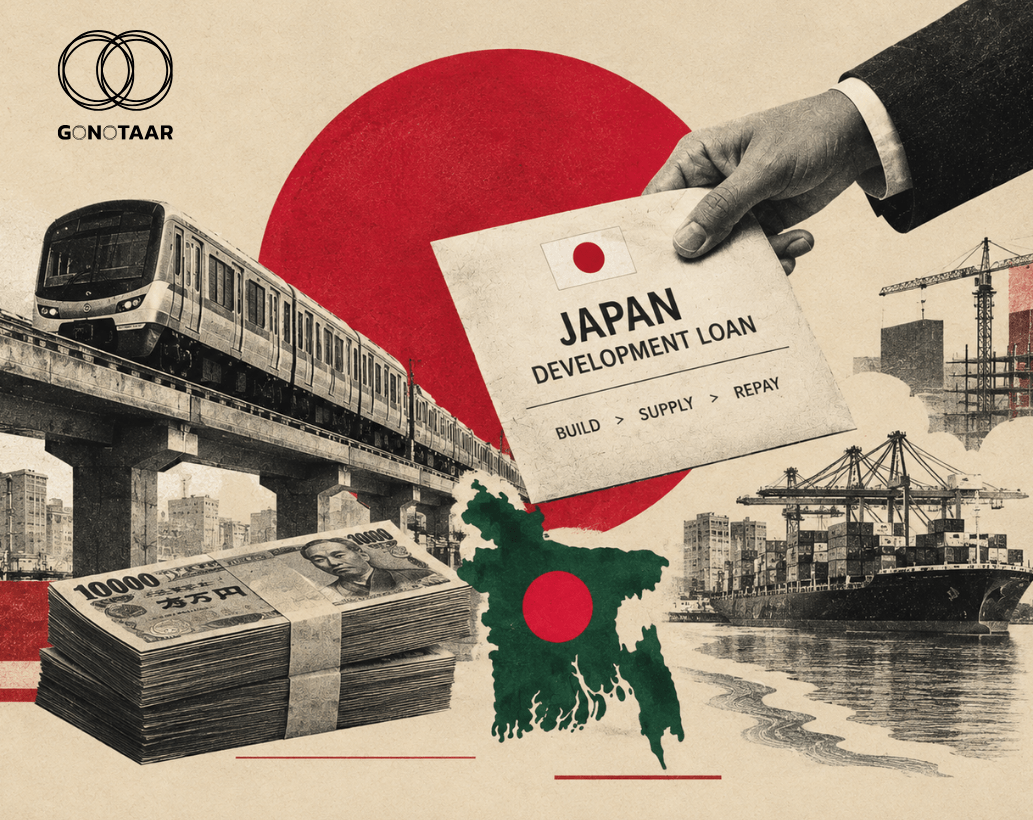
Every ribbon-cutting in Dhaka’s metro system, every crane over Matarbari, every fresh stretch of the Chattogram-Cox’s Bazar highway carries the same quiet signature: financed by Japan, built by Japan, priced by Japan. For two decades, that signature has been read as a mark of trust. Japan is Bangladesh’s most reliable lender, the one country willing to write cheques nobody else will, at interest rates nobody else will match.
What gets read less often is the fine print. Japan’s development loans do not simply fund a bridge or a rail line. They come bundled with the right to study the project, cost the project, build the project, and supply the materials for the project, almost always through Japanese firms. Bangladesh gets the loan. Japan’s contractors get the contract. And when the bill comes in far above the original estimate, as it has on nearly every major Japanese-financed project of the last decade, Bangladesh has almost no room to negotiate it down.
This is not corruption in the conventional sense. There is no evidence, so far, of bribery or bid-rigging. It is something more structural, and in some ways harder to fix: a lending model that turns “concessional” into a moving target, and turns partnership into dependency.
The mechanism: STEP loans
The legal architecture behind this is a JICA lending category called STEP, Special Terms for Economic Partnership, introduced in 2002. JICA’s own documentation is explicit about what STEP is for: loans under this scheme are extended to projects where Japanese technologies and know-how are substantially utilized, and only to countries that qualify for tied aid under OECD rules. In plain terms, STEP loans come with a condition that the engineering, the contractors, and often the equipment, have to be Japanese.
That single condition explains a pattern that shows up across every major Japanese-financed project in Bangladesh: thin competition at the tender stage, contractor pools limited to a handful of Japanese firms, and a lender that can decline requests to reopen bidding once prices come in high.
Case one: the metro rail that doubled
Dhaka’s MRT Line-1, the country’s first underground metro, was approved in October 2019 at an estimated cost of Tk52,561 crore. Dhaka Mass Transit Company Limited has since proposed revising that cost upward by 117 to 130 percent, to somewhere between Tk1,14,394 crore and Tk1,20,794 crore, pushing the completion date from 2026 to 2033. MRT Line-5 North has followed the same trajectory, with a proposed cost increase of around 126 percent.
The interest rate has moved in the same direction as the price tag. Financing that was originally priced at a concessional 0.6 percent has climbed toward 3.5 percent, with JICA’s Dhaka office attributing the rise to global interest rate conditions and lender policy at the time each tranche is finalised. A state minister told reporters the rate, once around 0.7 percent, had already reached about 3.05 percent, and warned JICA could revise it again if the agreement stayed unsigned.
The more telling detail sits in the tender process itself. When contractor bids for MRT-1 came in at nearly Tk970 billion against an approved cost of Tk525.61 billion, DMTCL asked JICA for a second round of tenders. JICA said no. The loan agreement also prohibits DMTCL from negotiating with contractors to bring their bids down. Professor Shamsul Haque of BUET’s civil engineering department has pointed to the same structural flaw across every JICA-financed metro package: in the final round, often only two Japanese firms are left bidding, and the “lowest bidder” among two is still whatever price those two firms decide to name.
The comparison that should embarrass every official who has signed off on these costs sits one border over. Patna’s metro, also financed by JICA, is being built by Indian contractors at roughly Tk450 crore per kilometre for underground sections, a fraction of what Dhaka is paying, because India’s loan terms do not restrict competitive bidding the way Bangladesh’s do.
None of this is abstract for the people who will eventually pay for it. Between 2026 and 2031 alone, Bangladesh owes over Tk3,700 crore in repayments on the MRT-6 loan, an average of roughly Tk740 crore a year, at a time when fares are already higher than comparable systems in the region and further hikes are politically difficult.
Case two: a coal plant that cost eight times too much
Matarbari’s Ultra Super Critical coal-fired power plant offers the starkest number in this entire story. Independent energy analysis has put its per-unit cost at eight to ten times that of comparable coal plants built in China. JICA has already disbursed $1.48 billion for the plant and its associated port and channel infrastructure, and intends to add another $1.33 billion.
The original engineering, procurement and construction consortium included Sumitomo, Toshiba and IHI. In March 2022, Sumitomo pulled out, citing its own commitment to carbon neutrality by 2050, a decision that left JICA, in the words of one energy analyst, as the last major partner still standing on a project the rest of the industry was already backing away from.
The plant that finally came online has not performed as promised. Output has fallen below 55 percent of capacity due to unresolved boiler and system faults, and technical disputes with the Japanese contractor over responsibility for the fix have delayed repairs and deepened the financial losses.
Hasan Mehedi, general secretary of the Bangladesh Working Group on External Debt, has pointed out the deeper irony: Bangladeshi policymakers were prepared to consider renewable alternatives, but Japan remains, by his account, the only country in Asia still actively pursuing new coal financing abroad.
Case three: the Chattogram-Cox’s Bazar highway
The bypass-and-flyover package alone, covering roughly 23 kilometres at five bottleneck points, has been costed at close to Tk256 crore per kilometre, nearly three times the per-kilometre cost of comparable four-lane highway projects the Roads and Highways Department has built elsewhere, such as Bhanga-Jashore-Benapole at Tk85.79 crore per kilometre or Dhaka-Sylhet at Tk82 crore. RHD officials, questioned on this gap at a Planning Commission meeting, pointed to JICA’s own engineering conditions as the reason competition, and therefore price discipline, has narrowed.
A newer, more ambitious JICA feasibility study, submitted in October 2025, proposes a Tk47,000 crore upgrade for a 65-kilometre stretch from Shah Amanat Bridge to Fasiakhali, which would make it the single most expensive road project ever undertaken in Bangladesh. JICA’s justification is ecological: nearly 60 percent of the route would be elevated to preserve migration corridors for endangered Asian elephants between the Chunati and Fasiakhali sanctuaries. It is a genuine environmental rationale. It is also, notably, a rationale that arrives from the same lender whose contractor-selection rules already push costs upward on every other project it finances, which makes it difficult to know how much of the premium is conservation and how much is the STEP structure doing what it always does.
When the work itself fails
Cost is one axis of this story. Whether the work holds up is another, and Japan’s record on that front has its own cracks.
On 26 October 2025, a rubber-and-steel bearing pad, weighing roughly 140 to 150 kilograms, dislodged from Pier 433 of the Dhaka metro’s elevated viaduct near Farmgate and fell onto the footpath below. It struck 35-year-old Abul Kalam Azad, killing him at the scene, then smashed into a tea stall, injuring the stall owner and another bystander. Train services across the entire Uttara-Motijheel line were suspended for hours. It was not the first time this had happened: an identical bearing pad had come loose from a neighbouring pillar in the same Farmgate stretch in September 2024, with no casualties that time.
A five-member investigation committee, led by the Bridges Division secretary, spent two months examining the failure. Its finding, submitted on 1 January 2026, was unambiguous: BUET laboratory tests on the two pads that fell showed they did not meet required quality standards, and the viaduct design itself was flawed. The committee nonetheless recommended the line continue operating, under closer monitoring, rather than face a fuller shutdown. Two public-interest writ petitions followed in the High Court, seeking compensation for the victim’s family and an independent technical review of bearing pads across every metro and flyover structure in the country, Japanese-financed or otherwise. The government’s initial response was Tk5 lakh in compensation and an offer of a metro-rail job to a family member.
Matarbari’s underperformance belongs in the same category. Beyond the cost overrun, the plant that finally came online is running below 55 percent of its rated output, with unresolved boiler and system faults, and an unresolved dispute with the Japanese contractor over who pays for the fix.
A third example is less a technical failure than an institutional one. Dhaka’s new airport terminal, Hazrat Shahjalal International Airport’s Third Terminal, was built at a cost of over Tk21,000 crore with JICA as the principal financier, and construction has been essentially complete for well over a year. What has kept it shut is a collapsed negotiation with the Japanese consortium originally lined up to operate it, over how revenue from passenger fees and commercial space would be split. With no operator agreement in place, the terminal cannot open. Loan repayments on the facility begin regardless, penciled at roughly Tk1,200 crore a year from 2027, while equipment warranties expire and an estimated $2.1 billion in built assets sits idle. A former CAAB chairman has put the cost of the two-year delay at around Tk2,500 crore. The building itself is not defective. The dependency on a single Japanese counterparty to actually run it, on terms that counterparty gets to help set, is the same structural thread running through every case in this piece.
Individually, each of these might be dismissed as bad luck, a manufacturing lapse, a hard negotiation. Taken together, across three different kinds of infrastructure built under three different arrangements with the same lender, they describe a pattern: the same tied structure that inflates costs also appears to be thinning out the accountability for what gets delivered once the money is spent.
The other side of the ledger
None of this erases what Japan has actually built. The Dhaka Metro, the Padma Bridge rail link, the Jamuna Railway Bridge, the two Meghna and Gomti bridges, all exist because Japan was willing to lend at scale when few others were. As of June 2025, Japan accounted for 18 percent of Bangladesh’s total outstanding external debt of $77.28 billion, a scale of exposure no other single bilateral lender comes close to matching, and Japanese loans remain, on paper, concessional relative to commercial borrowing.
The government’s own position, articulated by state minister Habibur Rashid, is that walking away is not a realistic option. The policy decision, he has said, is to proceed with Japanese financing on the metro lines while continuing to negotiate down costs, because Japan is one of Bangladesh’s most important development partners and severing an agreement carries its own diplomatic price. JICA’s standard defence of the cost premiums is that higher upfront spending buys higher build quality and lower maintenance costs over a project’s lifetime, an argument that is, at minimum, harder to sustain after Matarbari’s boiler failures and MRT-1’s seven-year schedule slip.
The shape of the dependency
Nothing in this record points to concealment. STEP is a published JICA lending product, not a secret clause. The tender restrictions sit in agreements that Bangladeshi officials read, negotiated, and signed. What emerges instead is a structural dependency that both governments have found reasons to keep renewing: Japan secures a guaranteed market for its construction and engineering firms at a moment when its own domestic infrastructure spending has slowed, and Bangladesh secures financing at a scale no other single bilateral partner offers, for infrastructure its planners have decided they cannot do without.
That arrangement is being paid for on three separate ledgers. The first is the price tag itself, inflated across nearly every major project by a tender process with too few real bidders and a lender that can decline to reopen it. The second is the interest, compounding at rates that have tripled from where they started while disbursement drags across years and sometimes decades. The third, and the one least discussed, is the one Abul Kalam Azad’s family is now living through: the cost of what happens when a system built under thin competition and limited local oversight turns out, on inspection, not to have met its own standard.
Bangladesh has room to change the terms of this relationship before the next loan package is signed, not by refusing Japanese financing, but by insisting that future tenders allow genuine competition, that quality audits sit with an independent Bangladeshi body rather than the financier alone, and that repayment schedules do not begin on projects that are not yet delivering the service they were built for. Whether that room gets used is, at this point, a political choice, not a technical one.