
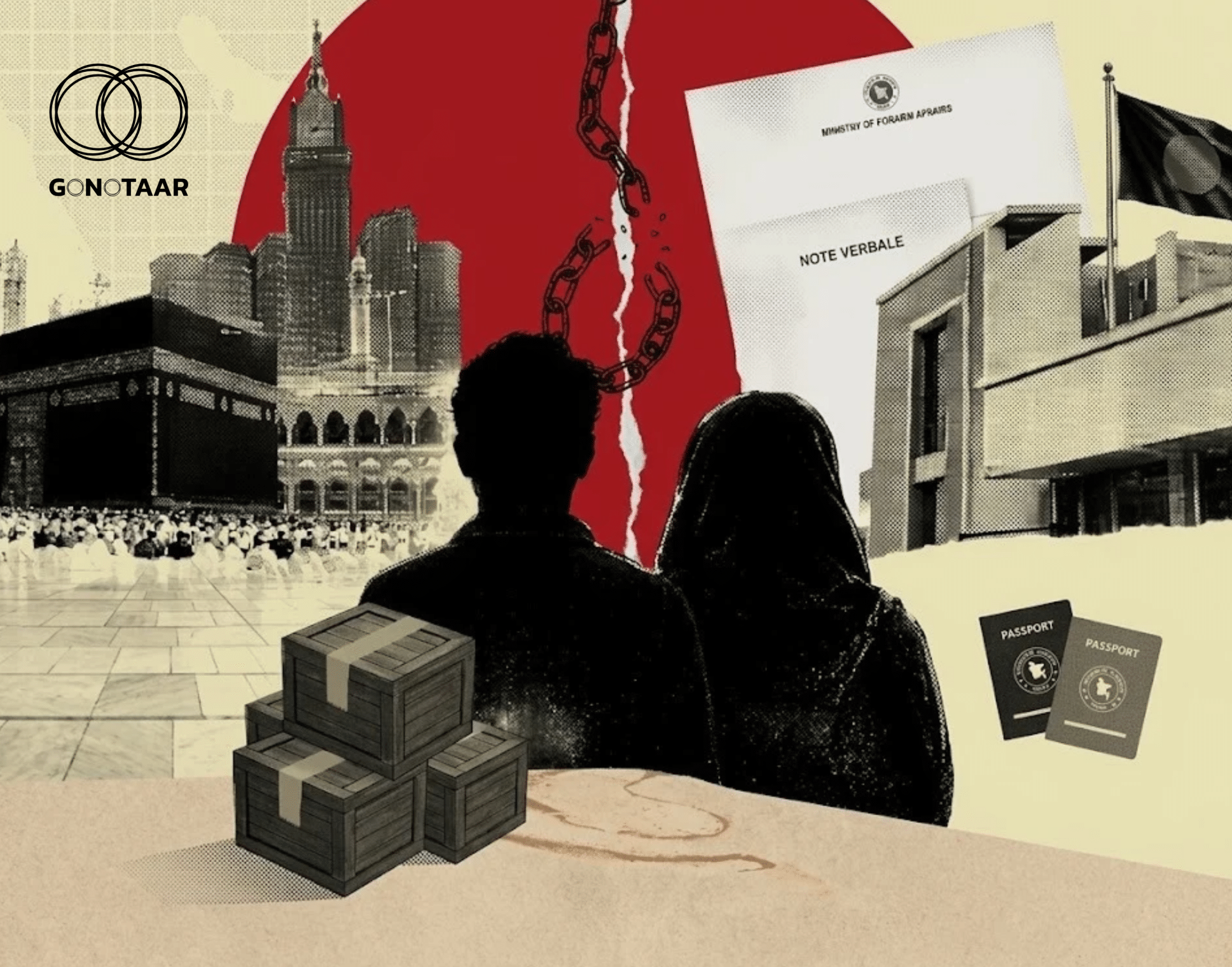
On October 14, 2026, two Bangladeshi nationals—Nazerul Islam Abdul Basir and Siti Akhtar—were executed in the Makkah region of Saudi Arabia. The official statement issued by the Saudi Ministry of Interior was brief: the two had been convicted of an unspecified “immoral act” inside a mosque, an offense deemed a severe violation of sacred space and time. Behind those minimal state-sanctioned phrases lay two human lives extinguished under discretionary judicial powers (Ta’zir), without public details regarding their relationship, the circumstances of their arrest, or whether they were ever afforded a defense attorney or a fair trial.
What makes their execution even more tragic is the total isolation in which it took place. The Bangladesh Consulate General in Jeddah received no prior notification of their arrest, trial, sentencing, or pending execution. Consular officials only learned of the executions through public media reports, prompting them to send a post-facto note verbale to the Saudi Ministry of Foreign Affairs simply asking for official confirmation that two of their citizens had been killed.
What happened in Makkah
Three steps, and Bangladesh was absent from all of them
Source: Saudi Ministry of Interior statement; Bangladesh Consulate General, Jeddah
This incident is not an isolated legal anomaly. It represents a recurring pattern of systemic vulnerability, where millions of low-wage migrant workers—whose labor fuels both the Saudi economy and their home countries’ survival—navigate an opaque judicial system without the basic shield of state protection.
A Tale of Two Nations: How Sri Lanka Saved Its Citizen
The quiet demise of Nazerul and Siti stands in contrast to another case decided in Saudi Arabia just hours earlier. In mid-2026, Anojan Sivarasa, a 24-year-old Sri Lankan Hindu migrant worker, was arrested and initially sentenced to five years in prison and a 3 million Saudi Riyal fine over a deleted social media comment deemed blasphemous. In September 2026, a Saudi appellate court elevated his sentence to death.
Faced with the imminent execution of its national, the Sri Lankan government did not wait for official post-execution notifications. Instead, it mobilized a comprehensive diplomatic and legal response:
- Executive Leadership: President Anura Kumara Dissanayake met directly with Sivarasa’s family in Colombo, assuring them of full state support.
- High-Level Legal Delegation: The Sri Lankan Ministry of Foreign Affairs dispatched a specialized four-member legal team to Saudi Arabia, retained licensed Saudi defense counsel, and directed Ambassador Amir Ajwad to engage directly with judicial and prison authorities.
- Judicial Overturn: On October 13, 2026—one day before the two Bangladeshis were executed—the Supreme Court of Saudi Arabia set aside Sivarasa’s death sentence following the structured appeal submitted by his legal team.
Two countries, two responses
Both cases ended in Saudi Arabia within 24 hours of each other
| Sri Lanka Anojan Sivarasa | Bangladesh Nazerul Islam & Siti Akhtar | |
|---|---|---|
| Charge | Blasphemy over a deleted Facebook comment | “Immoral act” inside a mosque |
| Sentence | Raised to death on appeal | Death under Ta’zir |
| State action | Four-member legal team sent; Saudi defence lawyers hired; Ambassador met judicial officials | No legal help or consular presence before the verdict |
| Leadership | President met the family; foreign ministry coordinated strategy | Silence before the executions |
| Outcome | Supreme Court set aside the death sentence (Oct 13) | Executed under Royal Order (Oct 14) |
Source: Sri Lankan and Bangladeshi official and media accounts
The Sivarasa case demonstrates that even within Saudi Arabia’s strict legal environment, active consular intervention and dedicated legal representation can halt an execution. Bangladesh’s passive approach leaves its citizens facing summary judicial outcomes without meaningful assistance.
The Caravan of Coffins: The Human Cost of Domestic Work
Siti Akhtar’s fate highlights a broader, gendered tragedy. Since Bangladesh signed a bilateral labor agreement with Saudi Arabia in 2015, tens of thousands of Bangladeshi women have traveled to the Kingdom seeking economic stability for their families. Many find themselves trapped in private homes under the Kafala (sponsorship) system, isolated from public oversight and unprotected by national labor laws.
Physical, Sexual, and Psychological Trauma
Documented surveys and interviews conducted with returnee female domestic workers by migration research organizations—such as BRAC, OKUP, and RMMRU—reveal systemic levels of abuse within private households:
- Physical Violence: Women report being beaten with belts, shoes, and keys; having their hair pulled; being slammed against walls; and suffering severe burns from hot oil or scalding water.
- Deprivation and Forced Labor: 82% of surveyed returnees were forced to work continuous shifts from early morning until midnight, 80% reported being denied adequate food, and 97% were denied weekly days off.
- Medical Neglect: 97% of returnees reported being denied medical care when ill.
- Sexual Abuse: 47% of surveyed returnees reported experiencing sexual harassment or assault in their workplaces.
Inside Saudi homes
Share of returnee Bangladeshi domestic workers reporting each abuse
Source: Surveys of returnee women by RMMRU, BRAC and OKUP
The Unspoken Truth of Repatriated Bodies
For hundreds of families each year, the migrant journey ends at Shahjalal International Airport in Dhaka, where bodies return in wooden crates. Saudi Arabia consistently accounts for the largest proportion of deceased Bangladeshi workers repatriated from abroad.
The women who came home in coffins
Bangladeshi female migrant workers returned as corpses, 2016 to 2022
Recorded cause of death (range across datasets)
Saudi Arabia accounts for 62% of all domestic worker suicides in the Gulf. Autopsies are rarely done.
Source: Government data compiled by BRAC. Bars show the range between datasets, not a single total.
According to data compiled by BRAC, between 2016 and 2022, at least 714 Bangladeshi female domestic workers were repatriated as corpses from the Middle East, with Saudi Arabia accounting for the majority of cases. In another 5-year dataset tracking 487 female worker deaths, 200 occurred in Saudi Arabia alone.
| Recorded Cause of Death | Percentage Share | Context and Discrepancies |
| “Natural Death” | 37% – 56% | Standard classification used on host certificates; rarely backed by autopsies. |
| Cerebral Stroke / Hemorrhage | 19% – 27% | Often linked to prolonged stress, extreme heat, exhaustion, and trauma. |
| Suicide | 16% – 31% | Saudi Arabia accounts for 62% of all domestic worker suicides in the Gulf. |
| Accidents / Violence | Remaining % | Includes fatal falls from high-rise apartments during escape attempts. |
These classifications raise significant questions. Before departing Bangladesh, every worker must pass mandatory health screenings. The high rate of “natural deaths” or “strokes” among young, previously healthy women within months of arrival suggests that severe physical exhaustion, extreme heat, prolonged abuse, and unaddressed medical emergencies are being routinely categorized under non-investigative medical terms.
Autopsies are rarely conducted in host countries, and bodies are typically buried or sent home without forensic investigation. A notable exception occurred in the case of Abiron Begum, a 40-year-old worker from Khulna murdered by her employers in Riyadh in March 2019. Persistence by her family and domestic advocacy groups led to a rare autopsy that confirmed severe physical torture, resulting in a Saudi court sentencing her primary employer to death in 2021—a rare instance of criminal accountability.
Transnational Scope: An Invisible Global Workforce
The abuse of female migrant workers in Saudi Arabia affects women from multiple developing nations across Asia and Africa:
- Kenya: The Kenyan Ministry of Foreign Affairs reported that 89 Kenyan citizens—predominantly female domestic workers—died in Saudi Arabia between 2020 and 2021. Widespread reports of physical violence and wage theft led the Kenyan Parliament to launch formal inquiries into deployment conditions.
- The Philippines: Amnesty International has documented ongoing patterns of isolation, unpaid wages, physical assault, and sexual abuse targeting Filipino domestic workers.
- Uganda and Ethiopia: Human rights organizations have documented instances of physical torture, forced confinement, and the arbitrary detention of hundreds of migrant women in overcrowded deportation facilities.
These cross-national accounts show that the vulnerabilities faced by workers are built into the host country’s regulatory and legal structure.
The Architecture of Vulnerability: Saudi Laws and the Kafala System
Uncodified Law and Capital Punishment
Saudi Arabia’s judicial framework presents structural challenges for foreign defendants:
- Lack of a Codified Penal Code: Criminal jurisprudence relies heavily on judicial interpretations of Sharia without a standardized written penal code. Under the doctrine of Ta’zir, individual judges retain broad discretion to define acts as criminal and impose capital punishment, leading to unpredictable sentencing outcomes.
- Escalating Capital Punishment: According to Human Rights Watch and Amnesty International, Saudi Arabia carried out 345 executions in 2024 and a record 356 executions in 2025. Foreign workers, who often lack language access and legal representation, are disproportionately affected.
- International Legal Standards: Article 6 of the International Covenant on Civil and Political Rights (ICCPR) and the Arab Charter on Human Rights restrict the death penalty to the “most serious crimes”—specifically intentional homicide. Applying capital sentences for discretionary moral offenses or non-violent charges violates these international norms.
Executions are rising
Executions carried out by Saudi Arabia
Foreign nationals, especially low-wage migrant workers, make up a disproportionate share.
Source: Human Rights Watch and Amnesty International
The Kafala Sponsorship System
The primary structure governing migrant labor is the Kafala system. By legally binding a worker’s immigration status (Iqama) to an individual employer (Kafeel), the system creates an imbalance of power:
- Control Over Movement: Domestic workers cannot change employers or leave the country without their sponsor’s formal consent.
- Criminalization of Escape (Huruub): If a worker flees an abusive home, the employer can report them for “absconding” (Huruub). This automatically converts the victim into an undocumented worker, subject to arrest, detention, and deportation.
- Document Confiscation: Despite formal prohibitions, employers routinely confiscate workers’ passports upon arrival, restricting their freedom of movement.
Structural Failure: Remittance Dependency and Consular Inaction
The Macroeconomic Paradox
Bangladesh’s national economy relies heavily on remittances sent home by migrant workers. These funds provide critical foreign exchange and support millions of households. Public discourse frequently honors migrant labor with the title Probashi Yoddha (“Remittance Warriors”).
However, this economic dependency often translates into diplomatic caution. State agencies tend to prioritize maintaining labor market access over vigorously defending the rights of overseas citizens. When legal or physical crises occur, the state apparatus frequently defaults to a passive posture.
Why Dhaka stays quiet
How dependence on remittances turns into a protection gap
Source: Gonotaar analysis
Institutional Deficits in Consular Protection
The execution of Nazerul Islam Abdul Basir and Siti Akhtar highlights systemic gaps in Bangladesh’s foreign service operations:
- Lack of Legal Defense Infrastructure: Unlike diplomatic missions from countries like Sri Lanka or the Philippines, Bangladeshi embassies in the Gulf do not maintain dedicated legal defense funds to retain local lawyers for citizens facing capital charges.
- Inadequate Custodial Tracking: Consular sections rarely maintain proactive registries of detained citizens or conduct systematic prison visits, leaving workers to navigate foreign judicial systems alone.
- Reactive Diplomacy: Official responses are often limited to post-facto diplomatic notes sent after sentences have been carried out.
- Lack of Forensic Investigation: When bodies are repatriated, welfare agencies disburse small burial allowances without investigating suspicious circumstances or requesting independent autopsies.
What needs to change
From Bangladesh’s Ministry of Foreign Affairs:
- Set up an early legal intervention fund in embassies in high-risk countries, so qualified local lawyers can be hired the moment a citizen is arrested on a capital charge.
- Negotiate binding agreements that require host states to notify Bangladesh within 48 hours of arresting any Bangladeshi.
- Expand safehouses in Riyadh and Jeddah, staffed with social workers, legal aides and medical personnel to help women who flee abusive homes.
- Require forensic autopsies in Bangladesh when a returning body comes with a vague certificate such as “natural death” or “stroke,” and use the evidence to seek legal remedy abroad.
From Saudi Arabia:
- Write a codified penal code that meets international human rights standards, and end the death penalty for non-violent or vaguely defined moral offences.
- Dismantle Kafala: cut the tie between immigration status and the employer’s consent, stop criminalising “absconding,” and let workers change jobs or leave freely.
- Bring domestic workers under standard labour law, with working-hour limits, rest days and inspections of private households.
From international bodies:
- The International Labour Organization should press for compliance with Convention No. 189 on domestic work and push for regional oversight in the Gulf.
- UN human rights experts, including the Special Rapporteur on extrajudicial, summary or arbitrary executions and the Special Rapporteur on the human rights of migrants, should be invited to examine detention conditions, trial fairness and execution practices in Saudi Arabia.
Two people were put to death in a country far from home, for an act their own government still cannot describe. Sri Lanka showed a day earlier that a state that fights can sometimes win. The question for Dhaka is why it did not even try.


