
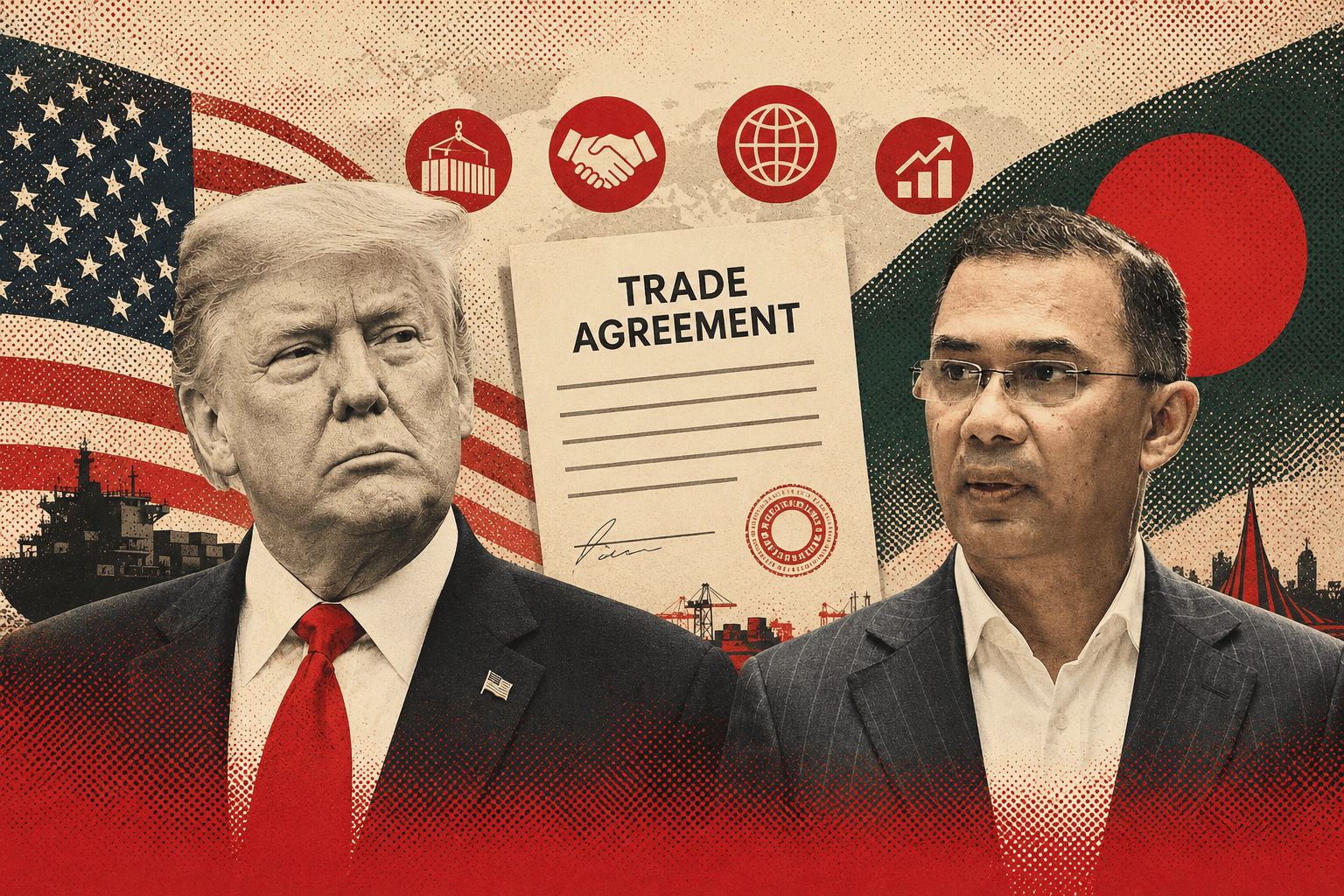
Bangladesh–US trade deal, decoded
Agreement on Reciprocal Trade (ART) · Signed February 9, 2026 · Not yet in effect
on Bangladesh
on the United States
Source: Prothom Alo · Compiled by Gonotaar
What is this agreement?
The full name is the Agreement on Reciprocal Trade (ART). It was signed on February 9, three days before the national election. It hasn’t formally taken effect yet — but Bangladesh has already started buying US products as part of its commitments under the deal. Critics from across the political spectrum, including MP Rumin Farhana in parliament, have called for it to be cancelled or renegotiated.
On tariffs and trade
Bangladesh has agreed to reduce or eliminate tariffs on a wide range of US goods, with some dropping to zero immediately and others phased out over 5 to 10 years. Bangladeshi authorities must also accept US product certifications — for medical devices, vehicles, food — without adding local approval requirements on top.
There’s even a clause about cheese and meat: Bangladesh cannot block US products simply because of the name they use, which essentially stops Bangladesh from using naming rules as a trade barrier.
In return, the US has agreed to allow some Bangladeshi garments and textiles to enter at reduced or zero tariffs — but only up to a quota, and only if Bangladesh is buying enough US cotton and synthetic fiber to qualify. The benefit is conditional and capped.
On intellectual property
Bangladesh must enforce IP rights at the civil, criminal, and border level, including online. Copyright and trademark violations must be treated as an enforcement priority. Bangladesh is also required to join 10 international IP treaties within five years — including the WIPO Copyright Treaty, the Patent Cooperation Treaty, and the Madrid Protocol.
Geographic indication rules must also be fair and transparent. Generic product names — say, “American cheese” — cannot be given special protection that would shut out US products.
On digital trade
This is one of the most expansive sections of the deal. Bangladesh cannot impose taxes on US digital services in a way that singles them out. Cross-border data flows must be allowed for business purposes. US companies cannot be forced to hand over source code, algorithms, or trade secrets as a condition of operating in Bangladesh.
There’s also a significant geopolitical clause here: if Bangladesh signs a digital trade deal with another country and the US decides that deal threatens its interests, it can cancel this entire agreement and reinstate the tariffs from Trump’s Executive Order of April 2, 2025. Bangladesh’s ability to sign future trade agreements is effectively subject to US approval.
Bangladesh has also committed to reforming its Cyber Safety Ordinance to include free speech protections, and to removing requirements that would force companies to hand over encryption keys.
On labour rights
This section carries some of the most specific and time-bound obligations. Within two years, Bangladesh must bring EPZs (Export Processing Zones) under labour law, giving workers in those zones the right to form independent trade unions — something they currently cannot do.
The deal also requires Bangladesh to drop pending criminal cases against garment workers and union leaders from the 2023 minimum wage movement. Annual minimum wage reviews must begin within three years.
Labour inspectors must be given the authority to conduct surprise visits to all workplaces, including EPZs. Penalties for labour law violations must increase.
On security and geopolitics
Bangladesh must align its export control system with US rules and help prevent US sanctions from being bypassed through Bangladeshi territory. It must share foreign investment data with the US.
On energy, Bangladesh cannot buy nuclear reactors, fuel rods, or enriched uranium from countries the US considers a security risk — unless no alternative supplier exists or a contract was already in place before the deal.
And perhaps most significantly: if Bangladesh signs a trade or economic agreement with a country the US classifies as a “non-market economy” — widely understood to mean China — and the US believes it weakens this deal, the US can cancel the agreement entirely.
On investment
US companies in oil and gas, insurance, and telecoms must be given easier access to the Bangladeshi market. Foreign ownership restrictions in these sectors must be relaxed. State-owned enterprises must follow market rules and cannot treat US goods or services less favourably than others.
The mandatory requirement forcing foreign insurers to give 50% of their business to state-run Sadharan Bima Corporation must also be removed.
The bottom line
The deal gives the US significant leverage over Bangladesh’s trade policy, digital laws, energy procurement, and foreign economic relationships — with relatively few firm commitments in return. The garment tariff benefit, which is the most tangible gain for Bangladesh, comes with conditions tied to how much the country buys from the US. The exit clause — allowing the US to reinstate tariffs if Bangladesh signs certain agreements with other countries — is a constraint on Bangladesh’s economic sovereignty that has no equivalent restriction on the US side.
The deal is not yet in force. But it is already reshaping how Bangladesh is doing business.


