An In-Depth Investigative Report Sources: WHO, UNICEF, The Daily Star, Science (AAAS), The Lancet, Al Jazeera, Prothom Alo, bdnews24, The Business Standard, AFP | Compiled: May 11, 2026
Key Facts: Bangladesh Measles Outbreak 2026
The Scale of the Catastrophe
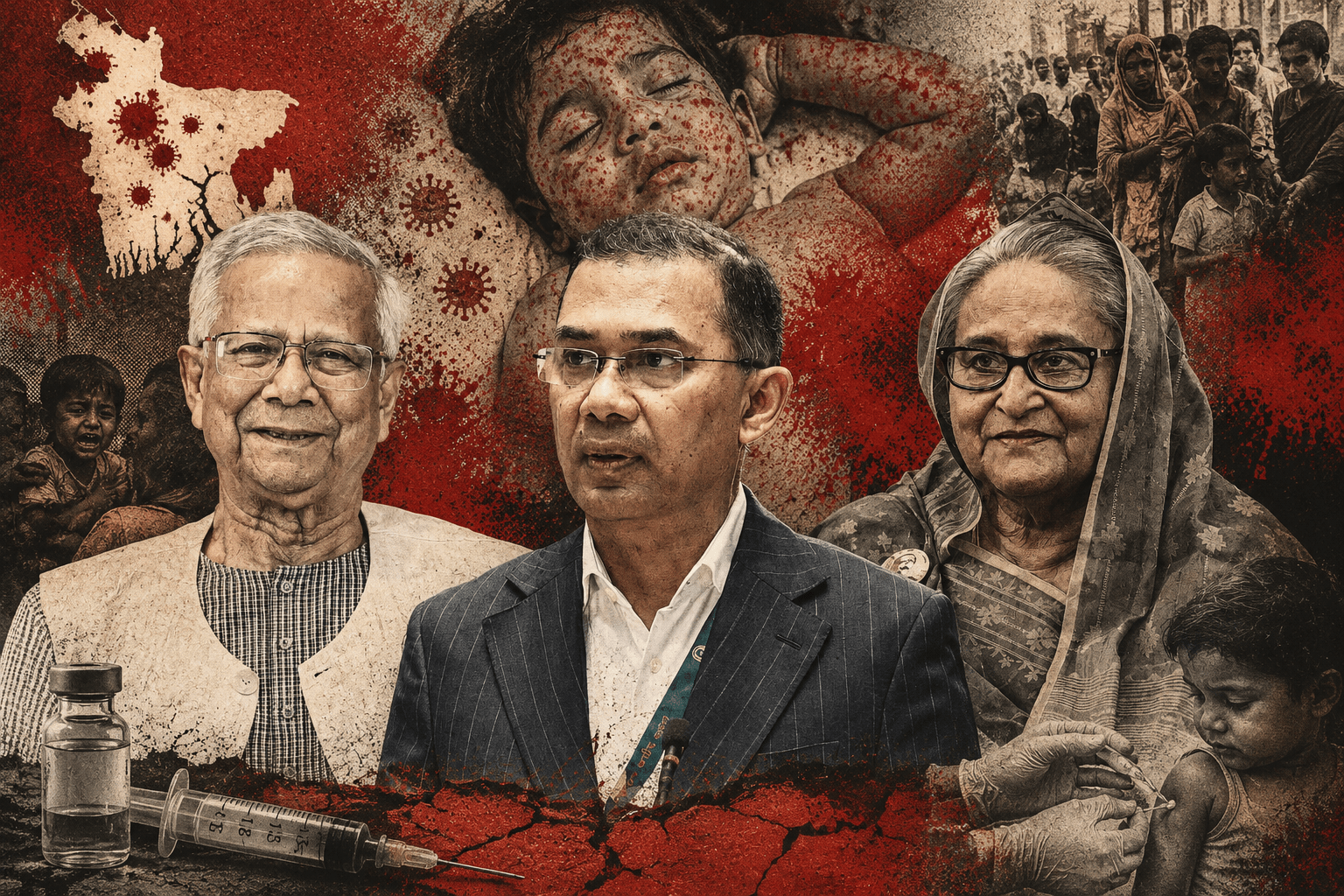
Bangladesh is enduring its deadliest measles outbreak in decades. As of May 10, 2026, the Directorate General of Health Services (DGHS) confirmed that 409 children have died — either from confirmed measles or measles-like symptoms — since the outbreak was formally tracked from mid-March. On May 4 alone, 17 children died in a single 24-hour period, the highest single-day toll recorded. The total caseload has surpassed 55,900 infections across 58 of Bangladesh’s 64 districts — virtually the entire country.
Of those deaths, 179 were recorded in Dhaka division alone, partly because critically ill patients are routinely transferred from district hospitals to the capital’s overstretched facilities. Rajshahi and Chattogram divisions follow with some of the highest case burdens.
The overwhelming majority of victims are children aged six months to five years. Infants under nine months — too young to receive the standard first vaccine dose — account for 33% of reported cases. The World Health Organization (WHO) has classified the national risk level as “high”, noting on April 23 that the outbreak poses “a considerable risk” of spreading into neighbouring Myanmar and India.
The Lancet described the hospital pressure as “phenomenal.” Dhaka’s Infectious Diseases Hospital in Mohakhali admitted 560 suspected measles cases in the first three months of 2026 — compared to just 69 for all of the previous year. March alone accounted for 448 of those admissions, with a crude in-hospital mortality rate of 4.7% for that month — an alarming figure for what is, in principle, a fully vaccine-preventable disease.
The WHO called it outright: “a reversal from Bangladesh’s previous progress towards measles elimination.”
How It Started: The Rohingya Camps as Ground Zero
The outbreak is believed to have ignited in Rohingya refugee camps in Cox’s Bazar, near the Myanmar border, in January 2026. The camps host over 1.1 million refugees, roughly 190,000 of whom are children under five. Overcrowded, poorly sanitised, and chronically under-resourced, the camps have historically been a hotspot for vaccine-preventable diseases.
Rohingya refugees face a compounding vulnerability: many children arrived in Bangladesh already unvaccinated, due to long-standing immunisation gaps in Rakhine State. This pre-existing immunity deficit, combined with the outbreak of measles in a densely packed setting, created conditions for rapid spread — which then jumped into Bangladesh’s general population, where, critically, vaccination coverage had already collapsed.
The International Rescue Committee (IRC), which operates in Cox’s Bazar, launched an emergency measles response, describing the outbreak as “a direct consequence of years of strain on the health system in Bangladesh caused by lack of resources to meet the needs of local communities and a growing refugee population.”
The Root Cause: A Vaccination System in Free Fall
Bangladesh’s Immunisation Legacy
Bangladesh had, for years, been celebrated as a model for low-income countries in public health. Between 2014 and 2015, nationwide measles-rubella (MR) campaigns vaccinated over 50 million children. By the mid-2010s, more than 92% of children received the first vaccine dose, and second-dose coverage exceeded 80%. Measles mortality among under-fives declined steadily across three decades.
The system relied on two routine MR doses — the first at nine months, the second at fifteen months — supplemented by a nationwide supplementary immunisation campaign every four years, designed to catch any children missed by routine services and maintain the 95% population immunity threshold required to prevent outbreaks. For years, UNICEF supplied these vaccines with funding primarily from Gavi, the Vaccine Alliance, alongside government contributions.
That system, the WHO and public health experts now agree, collapsed between 2024 and 2026.
The 2024 Revolution and Its Aftermath
In August 2024, following a student-led uprising in which hundreds were killed, Prime Minister Sheikh Hasina was ousted and fled the country. A caretaker interim government, led by Nobel Peace Prize laureate and economist Muhammad Yunus, assumed power.
The political upheaval immediately disrupted the health system. A supplementary measles-rubella vaccination campaign that had been scheduled for June 2024 was postponed — first to 2025 because of the unrest, and then, under the interim government, cancelled altogether. This was critical: Bangladesh had not conducted a nationwide supplementary measles campaign since 2020, meaning a growing cohort of children had never received catch-up vaccination.
The Procurement Decision That Changed Everything
The most consequential decision — and the most contested — came in September 2025, when the interim government’s Cabinet Committee on Economic Affairs ordered a fundamental change to how Bangladesh procures its vaccines.
For decades, Bangladesh had purchased vaccines through UNICEF under what was called the Direct Procurement Method (DPM) — a streamlined arrangement under which a line director in the Expanded Programme on Immunisation (EPI) could place orders with a single finance ministry approval. The interim government decided to halt this arrangement and switch to an open tender system, in which the government invites private suppliers to competitively bid for vaccine contracts.
Additionally, the committee directed the health ministry to negotiate vaccine prices directly with UNICEF for half its procurement, adding another layer of bureaucratic complexity.
UNICEF was emphatic in its opposition. Rana Flowers, the agency’s representative in Bangladesh, repeatedly warned health officials that the change could disrupt the immunisation system and trigger an outbreak. In a conversation she later recounted to Science magazine, she pleaded with former interim health advisor Nurjahan Begum: “For God’s sake… don’t do this.” Flowers has since said the decision needs to be investigated.
Her warnings were not heeded.
The tender process became mired in bureaucratic delays. Under the new system, separate tenders were required for each type of vaccine — a process experienced EPI officials had never managed before and which required approvals from two cabinet committees, rather than the single approval previously needed. An EPI official told The Daily Star in early April, on condition of anonymity: “All these decisions caused complications, and we have not received a single vaccine through any of the methods to date.”
The interim government did procure vaccines worth approximately Tk 200 crore from UNICEF on credit in late 2025 when reports of shortages began to surface — but, officials say, it was not enough. Stocks of six types of vaccines, including measles, were exhausted by March 2026.
The Coverage Collapse
In late March 2026, government data — subsequently removed from the health ministry’s website — showed that only 59% of eligible children received their measles vaccination in 2025. The required coverage for herd immunity is 95%. The result: a vast immunity gap across the country, with children in urban slums and rural areas most exposed.
UNICEF and WHO have calculated that nearly 5 million children in Bangladesh were not fully immunised in 2025, including 70,000 with zero vaccine doses. As the Lancet noted, with normal two-dose coverage and catch-up systems in place, outbreaks are predictable — and preventable.
The Health Worker Factor
Compounding the procurement failure was a period of health worker discontent and intermittent strikes during the interim government’s tenure. Disaffected healthcare workers periodically disrupted routine immunisation services, further reducing the number of children receiving scheduled doses. These strikes, combined with the vaccine stockouts, meant that even the already-weakened routine system could not function normally.
Who Bears Responsibility? A Multi-Layered Accountability Crisis
The Interim Government (Yunus Administration, August 2024 – February 2026)
The scientific and journalistic consensus, based on reporting from Science (AAAS), The Daily Star, The Lancet, and bdnews24, points most directly to the Yunus-led interim government’s vaccine procurement decision as the proximate trigger for the outbreak.
The decision to abandon UNICEF procurement — over the explicit, repeated warnings of UNICEF representatives — without having a functioning replacement system in place created the vaccine stockout that collapsed immunisation coverage. The supplementary campaign that could have closed the immunity gap was cancelled. And when shortages became apparent, the response was too slow and too small.
The former health adviser’s defence — that the change was intended to move the system from an “emergency clause” to a “rule-based” arrangement — has not satisfied public health experts, given the catastrophic consequences. A Supreme Court lawyer, Biplob Kumar Das, filed a complaint with Bangladesh’s Anti-Corruption Commission on April 12, alleging corruption and vaccine procurement failures under the interim administration. UNICEF’s Rana Flowers agreed that the decision needs to be formally investigated.
However, the former special assistant to Yunus in health affairs, Sayedur Rahman, denied that any fundamental changes were made to procurement rules, saying the interim government wanted to “avoid questions about transparency or perceptions of bias.” He did not answer follow-up questions about what specifically went wrong.
The Hasina Government (Pre-August 2024)
Prime Minister Tarique Rahman, in Parliament on April 18 and again on April 22, called the failure of the previous two governments — both the Hasina administration and the interim government — to ensure measles vaccination an “unforgivable crime.”
The accusation directed at the Hasina government is more diffuse: the national supplementary immunisation campaign had not been conducted since 2020, suggesting routine complacency had already set in before the 2024 revolution. The campaign due in 2024 was postponed due to the uprising — but critics note that the delays predated the political crisis.
Sheikh Hasina, from exile, pushed back: she told Science that her government “prioritised vaccination” and noted that no major measles outbreaks occurred during her 15 years in power — a claim that is broadly accurate, though the coverage data shows the system had begun to weaken.
The Current Government (Tarique Rahman, from February 2026)
Bangladesh held general elections in early February 2026, resulting in a BNP victory and Tarique Rahman becoming Prime Minister. The new government inherited the active outbreak.
Its response has included:
- Reinstating UNICEF procurement in April 2026
- Coordinating with WHO and Gavi to secure emergency vaccine supplies
- Launching an emergency measles-rubella vaccination campaign targeting children aged 6–59 months on April 5 in 30 high-burden upazilas, followed by a nationwide rollout on April 20
- Deploying the military to set up a 20-bed field hospital at Dhaka Medical College Hospital
- Directing two senior ministers to travel nationwide to assess the crisis
As of May 10, 17.8 million children had been vaccinated under the emergency campaign, against a target of 18 million by May 20 — representing 99% of the official target. However, UNICEF’s Rapid Convenience Monitoring (RCM) found that 30–40% of children in urban areas and 15% in rural areas had still not received the vaccine, raising serious questions about the reliability of the government’s own coverage estimates.
Vaccination alone, however, will not quickly stop the epidemic. Public health expert Be-Nazir Ahmed, former director of disease control at the DGHS, warned: “At this rate of vaccination, the infection will not decrease right now.” It typically takes several weeks before mass vaccination begins to suppress transmission. Meanwhile, a shortage of testing kits has also prevented health authorities from medically confirming all daily infections.
Aggravating Factors: Beyond Policy
Malnutrition
Around 28% of Bangladeshi children under five are stunted, indicating chronic malnutrition. Malnourished children face far higher risks of severe complications from measles — including pneumonia, encephalitis, and death. This is reflected in the case fatality rate: the crude in-hospital mortality rate at the Infectious Diseases Hospital in Dhaka reached 4.7% in March.
Missed Vitamin A Campaigns
Vitamin A supplementation, which strengthens children’s immune response, had not been distributed nationally since 2024. ASM Alamgir, a former principal scientist at the Institute of Epidemiology, Disease Control and Research (IEDCR), said missed Vitamin A campaigns since 2024 had further weakened children’s immunity ahead of the outbreak. Authorities have now included Vitamin A distribution as part of the outbreak response.
Urban Density and Informal Settlements
Cases in Dhaka are heavily concentrated in densely populated informal settlements — Demra, Jatrabari, Kamrangirchar, Korail, Mirpur, Tejgaon — where healthcare access is limited and children are most likely to have missed vaccination. This urban vulnerability highlights how immunisation failures disproportionately affect the most marginalised communities.
International Concern and Calls for Action
The International Society for Human Rights (ISHR) has formally expressed “profound concern,” stating that what is unfolding is “not merely a health crisis, but a grave human rights issue, where the most fundamental right — the right to life of children — is being compromised.”
Mohammad Mushtuq Husain, an advisor at Dhaka’s IEDCR, publicly called on the government to formally declare a public health emergency: “This is already an emergency, so why hesitate to officially declare a public health emergency?”
WHO’s assessment of a “considerable risk” of cross-border spread — to Myanmar, where civil war has also disrupted immunisation, and to India — has prompted international concern. Districts such as Jashore and Chapainawabganj, major transit points near land crossings, have been specifically flagged.
What the Numbers Tell Us
| Indicator | Figure |
|---|---|
| Total deaths (as of May 10, 2026) | 409 |
| Total suspected + confirmed cases | 55,900+ |
| Districts affected | 58 out of 64 (91%) |
| Children unvaccinated in 2025 (fully) | ~5 million |
| Measles vaccination coverage in 2025 | 59% (target: 95%) |
| Highest single-day death toll | 17 (May 4, 2026) |
| Children vaccinated in emergency campaign | 17.8 million (as of May 10) |
| Children in Dhaka urban areas still unvaccinated (est.) | 30–40% |
Conclusion: A Preventable Tragedy
The Bangladesh measles outbreak of 2026 is, by every expert assessment, a man-made catastrophe. Measles is one of the most vaccine-preventable diseases known to medicine. Bangladesh had built a functioning, internationally recognised immunisation system over decades. That system was dismantled — through policy missteps, procurement failures, political disruption, and bureaucratic inertia — with consequences that are now being borne by the country’s most vulnerable children.
The weight of evidence from WHO, UNICEF, Science (AAAS), The Lancet, and Bangladeshi investigative media points most directly to the Yunus-led interim government’s September 2025 procurement decision as the proximate trigger — a decision made against the explicit warnings of UNICEF and which collapsed vaccine coverage to 59%, far below the 95% herd immunity threshold. The cancelled supplementary campaign compounded the damage.
The current Tarique Rahman government inherited this crisis on Day One and has moved with some urgency — but even its own emergency campaign has left millions of urban children without coverage, and deaths continue to mount daily. Its political incentive to blame its predecessors, while partly justified, should not obscure the fact that the response remains incomplete.
What remains beyond dispute is the human cost: 409 children dead, tens of thousands hospitalised, and families across Bangladesh shattered by a disease that a single functioning vaccination programme should have prevented.
Sources consulted: WHO Disease Outbreak Notice (April 2026); Science.org / AAAS (April 30, 2026); The Lancet (April 2026); Al Jazeera (April 5, 2026); The Daily Star Bangladesh (multiple reports, April–May 2026); Prothom Alo English (May 11, 2026); bdnews24 (May 2026); The Business Standard Bangladesh; Anadolu Agency (May 10, 2026); International Society for Human Rights (May 5, 2026); Asian News Network (April 8, 2026); MSF / IRC field reports.