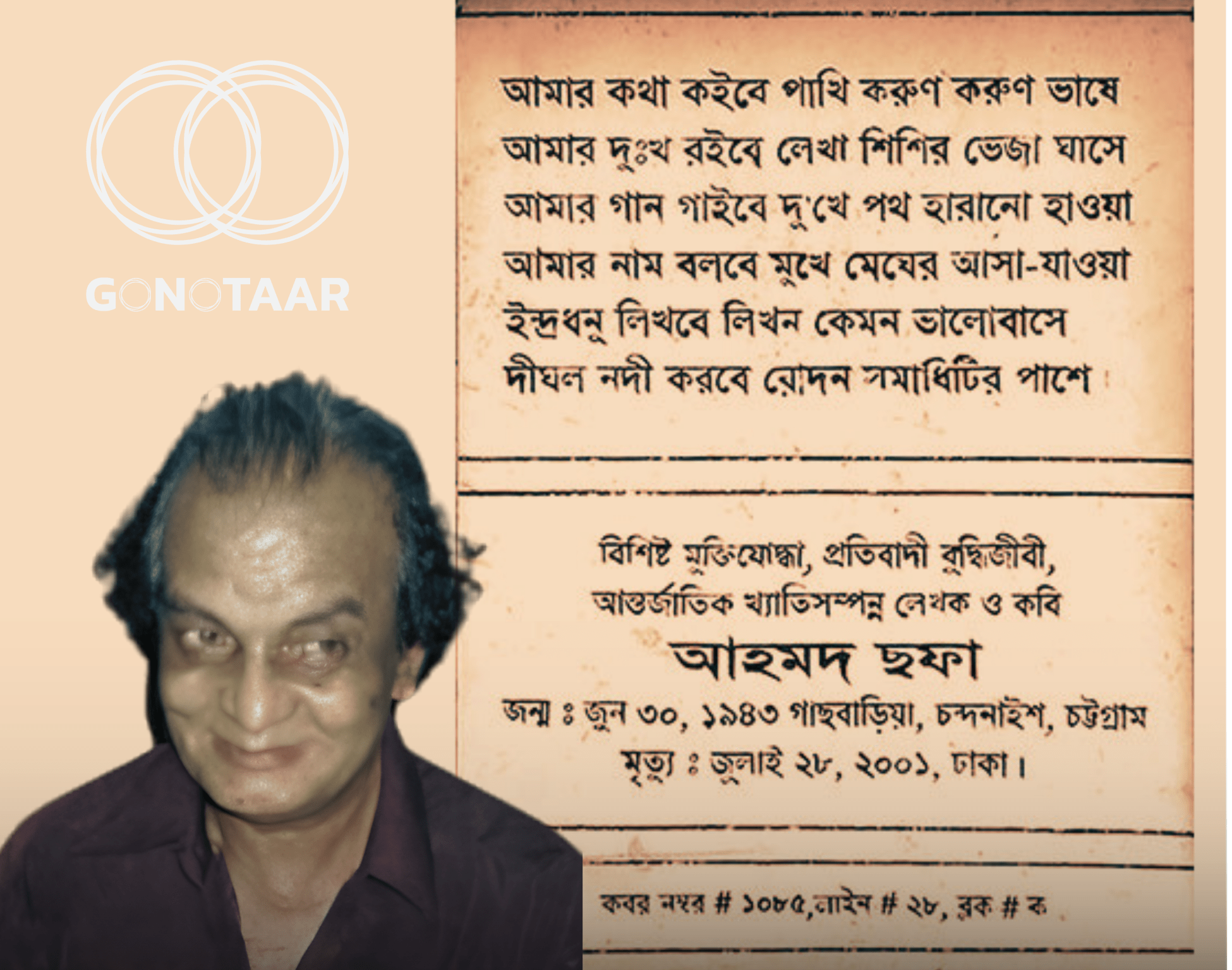
The grave of renowned Bangladeshi thinker and writer Ahmed Sofa is set to be relocated from a general cemetery in Mirpur to the Martyred Intellectuals Cemetery, following a decision by the Dhaka North City Corporation (DNCC).
The decision was approved during the 14th corporation meeting of the DNCC after a formal application was submitted by the writer’s family earlier this year.
According to DNCC sources, Nurul Anwar, Ahmed Sofa’s nephew, officially applied on January 11 seeking the relocation of the writer’s grave. In the application, the family stated that despite Ahmed Sofa’s outstanding contributions to Bangladesh’s literature, culture, politics, and social thought, he had not yet received the recognition he deserved.
The issue was discussed in detail during a DNCC corporation meeting on April 13, where members unanimously agreed to relocate the grave to the Martyred Intellectuals Cemetery with proper state dignity.
Authorities said the relevant departments have already begun the necessary verification and administrative procedures to implement the decision.
Speaking about the move, Nurul Anwar said the family had always wanted Ahmed Sofa to be buried at the Martyred Intellectuals Cemetery following his death in 2001, but the administration at the time did not cooperate.
“After Ahmed Sofa’s passing, it was our heartfelt wish to bury him at the Martyred Intellectuals Cemetery, but due to the unwillingness of the then administration, it was not possible,” he said.
He added:
“For years, this remained a source of pain and disappointment for us. Our main goal was to restore the dignity that a personality like Ahmed Sofa truly deserves.”
Nurul Anwar also noted that he had personally arranged the original burial plot for 99 years, but believed a permanent and honorable resting place for such a national intellectual was a moral responsibility.
Prominent essayist and academic Salimullah Khan described the initiative as the result of a long-standing effort by Ahmed Sofa’s admirers and family members.
“Although delayed, the state’s decision to give Ahmed Sofa the dignity he deserves will be welcomed by conscious citizens and countless admirers as a historic correction,” he said.
However, essayist and critic Morshed Shafiul Hasan expressed a different view, arguing that the writer’s legacy does not depend on the location of his grave.
“Ahmed Sofa’s stature as a writer does not rely on where he is buried. Perhaps he himself would have been happier if his grave had been in his birthplace, Gachhbariya in Chattogram,” he said.
Ahmed Sofa, born on June 30, 1943, in Chandanaish, Chattogram, is regarded as one of Bangladesh’s most influential intellectuals. His works, including “Buddhibrittir Notun Binnyash” (1973) and “Bangali Musalmaner Mon” (1976), remain widely discussed for their profound analysis of Bangladeshi society, politics, and identity.
The celebrated writer passed away on July 28, 2001.