“The oppressed are allowed once every few years to decide which particular representatives of the oppressing class are to represent and repress them.” — Karl Marx
“I may still be a kind of a Marxist but I’m very realistic, I don’t have these dreams of revolutionists around the corner.” — Slavoj Žižek
“When we seem to have won or lost in terms of certainties, we must, as literature teachers in the classroom, remember such warnings — let literature teach us that there are no certainties, that the process is open, and that it may be altogether salutary that it is so.” — Gayatri Chakravorty Spivak
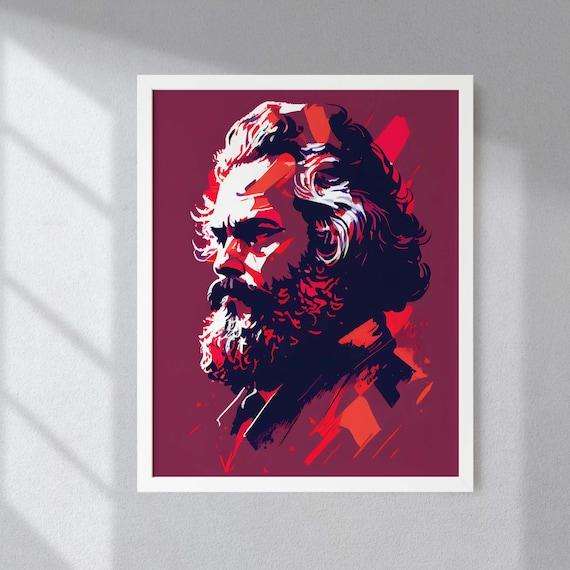
In Javid Nama, Iqbal generously praises Marx, giving him the highest status that a person could aspire to, short of prophethood. “He is not a prophet but he holds a book under his arm,” says Iqbal about the author of Das Kapital. But often people misunderstand Marx and portray him as a supporter of colonialism for his early-age writings. So today, on Karl Marx’s birthday, we will complete a chapter on Marx’s relationship with colonialism on behalf of Algerian Sunset!
For over a century, the intellectual portrait of Karl Marx has been framed within the narrow, soot-stained windows of the Industrial Revolution. We have been taught to see him as a rigid, Victorian theorist, a man whose horizons were bounded by the British Museum’s reading room and the smokestacks of Manchester. To his detractors in modern liberal academia, he is often dismissed as a Eurocentric relic, a thinker who viewed the non-Western world as a mere stage for the civilizing drama of capital. To his more dogmatic disciples, he was the architect of a cold, linear history where every nation had to trudge through the mud of industrialization before they could even dream of liberation.
If you look at the “Late Marx”—the man who spent his final months in 1882 breathing the dry air of Algiers, railing against French “shameless arrogance”—you don’t find a Eurocentric scholar. You find a revolutionary who had undergone a profound, radical pivot. Marx didn’t just add colonialism to his notes; he realized that the secret of capitalist power was not just hidden in the factory floors of the West, but was being forged in the blood-soaked soil of the global periphery.
In the early, brash days of the Communist Manifesto, Marx and Engels famously wrote of the bourgeoisie drawing even the most “barbarian” nations into civilization. It is a passage that critics love to cite as evidence of his colonial bias. But history is not a static document, and neither was Marx’s mind. By the time he reached the 1870s, the “civilizing mission” had revealed itself to him as a grotesque masquerade.
Marx’s 1879 notes on Algeria, written years before his doctor recommended the Mediterranean climate for his failing lungs, show a man obsessed with the mechanics of dispossession. He watched the French administration dismantle communal land ownership, not to modernize the Arabs, but to turn land into a “free object of purchase and sale.” He saw that the goal was to break any danger of rebellion by tearing the people away from their natural bonds to the soil. He stopped seeing colonialism as a necessary evil of progress and started seeing it for what it truly was: systemic, legalized plunder. He realized that the bourgeoisie wasn’t bringing civilization; it was destroying the very foundations of human society to ensure that its own rate of profit wouldn’t collapse.
Marx’s most provocative insight into the colonial machine wasn’t just about money or land; it was about the psychology of the skin. He was one of the first to grasp how racism functions as a mechanical necessity for capital. In his analysis of the British domination of Ireland, Marx stumbled upon the secret that maintains the status quo to this day.
He observed how the English ruling class intentionally fomented a “profound antagonism” between the English and Irish workers. By convincing the English worker that he belonged to a superior race, the bourgeoisie offered him a “psychological wage”—a sense of status that blinded him to his own exploitation. Marx wrote that the English worker’s attitude toward the Irish was “exactly the same” as that of the “poor whites” toward the Black population in the American South.
This was not a peripheral observation. Marx called this racial division the “secret of the power of the capitalist class.” It remains the most vital political lesson of our century. Whether it is the “border crises” of the 21st century or the colonial “civilizing missions” of the 19th, the strategy is identical: divide the oppressed along racial and national lines so they never look up at the person holding the leash.
The most radical shift in Marx’s life was his realization that the revolution might not follow the path he originally mapped out. He had previously assumed that the industrial heartland of Europe would lead the way. But as he studied the 1857 Indian Rebellion and the resistance in Ireland, his strategy flipped.
He famously argued that the “lever” must be applied in Ireland. He realized that the British working class would never achieve its own emancipation so long as it remained complicit in the colonial subjugation of its neighbor. This was a direct challenge to the “Western-first” logic. He began to see the periphery—the colonized, the “lesser breeds,” the marginalized—as the vanguard that would spark the crisis in the center.
Marx’s support for the Sepoy soldiers in India was not based on a romanticized view of their consciousness, but on a hard-nosed recognition of their agency. He saw them as a specter haunting Europe from the East. He recognized that as long as the bourgeoisie had a colonial safety valve to extract super-profits and dump its excess goods, it could always afford to buy off or suppress the movement at home. To kill the beast, you had to cut off its global limbs.
In the winter of 1882, physically frail but intellectually incandescent, Marx watched the French colonists in Algiers. He was struck by their shameless arrogance and their obsession with “atonement”—the demand that innocent Arabs be tortured or executed for any act of rebellion. He compared the French police to the British in India, noting that the colonist regards himself as even more inviolable than the king.
Yet, in his letters, he spoke with genuine admiration for the dignity of the local population. He noted their inherent sense of social equality and their lack of the servility found in the European class structure. For Marx, the Algerian communal way of life wasn’t a backward obstacle to be cleared away; it was a potential blueprint for a future that bypassed the atomized greed of capitalism.
We live in an age that some call post-colonial, yet we see the same patterns of techno-fascism and algorithmic colonialism where the extraction of data and rare-earth minerals has replaced the extraction of rubber and spice. The instrumental skepticism of modern liberal quarters tries to dismiss Marx as an old white man with a Eurocentric bias.
But the Late Marx is a nightmare for those critics. He is the man who realized that the struggle against Capital is inseparable from the struggle against Empire. He is the man who looked at the Global South not with pity, but with revolutionary expectation. Marx’s final years teach us that you cannot be a socialist without being a fierce anti-imperialist. You cannot claim to fight for the worker in the imperial center while ignoring the super-exploited in the periphery. The prophet of the periphery knew that the chains of capital are forged globally. To break them, we don’t need a civilizing mission from the West; we need the righteous, retributive agency of the global oppressed.
In his final months, Marx didn’t just want to interpret the world from a London library. He wanted to see the colonies set the world market on fire. And if we are to understand the 21st century, we must stop looking at the young Marx of the 1840s and start listening to the old Marx of Algiers. The lever is still where he left it.