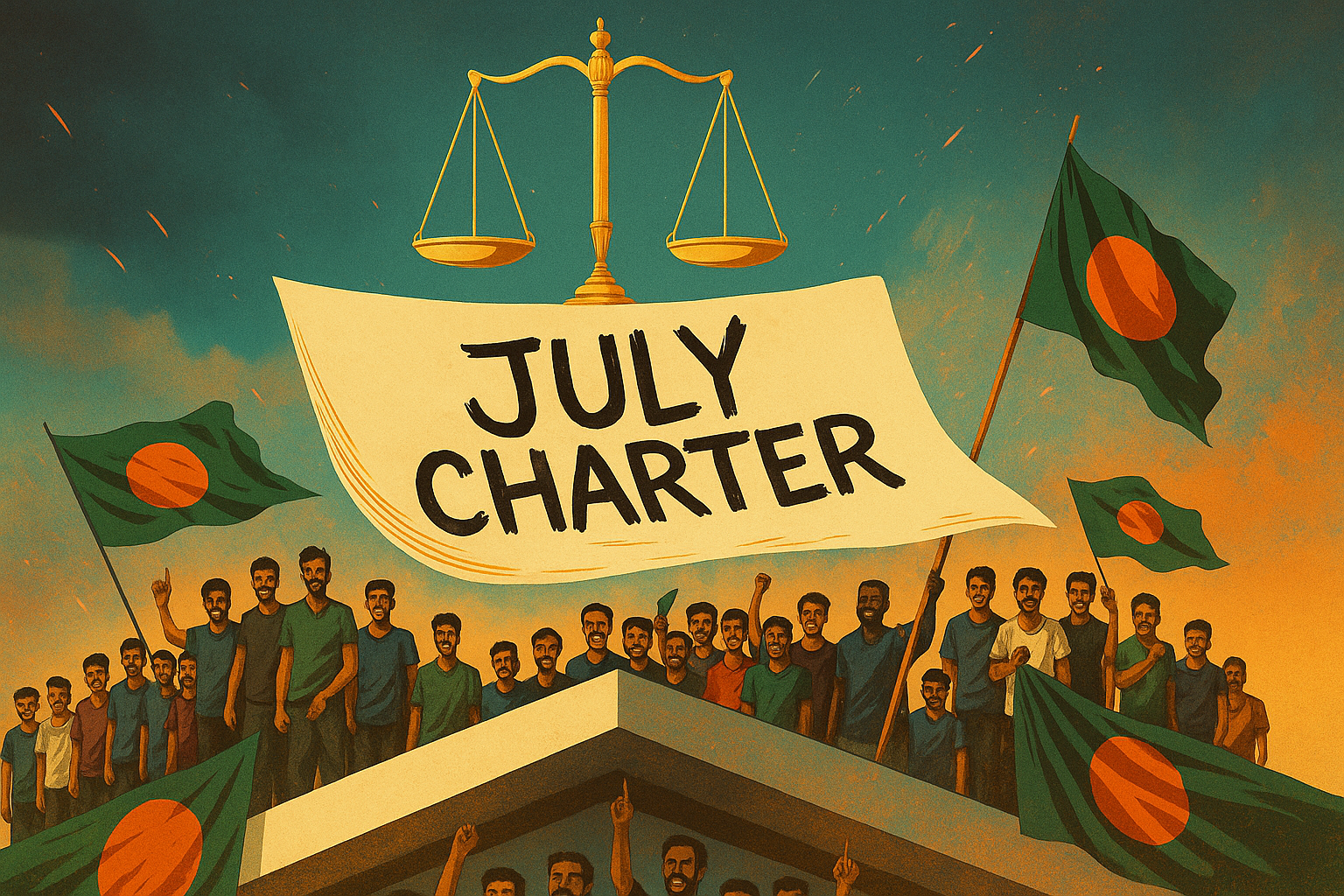
The July National Charter 2025 has entered its final drafting phase with consensus on 82 major reform points following two rounds of national dialogue, according to the National Consensus Commission. However, the BNP has officially submitted dissenting notes on eight specific proposals, while left-leaning parties have raised concerns over potential changes to the fundamental principles of the constitution.
Professor Ali Riaz, Vice Chair of the National Consensus Commission, announced that the final draft of the charter—documenting all reform decisions and commitments—will be shared with political parties in the coming days. A formal signing ceremony is also in planning.
“We will try to swiftly prepare and hand over the final charter to you. A plan for a signing ceremony will also be made based on this,” said Riaz at the conclusion of the dialogue’s second phase.
Structure of the Charter
The charter will be divided into two key sections: one detailing consensus reforms and another outlining individual party commitments. Although discussions have formally ended, no unanimous decision has yet been made on how the charter will be implemented, leaving the pathway to execution open for further negotiation.
Finalised Topics and Key Reforms
In the second phase of talks spanning 23 days, consensus was achieved on 11 additional issues. These include:
- Opposing party nominations to four parliamentary standing committees
- Formation of a constituency delimitation committee
- Constitutional amendments to the president’s power to grant pardons
- Structural decentralisation of the judiciary
- Use of referendums for sensitive constitutional reforms (including the preamble, fundamental principles, and caretaker provision)
- Prime ministerial term limits (maximum of 10 years)
- Secret ballot for presidential election
- Formation of an independent Police Commission
- Regulation of emergency declarations
- Strengthening fundamental citizen rights
- A selection committee for election commissioner appointments
Contested Proposals: Dissent on 9 Issues
Despite broad agreement, nine issues were adopted with dissenting opinions from various parties. Key points of contention include:
- Article 70 reform
- Method of electing women’s parliamentary seats
- Appointment of the Chief Justice
- Whether the Prime Minister can hold multiple executive posts
- Provisions related to Public Service Commission, Anti-Corruption Commission, Auditor General, and Ombudsman appointments
- Mode of Upper House elections (proportional representation)
- Presidential powers
- Selection of the Chief Adviser to a future caretaker government
The BNP objected to proposals 8, 9, 11, and 12 in the final consolidated draft, which largely concern institutional appointments and executive power.
Redefined Presidential Authority
One of the most debated issues was the president’s authority over key national appointments. While the initial proposal would have granted the president wide unilateral powers—including appointment of the armed forces and intelligence chiefs—the final version scaled this back. The president will now be empowered to independently appoint the heads of several oversight bodies, including:
- National Human Rights Commission
- Information Commission
- Bangladesh Press Council
- Law Commission
- University Grants Commission
- Energy Regulatory Commission
- Governor of Bangladesh Bank
BNP and others objected specifically to presidential authority over energy and central bank appointments, citing concerns about accountability.
Implementation: Legal or Moral?
The biggest fault line has emerged around implementation. While BNP has reaffirmed its moral and political commitment to the charter, it rejected calls for immediate legalisation. In contrast, Jamaat-e-Islami and the National Citizen Party (NCP) are demanding a binding legal framework before signing.
BNP’s Salahuddin Ahmed described the charter as “the people’s sovereign will” and insisted that all signatory parties will remain morally bound.
“We are pledging it. There is no greater national consent than this. It is above the law. It is the will of the people,” he said.
He added that the charter includes a provision to implement the agreed reforms within two years of a new government taking office, and BNP is fully committed to that timeline.
Jamaat and NCP Demand Immediate Legal Framework
Jamaat and the NCP have rejected BNP’s stance, warning that without legal instruments the charter may be reduced to a symbolic gesture.
Jamaat’s Nayeb-e-Ameer Syed Abdullah Mohammad Taher threatened legal action if the charter lacks legal teeth:
“If it lacks a legal basis, the charter will become meaningless. For that reason, we will file a compensation lawsuit against the commission and the government,” he said.
Jamaat proposed a Legal Framework Order (LFO), followed by constitutional proclamation and parliamentary ratification—citing precedents from the Ziaur Rahman and HM Ershad transitions.
The NCP echoed these demands. Member Secretary Akhtar Hossain warned that a post-election implementation plan would amount to deception:
“If it is meant to be implemented within two years after the election, we will reject it. It must be done quickly,” he said.
He demanded that the charter be legally proclaimed by July 36, with constitutional safeguards agreed by all parties beforehand.
What Comes Next?
With the commission’s tenure ending on August 15, a press conference will soon be held to outline possible pathways to implementation. Professor Riaz reaffirmed the commission’s readiness to continue as a facilitator—both formally and informally—should parties require further consultation.
For now, the draft stands as a milestone in Bangladesh’s political reform process—one that reflects a rare moment of dialogue, but still faces significant hurdles before transforming from paper to policy.