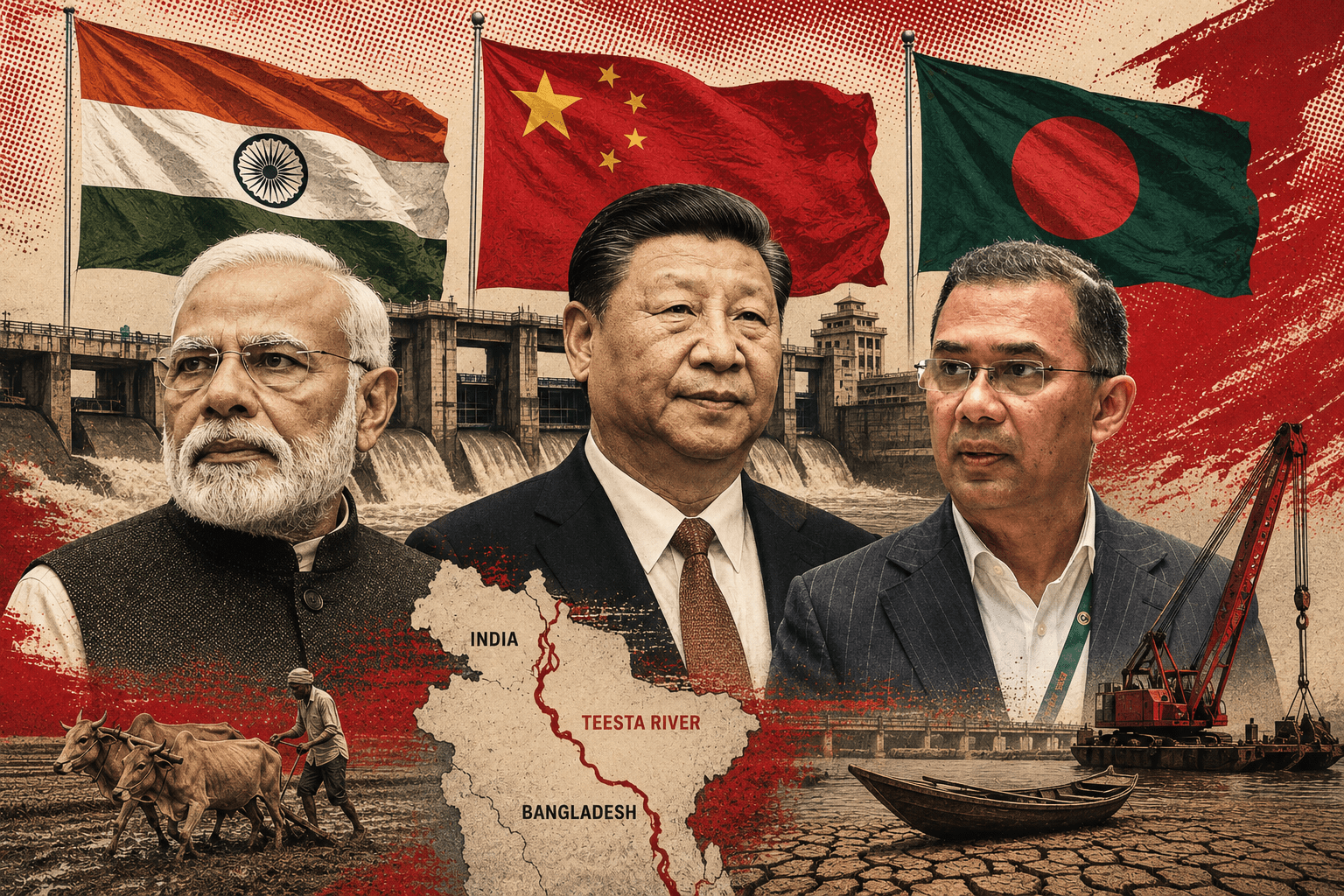
There is a river in northern Bangladesh that farmers once called their lifeline. Today, in the dry season, you can walk across parts of it on foot. Where boats used to carry goods year-round, there are now stretches of exposed sandbank as far as the eye can see. The Teesta River — 113 kilometres of it flowing through Bangladesh — is slowly disappearing.
But last week, the Teesta stopped being just a water crisis and became something far more complicated: a geopolitical tug-of-war between India, China, and a Bangladesh that has finally decided it is done waiting.
What Is Actually Happening to the Teesta?
The Teesta originates in Sikkim, flows through India’s West Bengal, and enters Bangladesh at the north. For the five districts of Rangpur, Nilphamari, Lalmonirhat, Kurigram, and Gaibandha, it is not a scenic feature — it is the irrigation backbone of their entire agricultural economy. Rice, maize, chili, jute, mustard — all of it depends on Teesta water during the dry season between December and April.
The crisis is severe and worsening. According to Bangladesh’s Water Development Board, the river’s natural dry-season flow is expected to be around 5,000 cusecs. In recent years it has dropped to as low as 400 cusecs — less than a tenth of what is needed. The Teesta Barrage Irrigation Project, the country’s largest irrigation scheme, was designed to serve around 84,000 hectares of farmland. After more than three decades, that target has never been met. Today, 60 to 70 percent of farmers in the region have given up on canal water and are paying out of pocket for diesel and electric pumps just to keep their crops alive.
And here is the cruel irony of the Teesta: the very same river that dries up and starves crops in winter transforms into a destroyer every monsoon. When India releases water from the Gazoldoba Barrage upstream — sometimes suddenly, sometimes excessively — the Teesta surges and floods the same villages that were desperate for water just months before. Over the past decade, more than 20,000 families have been displaced by Teesta erosion alone.
This is not a natural disaster. It is the consequence of a political failure that has been ongoing for over 40 years.
Forty Years of a Promise That Was Never Kept
Bangladesh and India have been talking about sharing the Teesta’s water since 1983, when a temporary agreement gave India 39 percent of the flow and Bangladesh 36 percent. That agreement was never formalised. It expired. And the conversation has been going in circles ever since.
The closest both countries came to actually settling this was in 2011. Then-Prime Minister Manmohan Singh was scheduled to visit Dhaka. A water-sharing framework had been negotiated. Both governments were ready. Then, at the last minute, West Bengal Chief Minister Mamata Banerjee refused to sign off — she argued that North Bengal did not have “a drop of water to spare” and that any deal would damage farmers on the Indian side. Since water is a state subject under India’s constitution, her consent was required. Without it, New Delhi could not move. The deal collapsed.
For the next fifteen years, the pattern repeated: Indian Prime Ministers would visit Dhaka, Teesta would come up, promises would be made, and nothing would happen. Mamata would not budge. The river kept drying up.
Bangladesh’s frustration deepened through successive governments. By the late 2010s, Dhaka began quietly exploring a different approach entirely — not sharing water with India, but managing whatever water Bangladesh actually receives on its own side of the border.
That is where China entered the picture.
China’s Offer and India’s Anxiety
In 2016, China and Bangladesh signed a memorandum of understanding to conduct technical studies on the Teesta. By 2019, during Prime Minister Sheikh Hasina’s visit to Beijing, Bangladesh’s Water Development Board and the Chinese state-owned company PowerChina signed the Teesta River Comprehensive Management and Restoration Project — now commonly known as the Teesta Mega Project.
The scope is significant. The plan involves building new embankments spanning 102 kilometres from the Teesta Barrage to the confluence at Chilmari, dredging the riverbed, reclaiming land, and building storage facilities to manage dry-season flow. The estimated cost is between Tk 8,000 to 12,000 crore — roughly $700 million to $1 billion — with China expected to provide a large portion through low-interest loans.
This is not a water-sharing agreement. It does not require India’s cooperation. Bangladesh is essentially saying: we cannot control how much water comes from upstream, but we can manage what arrives better than we currently do. The project, if executed, could transform flood control, reduce erosion, and improve irrigation reliability for millions of people.
So why did it stall for years?
Because of where it is located.
The Teesta project site sits in close proximity to the Siliguri Corridor — a 22-kilometre-wide strip of land in West Bengal that connects India’s entire northeastern region to the rest of the country. India refers to it as the “Chicken’s Neck” because it is the singular narrow passage through which road, rail, and military supply lines must pass. Chinese engineers and infrastructure, positioned that close to this corridor, is a scenario India views as a direct strategic threat.
In May 2024, India made a significant countermove: then-Foreign Secretary Vinay Kwatra visited Dhaka and offered Indian financing for the Teesta project — a clear attempt to displace China from a project that had already been signed with PowerChina. The Hasina government, trying to balance both relationships, appeared to pause the Chinese project in response to Indian pressure.
Then Hasina was ousted in August 2024. And everything shifted.
A New Government, a New Direction
The BNP won Bangladesh’s February 2026 election in a landslide, ending nearly two decades of Awami League rule. Tarique Rahman became Prime Minister. From the outset, the new government signalled a recalibration — not a dramatic pivot, but a deliberate move toward what it calls “balanced diplomacy.” Less dependence on any single neighbour. More diversification.
China read the moment quickly. Within a week of Tarique Rahman’s inauguration, Chinese Premier Li Qiang sent a congratulatory message explicitly mentioning the Teesta project and “high-quality Belt and Road cooperation.” The Chinese Ambassador visited Dhaka and said the project would “begin soon.” The signals were unmistakable: Beijing saw the political transition as an opening.
And Dhaka responded. On May 6, 2026, Foreign Minister Khalilur Rahman sat across from Chinese Foreign Minister Wang Yi at the Diaoyutai State Guest House in Beijing and formally sought China’s involvement in the Teesta project. Before departing for China, Rahman told reporters plainly: “We cannot just sit and wait. We have our own work to do.”
That sentence is worth sitting with. It is a direct message to India — delivered publicly, on the eve of a visit to its strategic rival — that Bangladesh’s patience has run out.
The West Bengal Wildcard
The timing of all this is remarkable, because the very obstacle that blocked the India-Bangladesh Teesta deal for fifteen years has just been removed — and Bangladesh is moving toward China anyway.
Mamata Banerjee and her Trinamool Congress party lost the West Bengal assembly election on May 4, 2026. The BJP won 206 out of 294 seats — a landslide that ended fifteen years of TMC rule. The party that blocked the 2011 Teesta deal is no longer in power.
On paper, this should have been good news for Bangladesh. The BJP, which governs at India’s centre and now in West Bengal, has long claimed it supports a Teesta agreement with Bangladesh. The state-level veto that paralysed negotiations for a decade and a half is gone.
But the reality is considerably more complicated.
First, the BJP won West Bengal on a campaign that was, in significant part, anti-Bangladesh. Promises of stricter border enforcement, stopping “infiltration” from Bangladesh, and cracking down on undocumented migrants were central themes. BJP’s support in North Bengal — the region directly adjacent to the Teesta and most affected by any water-sharing arrangement — is strong, and those voters have their own agricultural concerns about sharing water. Winning the election does not make the politics of water-sharing easier; it may simply transfer the veto from Mamata to a different set of local pressures.
Second, there is the broader context of how Bangladesh and India’s relationship has looked since August 2024. The fall of Hasina — whom New Delhi considered a close ally — soured relations sharply. Visa services were suspended. Trade was disrupted. Relations are only now beginning to thaw. The diplomatic trust required to negotiate a complex, contentious water treaty simply does not yet exist.
Third, and perhaps most significant for Bangladesh’s calculations: even if a BJP-led India were to offer a Teesta water-sharing deal tomorrow, it would not solve the infrastructure problem. Bangladesh still needs the dredging, the embankments, the storage facilities. It still needs the Teesta Mega Project. And India has not offered to build that at the scale China has.
Bangladesh’s Foreign Minister signalled all of this in a careful response when asked about the BJP victory and Teesta prospects: “A government has not yet been formed in West Bengal. Unless they clarify what they are thinking, it is not reasonable to expect us to read their minds.” Diplomatic language for: we are not holding our breath.
What China Actually Gets From This
It would be naive to read China’s enthusiasm for the Teesta project as purely charitable. Beijing’s involvement in Bangladesh’s infrastructure, particularly close to the Siliguri Corridor, serves Chinese strategic interests in ways that go beyond any single project.
China and India share a contested border and a deeply adversarial strategic relationship. Any Chinese infrastructure presence near the Chicken’s Neck — even civilian, even developmental — changes the calculus for India’s northeastern defence planning. This does not mean Bangladesh is being used as a pawn; it means that in geopolitics, the same project can simultaneously be a genuine development intervention for one party and a strategic asset for another.
China also sees Bangladesh’s new government as an opportunity to deepen BRI-linked ties in South Asia at a time when several countries in the region are renegotiating or distancing themselves from Chinese infrastructure deals. A high-profile, visibly beneficial project in Bangladesh — one that addresses a genuine humanitarian need — is exactly the kind of soft power investment Beijing wants.
The expected visit of PM Tarique Rahman to China in June, which the Foreign Minister has confirmed is being prioritised over India as a destination, would formalise this new chapter. If announced during a state visit, the Teesta Mega Project would carry the political weight of a bilateral headline commitment — far harder to pause or pressure away than a technocrat-level MOU.
The Ganges Treaty Deadline Nobody Is Talking About
There is one more dimension to this that deserves attention and has received almost none: the 1996 Ganges Water Sharing Treaty between Bangladesh and India expires in December 2026.
That treaty — signed by then-Prime Ministers Deve Gowda and Sheikh Hasina — has been the only functioning water-sharing agreement between the two countries for thirty years. It governs dry-season flow from the Farakka Barrage into Bangladesh via the Padma river system. It is, by any measure, a cornerstone of the relationship.
Its renewal is not guaranteed. The political climate between Dhaka and New Delhi is fragile. The diplomatic bandwidth to negotiate both a Teesta settlement and a Ganges renewal simultaneously — while managing a new BJP government in West Bengal and a new BNP government in Bangladesh — is stretched thin. If the Ganges treaty lapses without renewal, it would compound Bangladesh’s water crisis enormously.
This is the full weight of what is at stake in the coming months. Bangladesh is not just navigating one river dispute. It is navigating the entire architecture of its transboundary water security, against a backdrop of deteriorating climate conditions, shifting political alignments, and two regional giants with competing interests on its doorstep.
So Where Does This Leave Bangladesh?
Bangladesh’s move toward China on the Teesta is not irrational. It is the product of four decades of exhausted patience, a genuine humanitarian crisis in the north, a changed political landscape in Dhaka, and a new government that has decided it cannot anchor its foreign policy on promises that have consistently failed to materialise.
The risks are real. Deeper Chinese infrastructure presence near the Siliguri Corridor will generate friction with India. A BJP government in West Bengal, combined with one in New Delhi, may interpret Bangladesh’s China pivot as a provocation and respond with harder stances on border enforcement, trade, and the Ganges treaty renewal. The diplomatic balancing act will require considerable skill.
But there is also something legitimate in what Bangladesh is doing. A country that shares 54 rivers with India has managed to sign exactly one water-sharing treaty in its entire history. The farmers of Rangpur, Nilphamari, and Kurigram cannot wait another fifteen years for a deal that may never come. The river is drying up. People’s crops are failing. An entire region’s economy is under threat.
When the Foreign Minister said “we have our own work to do,” he was not just making a diplomatic point. He was acknowledging a reality that has been building for decades — that Bangladesh must act for its own people, even when the geopolitical consequences are uncomfortable.
The Teesta is no longer just a water story. It is a story about sovereignty, strategic choices, and what it means to be a small country navigating the rivalry of its much larger neighbours. Whatever happens next — in Beijing in June, in New Delhi’s response, in the Ganges treaty negotiations by December — it will shape Bangladesh’s regional position for years to come.