A Supreme Court judge called unemployed youth “cockroaches.” In three weeks, those cockroaches had more Instagram followers than India’s two largest political parties combined — and were marching on Jantar Mantar. This is the story of what broke, what’s breaking, and what it means for a government that has run out of explanations.
Part One · The Spark
On the morning of May 15, 2026, Chief Justice Surya Kant of the Supreme Court of India sat in his courtroom and, in the course of an otherwise unremarkable hearing on fraudulent legal credentials, made a remark that would prove to be the most consequential thing he ever said from the bench — though not in any way he intended.
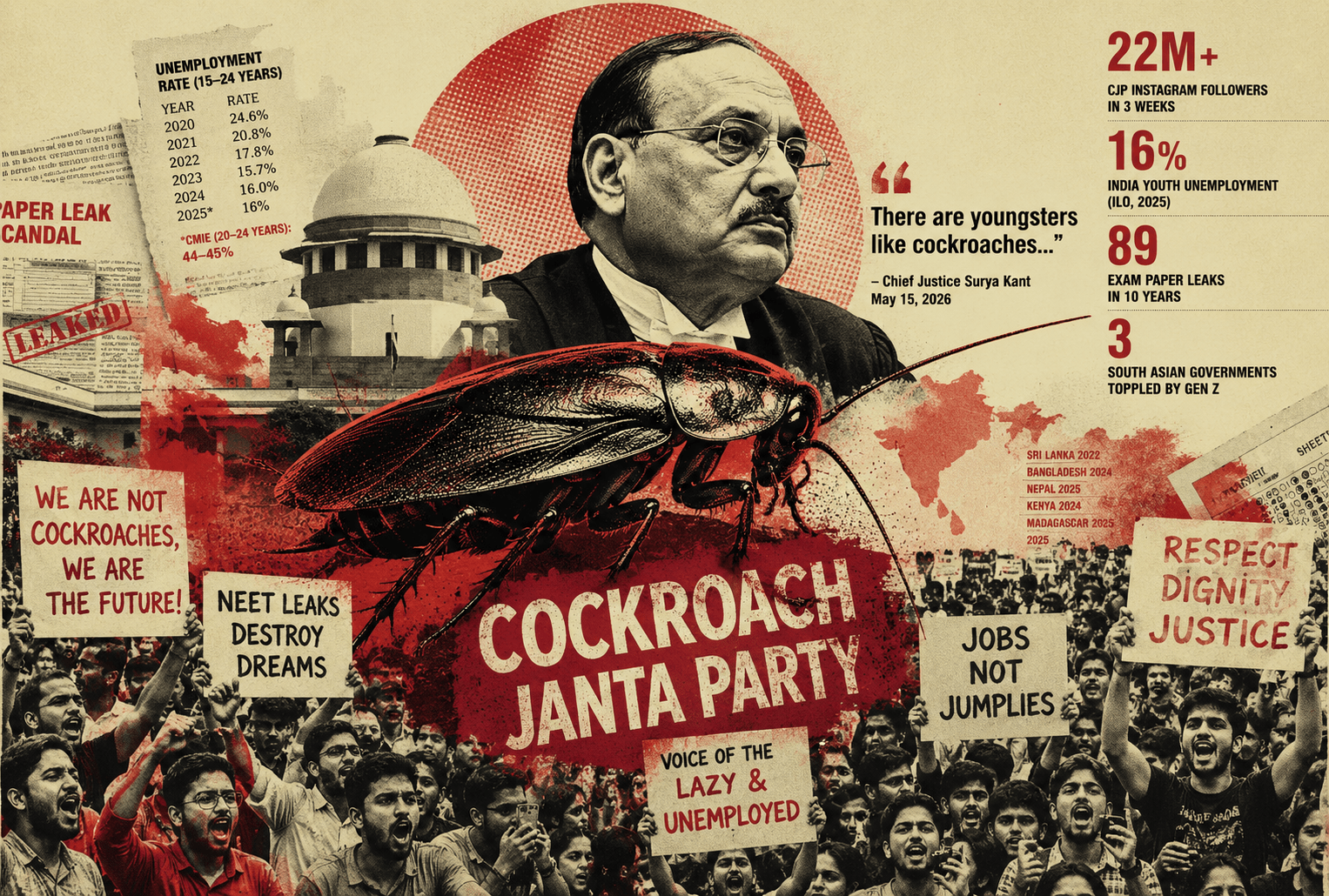
“There are youngsters like cockroaches,” he declared, “who don’t get any employment or have any place in the profession. Some of them become media, some of them become social media, RTI activists, and other activists, and they start attacking everyone.”
The remark was meant as a rebuke to critics of the legal establishment. Instead, it handed India’s disenchanted youth a mascot, a name, and a rallying cry.
Within 24 hours, Abhijeet Dipke — a political communications strategist and Boston University graduate who had previously worked with the Aam Aadmi Party — posted on X: “What if all the cockroaches come together?” The following day, May 16, he registered the Instagram handle and website for the Cockroach Janta Party (CJP), a deliberate satirical inversion of the ruling Bharatiya Janata Party’s name.
The party’s eligibility criteria were stated with sardonic precision: unemployed, lazy, chronically online, and able to rant professionally. Its slogan: Voice of the Lazy & Unemployed.
-
May
15CJI’s “cockroaches” remarkChief Justice Surya Kant calls unemployed youth “cockroaches and parasites” during a court hearing.
-
May
16CJP foundedAbhijeet Dipke launches Instagram handle and website as a satirical response. 3M followers within 78 hours.
-
May
20Student wing formedCockroach Students’ Union of India (CSUI) established. Demands include exam transparency and mental health support.
-
May
25NEET UG 2026 paper leak confirmedNationwide outrage. Youth Congress protests in Pune and across India. CJP absorbs the anger.
-
Jun
2Khan Sir shooting incident, PatnaFiring outside Khan Global Studies. Rival coaching director arrested. FIR eventually filed against Khan Sir.
-
Jun
6TodayJantar Mantar protestDipke flies from the US to lead CJP’s first offline rally. Permission granted till 5 pm.
Part Two · The Kindling: Three Matches, One Fire
The Cockroach Janta Party did not emerge in a vacuum. It was ignited by a single remark, but the fuel had been accumulating for years. Three recent events have acted as accelerants — each one a window into a system that has been failing India’s young people, and each one disproportionately resonating with the generation that Chief Justice Kant so carelessly insulted.
I. The NEET UG Paper Leak (May 2026)
The National Eligibility cum Entrance Test is the single gateway through which millions of Indian students seek entry into the country’s medical colleges. In 2026, more than 24 lakh candidates — many of whom had spent years and hundreds of thousands of rupees on coaching — sat for the exam. Before the results were even processed, the papers had leaked.
It was not the first time. According to Indian Youth Congress president Uday Bhanu Chib, there have been 89 incidents of paper leaks and 48 re-examinations across India in the last decade. The NEET fiasco has become a recurring scandal, not an aberration. Calls for the resignation of Union Education Minister Dharmendra Pradhan — now a unified demand of both the CJP and the formal political opposition — reflect a collapse of trust in the examination infrastructure that has been building since at least 2024.
For India’s aspiring doctors — young people who have sacrificed adolescence, social lives, and family savings to a single high-stakes test — the leak was not merely a bureaucratic failure. It was an announcement: that the system treats them as marks to be managed, not citizens to be served.
II. Khan Sir and the Coaching Economy Under Siege (June 2026)
On the night of June 2, a group of 15 to 20 men allegedly affiliated with a rival coaching institute called Gyan Bindu descended on the premises of Khan Global Studies in Patna, Bihar — vandalising property, pelting stones, and injuring a security guard. In the chaos that followed, the institute’s security guards fired shots into the air.
Faisal Khan — known across India simply as “Khan Sir” — had built one of the country’s most beloved educational presences on YouTube, offering accessible, energetic preparation for competitive exams in a country where quality coaching remains unaffordably expensive for most families. His subsequent legal troubles, with an FIR filed against him under the Arms Act and attempt-to-murder provisions, struck millions of his followers as a grotesque inversion of justice.
The episode has exposed the brutal commercial warfare beneath India’s coaching economy — a multi-billion-rupee industry that has flourished precisely because the formal education and employment systems have failed. Students who rallied outside his institute were not merely defending a teacher; they were defending the only credible route to employment that remained available to them.
“We want justice. We want security. We want security.”
— Student protester outside Khan Global Studies, Patna, June 3, 2026
Part Three · The System: The Arithmetic of Despair
Behind the memes, behind the satirical party name, behind the fury over Khan Sir and NEET — lies a set of numbers that India’s government has struggled to explain away. The CJP may be a joke in form, but the data it is built upon is not.
The divergence in methodology matters less than the lived reality: India’s youth unemployment figures, by any measure, are far worse than its headline GDP growth rate suggests. The country’s much-celebrated “demographic dividend” — the idea that a bulging working-age population would power decades of prosperity — has not materialised as promised. Instead, an estimated 7 to 8 million young people enter the workforce each year; the formal economy generates a fraction of the jobs required to absorb them.
The result is an economy of waiting. Young people study for years, pay for coaching, pass examinations that are then leaked, and emerge into a labour market that offers them contract work, gig arrangements, or nothing at all. The CMIE estimate that youth unemployment among the 20–24 age bracket hovered between 44 and 45 percent through much of 2025 — far higher than any official government figure — captures the scale of what is being suppressed in the public discourse.
“The frustration young Indians feel is not about laziness or entitlement,” one labour market analyst wrote in late 2025. “It is about mismatch. Skills, systems, and expectations are out of sync.” That language of mismatch — precise, bureaucratic, bloodless — does not quite capture what is happening when a Supreme Court judge calls the unemployed “cockroaches” and three weeks later those cockroaches have outflanked the country’s entire political establishment on social media.
Part Four · The Wave: India Is Not Alone — and That Is the Point
The BJP government’s strategists would be wise to study what happened in Colombo in 2022, Dhaka in 2024, and Kathmandu in 2025. In each case, the pattern was strikingly similar: a young population with legitimate economic grievances, a government that dismissed those grievances as noise, and then a social media–accelerated movement that moved from memes to the streets faster than any established institution could respond.
Aragalaya protests over economic collapse and corruption topple the Rajapaksa dynasty. President Gotabaya Rajapaksa flees. The first government overthrown by Gen Z.
Student protests over job quotas escalate into a revolution. Sheikh Hasina flees by helicopter after 16 years in power. Over 1,400 killed. Nobel laureate Muhammad Yunus leads interim government.
Gen Z protests against tax hikes and corruption. Parliament stormed. Government forced to withdraw the Finance Bill.
Government social media ban ignites mass unrest. 76 dead. Parliament buildings set ablaze. PM K.P. Sharma Oli resigns. Nepal’s first woman head of government sworn in.
Gen Z-led protests topple the president, following the South Asian pattern of youth-driven regime change.
Mass protests over economic conditions led by Gen Z in multiple cities, ongoing through late 2025.
The Council on Foreign Relations has documented that in 2024 alone, significant anti-government protests erupted in Bangladesh, Kenya, and Serbia; in 2025, they spread to Indonesia, Madagascar, Mexico, Morocco, Nepal, Peru, the Philippines, and Timor-Leste. In Nepal, the uprising was coordinated partly through a Discord server with over 100,000 members — a detail that would have seemed fantastical to any political scientist a decade ago.
What connects these movements is not ideology but frustration — and crucially, the digital tools that allow that frustration to bypass the gatekeeping mechanisms that governments have historically relied upon: state media, hierarchical party structures, the slow metabolism of traditional protest organisation. The CJP crossed 10 million Instagram followers faster than the BJP or the Indian National Congress ever had. The political establishment has no answer for that arithmetic.
“Similar movements led by disgruntled youth on social media in Nepal, Bangladesh, and Indonesia have disrupted economic activity and threatened political stability,” CNBC noted in its investor briefing on the CJP. The framing — assessing a youth protest movement through the lens of investor risk — is itself revealing. India’s Gen Z rebellion has become large enough to be discussed in the same breath as market volatility.
Part Five · The Question: Will India’s Cockroaches March?
The question that hangs over today’s Jantar Mantar protest is not whether CJP is a real political party — it is not, and its founders have never seriously claimed otherwise. The question is whether satirical rage can sustain itself when it moves from the frictionless territory of Instagram to the physical and institutional difficulty of street protest.
For the moment, the CJP has accomplished something that serious political parties have failed to do: it has made the government’s failures interesting again to a generation that had largely tuned out formal politics. It has linked the NEET paper leak to the Khan Sir incident to the Chief Justice’s contempt to the unemployment data to the global Gen Z rebellion — and it has done so in the language of meme and irony, which travels faster than press releases and parliamentary speeches.
The BJP has weathered protest movements before. In 2020, it faced the largest farmer protests in India’s history; after over a year of sustained agitation, Modi repealed the farm laws — but his government returned to power for a third term. More recently, in the 2026 West Bengal elections, the BJP achieved a historic win even as economic challenges mounted. The government’s resilience is not to be underestimated.
But there is a difference between protesting farmers and protesting students. Farmers have economic assets, social networks, and political geography on their side. Students have something else: time, digital fluency, and the terrifying patience of people who have nothing left to lose from the existing order. When a Supreme Court Chief Justice calls you a cockroach, and you immediately build a movement of 22 million people around the insult, you are demonstrating exactly the kind of creative political intelligence that existing power structures are least equipped to suppress.
“India’s once-celebrated youthful population now features prominently in international reports on high NEET rates — those Not in Education, Employment, or Training — denting perceptions of stability and growth.”
— International Labour Organisation, cited in analysis of India’s demographic dividend, 2025
The demographic dividend that India’s economists have promised for two decades has a deadline. The window within which a young workforce becomes an asset, rather than a liability, does not remain open indefinitely. What happens when a generation that was promised prosperity concludes — not from ideology but from lived experience — that the promise was a lie?
In Sri Lanka, they stormed the presidential palace and swam in his pool. In Bangladesh, they marched until the prime minister fled by helicopter. In Nepal, they burned the parliament. In each case, observers said it could not happen — until it did.
India is not Bangladesh. Its democratic institutions are more robust, its army more insulated from politics, its middle class more invested in stability. The CJP may remain a satirical curiosity, its Jantar Mantar rally a colourful footnote. But the conditions that produced it — the unemployment, the leaking exams, the contemptuous judiciary, the coaching economy that has become a parallel education system for a generation failed by the official one — those conditions have not been addressed. They are, if anything, worsening.
A Supreme Court judge called India’s youth cockroaches. In three weeks, those cockroaches assembled an army of 22 million. The government should study that number very carefully — not as a curiosity, but as a warning.
Editorial note: This feature report was prepared by GONOTAAR for publication on June 6, 2026. All data on the Cockroach Janta Party’s follower counts, the NEET paper leak, and the Khan Sir incident reflects information available as of the morning of June 6, 2026. The Jantar Mantar protest was ongoing at time of writing. Youth unemployment figures draw on ILO/World Bank annual estimates, CMIE monthly data, and the Government of India’s Periodic Labour Force Survey (PLFS) 2025.