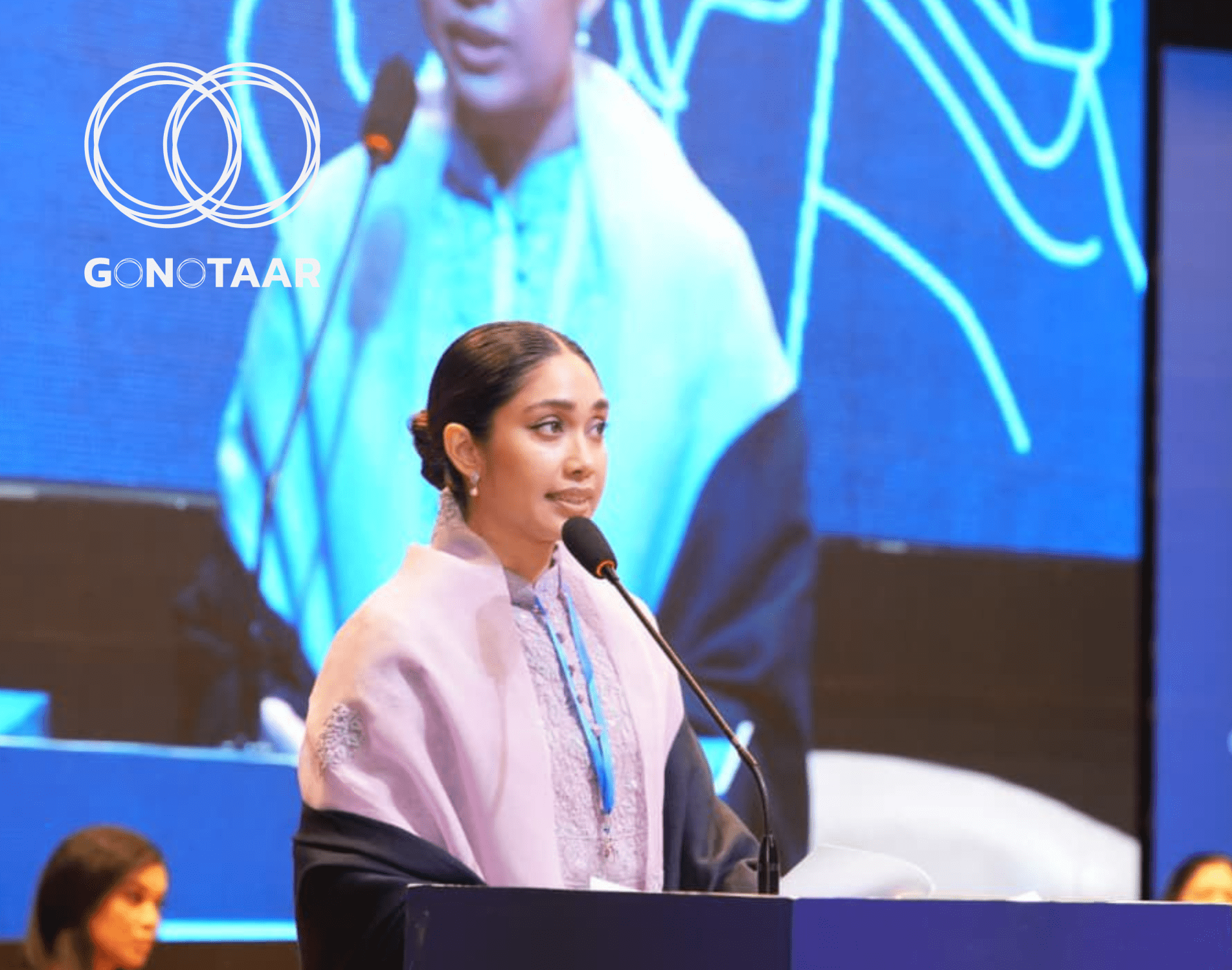
Barrister Zaima Rahman, daughter of BNP Chairman Tarique Rahman, has stated that Bangladesh cannot make significant progress while leaving half of its population behind.
Addressing a discussion titled “Women in Nation Building: Policy, Prospects, and the Future of Bangladesh” on Sunday (January 18) afternoon, she emphasized the necessity of women’s participation in the country’s development. The event was organized by Dhaka Forum at the Krishibid Institution Bangladesh (KIB) in the capital’s Khamarbari.
This marks the first public and policy-level speech by Zaima Rahman since her return to Bangladesh from London on December 25, alongside her father.
Democracy and Diversity
Reflecting on the nature of the gathering, Zaima Rahman highlighted that the beauty of democracy lies in the coexistence of differing opinions.
“Those of us present here today do not all share the same ideals, experiences, or perspectives. Yet, we have sat together and are engaging in discussion because we all care for the country and its people. This ability to speak together and listen to one another despite our differences is the true beauty of democracy,” she said.
A Personal Milestone
Zaima Rahman expressed deep emotion during her address, noting the significance of the moment in her personal and professional journey. She maintained a humble tone regarding her role in the nation’s future.
“I stand here today with a unique set of feelings and emotions. This is my first speech at a policy level in Bangladesh. I am not someone who has all the answers or knows the solutions to every problem,” she remarked.
She further urged citizens to contribute to the nation from their respective positions, saying, “We should all have the sincerity to do something for the country and society, even from our own small spaces.”
Key Attendees
The discussion was attended by several high-profile figures. Amir Khosru Mahmud Chowdhury, a member of the BNP Standing Committee, was present as the chief guest. The event brought together various stakeholders to discuss the strategic inclusion of women in the national policy framework.