
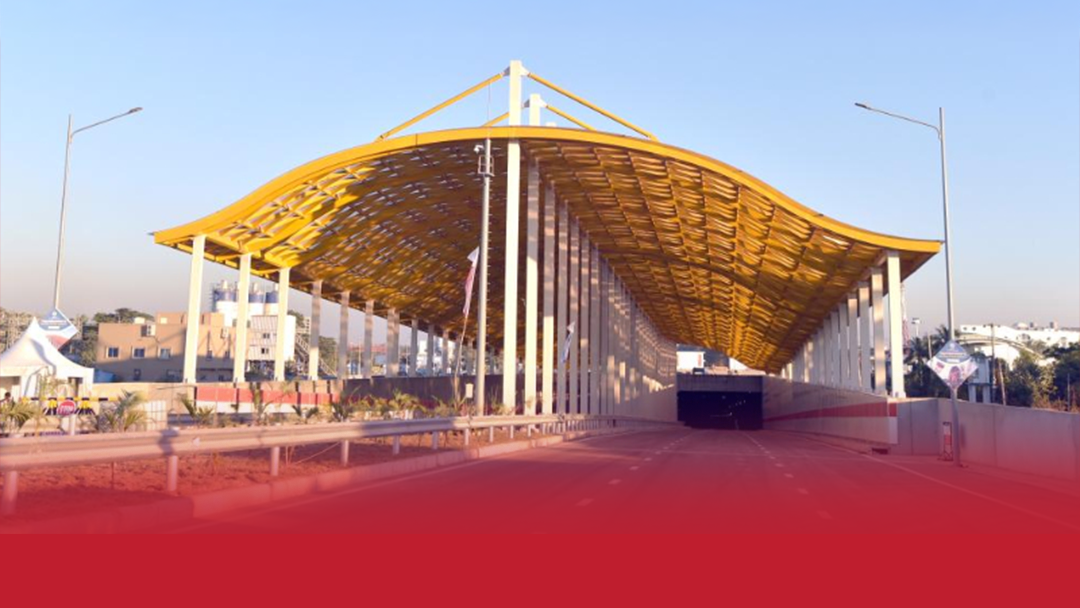
Two years after its launch, Bangladesh’s first underwater tunnel, once a source of national pride, is now a financial liability. Plagued by massive operational losses and new Anti-Corruption Commission (ACC) charges against a former minister, the Karnaphuli Tunnel has become a stark emblem of the costly failures within the Hasina-era’s “mega development” model.
A Tk 10,689 Crore Tunnel, A Failed Vision
Inaugurated on October 28, 2023, the Bangabandhu Sheikh Mujibur Rahman Tunnel was built at a cost of Tk 10,689 crore (USD 1.02 billion) by the China Communications Construction Company (CCCC), financed primarily through a mix of government funds and Chinese loans.
The 3.32-kilometre structure was projected to revolutionize connectivity between Patenga and Anwara, with ambitious projections of up to 28,000 vehicles per day by 2025. The reality, however, reflects severe mismanagement and unfulfilled promises.
The Economic Collapse: 5x Below Target
Verified data from the Bangladesh Bridge Authority (BBA) confirms the tunnel is operating at a fraction of its intended capacity:
- Traffic Shortfall: As of October 26, 2025, the tunnel has seen approximately 28.21 lakh vehicles pass—an average of just 3,870 vehicles per day. This is five times lower than the lowest projected target (19,000 to 28,000 vehicles daily).
- Daily Deficit: The total toll revenue of Tk 80.05 crore over two years averages only Tk 10.98 lakh per day. Against this, the Daily Operational Cost stands at a staggering Tk 37.47 lakh, resulting in a direct daily loss of Tk 26.49 lakh.
- Public Burden: The tunnel runs a deficit of nearly Tk 8 crore per month. Analysts estimate that, without factoring in maintenance or loan interest, it would take 27 years simply to recover the initial construction cost.
Subsidised Failure and Policy Blunders
The Bangladesh Bridge Authority is currently forced to draw heavily from the state exchequer to cover these operational costs. In effect, the public pays for the tunnel twice: first through taxes and debt financing its construction, and again through ongoing subsidies to keep it functional.
Experts largely attribute the failure to poor policy planning. The essential complementary infrastructure, such as connecting expressways and industrial facilities on the Anwara side, remains absent, leaving the tunnel drastically underutilized while the Shah Amanat Bridge handles the majority of the traffic.
ACC Probe Widens The Scandal
The financial disaster has been compounded by a deepening corruption scandal. The ACC has filed a case against former Road Transport and Bridges Minister Obaidul Quader and three other officials.
The investigation alleges financial irregularities through the unnecessary inclusion of three items—a service area, observation software, and a tugboat—which inflated the project cost by an estimated Tk 585 crore to Tk 686 crore. The case highlights the alleged disregard for expert recommendations and prioritisation of costly, questionable additions.
A Legacy of Unplanned Ambition
The Karnaphuli Tunnel is now a powerful symbol of the economic pitfalls of the “mega development” model. While projects like the Padma Bridge and Metro Rail have demonstrated technical prowess, the tunnel exposes the severe risk of prioritising political optics and massive foreign loans over rigorous economic feasibility and accountability.
The tunnel remains an engineering feat, but its financial performance and the scandal surrounding it offer a sobering lesson: “mega development” built on borrowed money and inflated projections can rapidly turn into a mega burden for the citizens who must ultimately shoulder the debt for decades.


