BNP rejects National Charter implementation process, Jamaat and NCP defend Commission’s authority
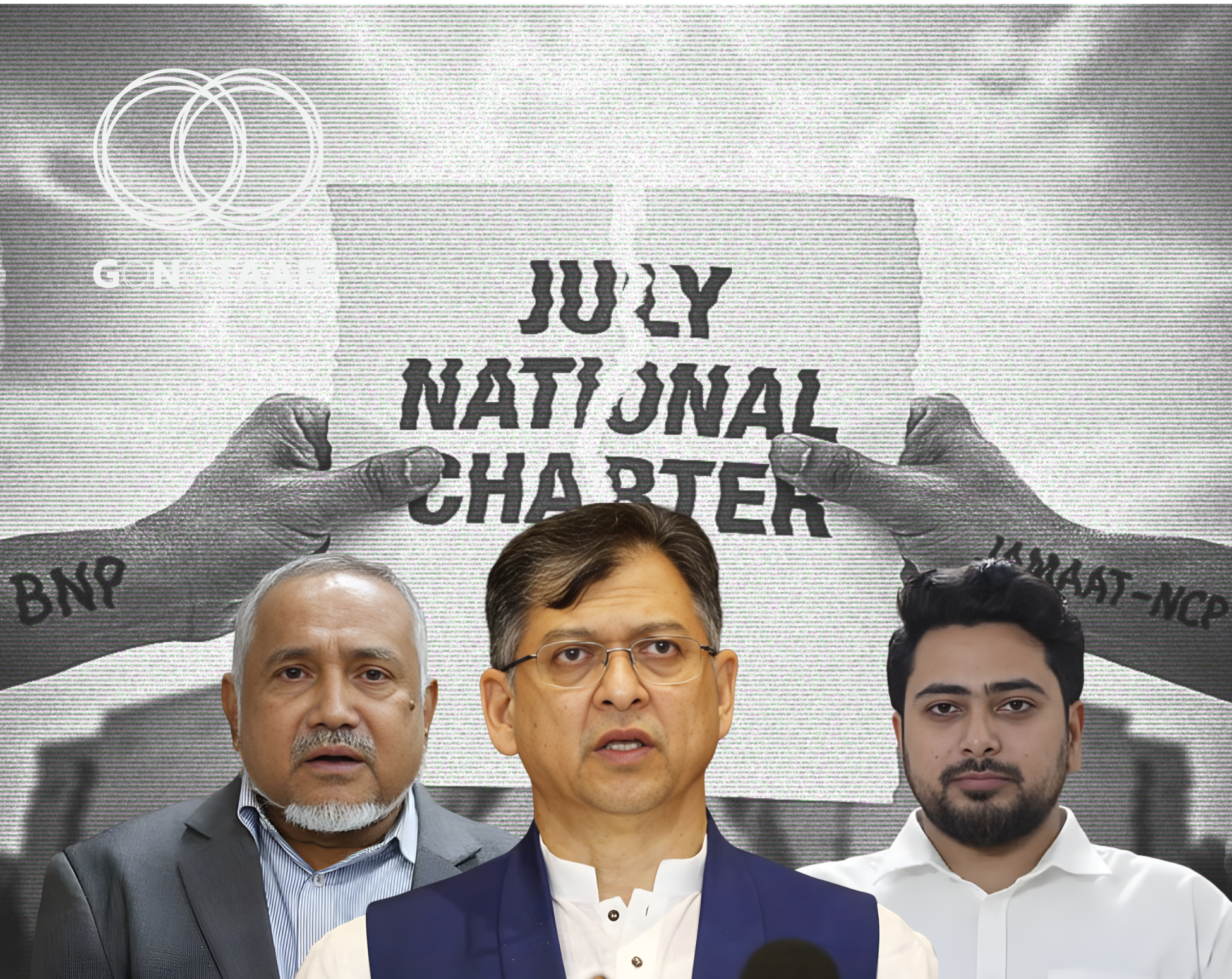
The submission of the National Consensus Commission’s recommendations for implementing the July National Charter has dramatically intensified existing political differences, particularly between the Bangladesh Nationalist Party (BNP) and other key stakeholders like the Jamaat-e-Islami and the National Citizen Party (NCP).
While Jamaat-e-Islami and the NCP have welcomed the recommendations, the BNP has reacted sharply against them, warning that the proposals threaten to divide the nation rather than build consensus. The ongoing conflict over the reform implementation process is fueling fresh anxiety in political circles regarding the stability of the national election trajectory.
BNP Cries ‘Deception,’ Claims Dissent Ignored
BNP’s Secretary General Mirza Fakhrul Islam Alamgir expressed the party’s strong reservations, asserting that the recommendations would lead to national division. Speaking at a program in Dhaka yesterday, he directed a strong warning toward the Chief Advisor of the Interim Government, Professor Muhammad Yunus.
“You are now accountable and bound by your promise to the people. You must enact the necessary reforms and deliver an election that is acceptable to the public,” Mr. Alamgir stated. “Should there be any deviation from this, the full responsibility will fall upon you alone.”
The core of the BNP’s objection centers on the omission of its ‘Note of Dissent’ (NCDs) in the final recommendations, which were formally submitted to Professor Yunus on Tuesday.
“We were promised by the Commission that our Note of Dissent on certain issues where we disagreed would be recorded in the recommendations,” Mr. Alamgir said, adding, “But we were surprised to see those issues completely ignored. This cannot be consensus. This is deception against the people and the political parties.”
BNP Standing Committee member Salauddin Ahmed echoed this sentiment, arguing that the recommendations do not fully reflect the spirit of the July Charter and represent an attempt to impose the views of a few parties and the Commission itself on the nation.
Jamaat and NCP Stand Firm
In contrast, Jamaat-e-Islami and the NCP have taken a constructive stance.
Syed Abdullah Muhammad Taher, Naibe Amir of Jamaat-e-Islami, dismissed the significance of the ‘Note of Dissent,’ stating that decisions are universally based on majority opinion, not dissenting views, and that any party genuinely seeking reform should not oppose the Commission’s decision.
“If any party wants to ensure and implement reform, they cannot oppose the Commission’s decision,” Mr. Taher told the media.
Jamaat-e-Islami Secretary General Mia Golam Parwar demanded that the date for the constitutional referendum be announced immediately. He warned that the failure to fix a date, as seen in the Commission’s recommendations, creates a complex situation and delays the national election.
The NCP’s Chief Coordinator, Nasiruddin Patwari, called on the government to swiftly draft and release the constitutional reform bill—derived from the referendum—to the public and begin implementing the non-constitutional reforms immediately.
Three Key Flashpoints
The political standoff revolves around three critical areas concerning the 48 constitutional reform proposals within the 84-point July National Charter:
- Timing of the Referendum: BNP favors holding the referendum concurrently with the general election, while Jamaat and NCP preferred it be held beforehand to make reform implementation mandatory for the incoming parliament.
- Omission of NCDs: The BNP insists that its dissenting positions, which were documented in the July Charter, must be honored and that the winning party’s electoral mandate should dictate how those specific points are addressed. The Commission and its supporters have prioritized majority consensus.
- Constitutional Reform Mechanism: Disagreement over the legal basis and process (e.g., the proposal for a Constitution Reform Council) through which the amendments would be enacted.
With the political heavyweights still at odds, all eyes are now on the Interim Government and its Chief Advisor, Professor Muhammad Yunus, to see what measures will be taken to bridge the gap and advance the election process.