
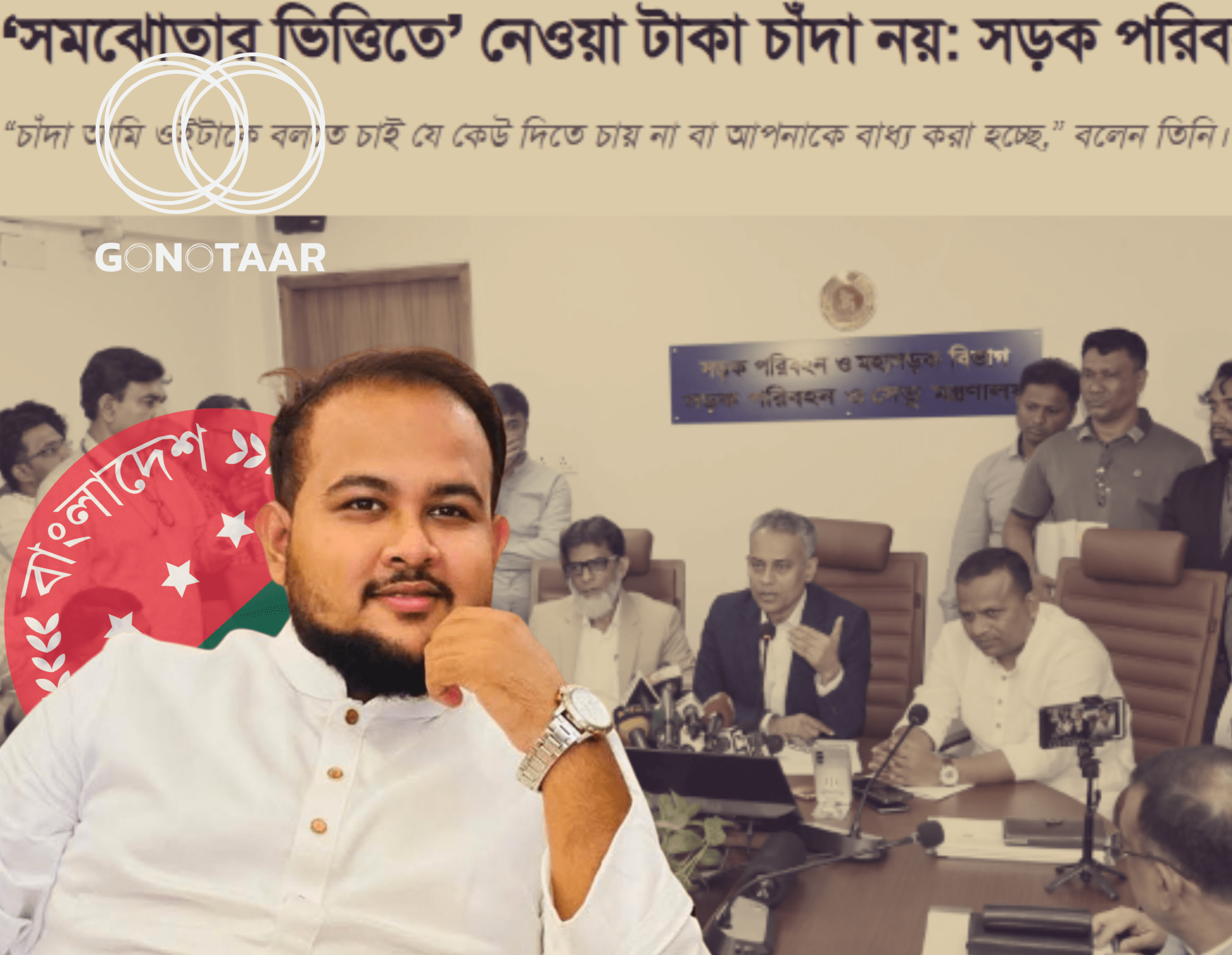
In a move that has garnered significant praise from the general public and student community, Shaikh Tanvir Baree Hamim, a prominent leader of the Bangladesh Jatiotabadi Chatradal (JCD), has publicly challenged the stance of the newly appointed Road Transport and Bridges Minister, Sheikh Rabiul Alam, regarding the collection of money on highways.
While the Minister recently characterized certain roadside collections as “mutual understanding” rather than extortion, Hamim—who served as the JCD-nominated GS candidate in the 2025 DUCSU elections—categorically labeled the practice of “slip-based” money collection as a form of blatant extortion that must be stopped immediately.
The Minister’s Controversial Stance
The debate began on Thursday during a meeting at the Secretariat, where Sheikh Rabiul Alam addressed the issue of money being collected from vehicles. The Minister stated:
“I don’t see what is happening in road transport as extortion in that sense. There are owner associations and worker federations; they collect these funds for their own welfare based on an ‘unwritten rule’ and mutual consent.”
He further clarified that he only considers it extortion if someone is “forced” to pay against their will, sparking criticism from transparency advocates and civil society who argue that such “consent” is often coerced under political and organizational pressure.

Hamim’s Counter: “Stop the Slip Culture”
Taking to social media today, Shaikh Tanvir Baree Hamim voiced a starkly different opinion, reflecting the pulse of the younger generation and the general public. Hamim argued that the long-standing “culture” of collecting money in the name of City Corporations, Municipalities, Unions, or worker organizations through slips is nothing short of extortion.
“This malpractice, which has continued for decades, was nowhere to be seen in the eight countries I have visited,” Hamim wrote. He emphasized that while tolls on bridges, elevated expressways, or highways are legitimate state revenues, the informal collection on the roads must end.
He further expressed confidence that the current BNP-led government would implement a “Zero Tolerance” policy against such activities.
A Call for Change and New Governance
Hamim’s post also highlighted the reformist steps taken by Tarique Rahman, the acting chairman of the BNP. He noted:
- Family Cards: Plans to launch family cards before Eid to support the public.
- Symbolic Leadership: Tarique Rahman has reduced his own protocol from 14 state vehicles to just four and has instructed law enforcement not to stand on both sides of the road for his movement to avoid public suffering.
“Change will come; change must happen,” Hamim asserted, concluding with the slogan, “Bangladesh first, Bangladesh for all.”
Public Reaction
The Chatradal leader’s direct contradiction of a senior cabinet member from his own party’s government has been widely appreciated by students and netizens. Many view this as a sign of healthy internal accountability within the new administration, where young leaders are willing to prioritize public interest over organizational traditions.


