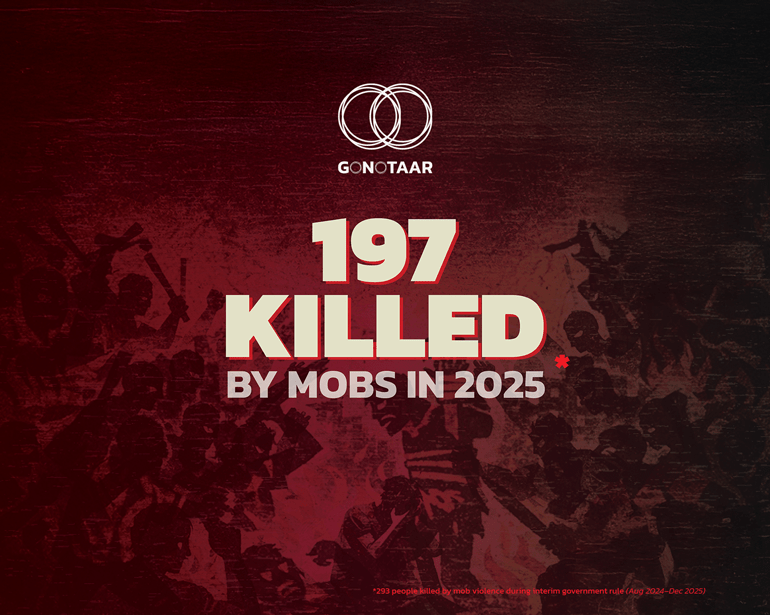
In 2025, Bangladesh witnessed a grim return to mob rule. According to Ain o Salish Kendra (ASK), at least 197 people were killed in mob violence over the year, marking one of the deadliest periods of vigilante justice in recent history. These killings were not isolated crimes; they were public executions carried out in streets, factories, shrines, and neighbourhoods—often in full view of law enforcement that failed to act.
ASK’s data places this crisis in an even wider and more alarming context. During the period of the interim government—from August 2024 to December 2025—at least 293 people were killed in mob violence nationwide, underscoring that the surge did not emerge overnight but intensified amid prolonged political transition and weakened enforcement.
Fuelled by rumour, religious extremism, moral vigilantism, and petty suspicion, mobs increasingly replaced courts, police, and due process. ASK warns that this violence reflects not momentary rage but a systemic collapse of the rule of law, where impunity has become normalised.
MOBOCRACY 2025: State of Siege as Lynching Deaths Hit Record High
DHAKA, Jan 4, 2026 (Gonotaar News) — A chilling report released by the human rights organization Ain o Salish Kendra (ASK) reveals that 2025 was the deadliest year for mob violence in Bangladesh’s recent history. With at least 197 people killed by mobs between January and December, the nation is grappling with a “street justice” epidemic that rights activists say is fueled by a collapse of faith in the judicial system and alarming police inaction.
The statistics highlight a grim milestone for the current administration: During the interim government’s regime (from August 2024 to December 2025), a staggering total of 293 individuals lost their lives to mob violence. This broader figure underscores that the surge in lynchings was not merely a post-uprising flashpoint but has remained a sustained crisis for over a year.
The Year’s Most High-Profile Brutalities (2025)
The following incidents became the defining faces of the 2025 mob crisis, illustrating a shift from “theft suspicion” to targeted ideological and religious lynchings:
- September 5, 2025 | The Rajbari Shrine Desecration: In Goalanda, Rajbari, a mob under the banner of the “Iman-Akida Raksha Committee” stormed the Nural Pagla Mazaar. The attackers exhumed the body of the late Sufi saint and set it on fire. During the mayhem, Rasel Mollah, the shrine’s khadem (caretaker), was brutally beaten and later succumbed to his injuries.
- December 18, 2025 | The Burning of Dipu Chandra Das: In Bhaluka, Mymensingh, Dipu Chandra Das, a 27-year-old Hindu garment worker, was dragged from his factory after baseless rumors of blasphemy. The mob beat him, hanged him from a tree, and set his body on fire. Subsequent investigations revealed no evidence of blasphemy.
- August 9, 2025 | The “Police Watch” Murders: In Taraganj, Rangpur, relatives Ruplal Das and Pradip Das were lynched on suspicion of being van thieves. Eyewitnesses alleged that police officers were present at the start of the beating but retreated as the crowd grew, leaving the two men to be murdered on the open road.
Monthly Mob Violence Fatalities — 2025 (ASK Data)
| Month | Deaths | Month | Deaths |
|---|---|---|---|
| January | 14 | July | 16 |
| February | 12 | August | 22 |
| March | 15 | September | 20 |
| April | 18 | October | 17 |
| May | 16 | November | 15 |
| June | 19 | December | 13 |
Total Lives Lost: 197
The violence peaked in urban and industrial districts:
- Dhaka: 27 deaths
- Gazipur: 17 deaths
- Narayanganj: 11 deaths
This was not a rural anomaly—it was a nationwide crisis.
Human rights defenders argue that mob violence thrives because perpetrators are rarely held accountable. Arrests are few, prosecutions rarer, convictions almost nonexistent. Each unpunished killing becomes an invitation for the next.
ASK repeatedly warns that law enforcement inaction, delayed intervention, and selective enforcement have eroded public trust. As mobs gain confidence, the legal system loses authority.
Mob violence is no longer about crime prevention. It has become a tool of social control, religious intimidation, and collective punishment.
As Bangladesh enters 2026, ASK’s findings pose a stark question:
Who governs the streets—the law or the crowd?
Until justice replaces vigilantism and accountability replaces silence, the toll of mob violence will continue to rise—one rumour, one crowd, one death at a time.