
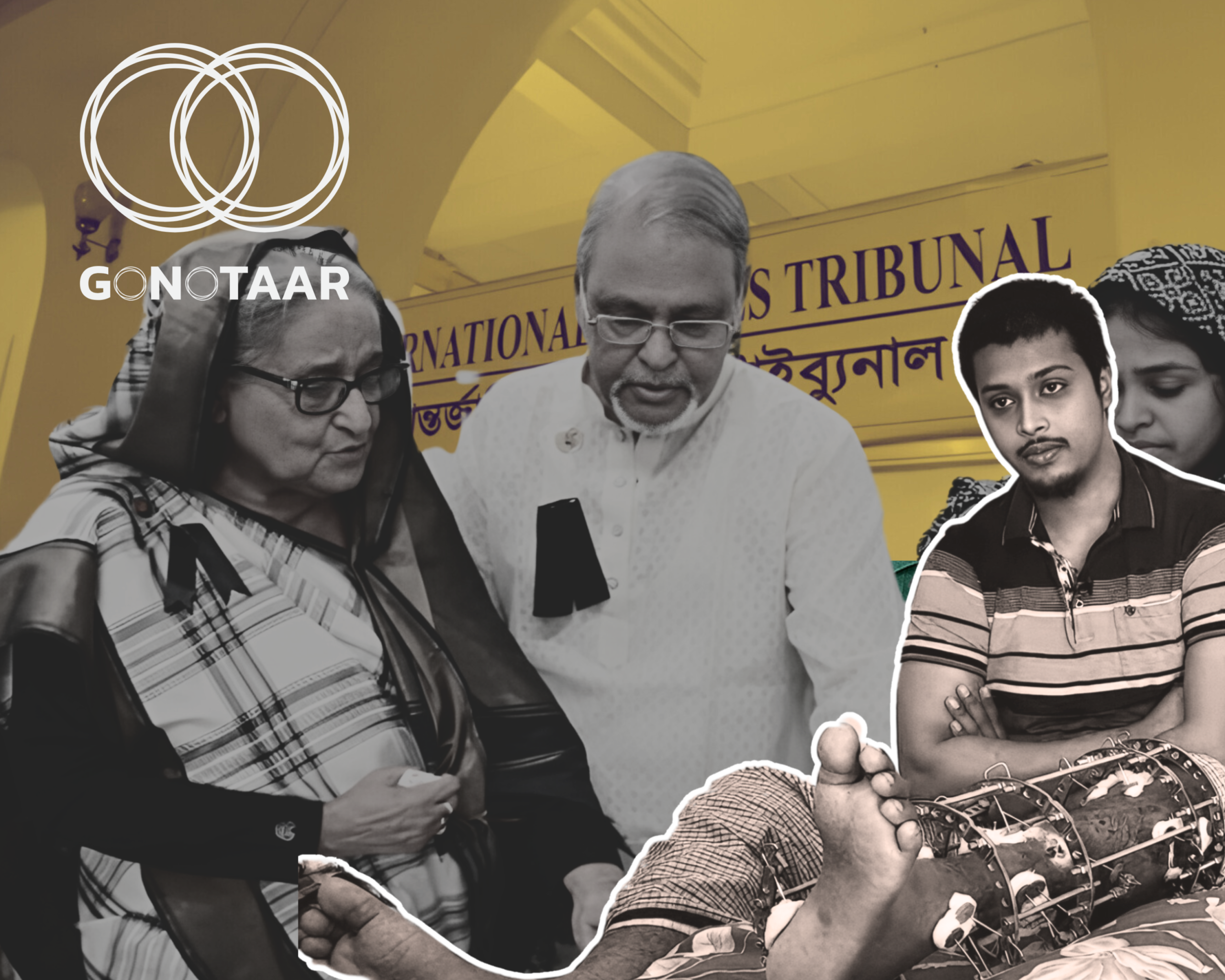
The war crimes tribunal hearing charges related to the July Uprising took a chilling turn today as a student witness accused former Prime Minister Sheikh Hasina of ordering hospital authorities to withhold treatment from protest victims.
Appearing as the second witness in the ongoing trial, student Abdullah Al Imran gave his testimony before International Crimes Tribunal-1, implicating Sheikh Hasina, former Home Minister Asaduzzaman Khan Kamal, and former IGP Chowdhury Abdullah Al-Mamun in crimes against humanity.
Imran recounted being shot in the leg during a protest near Bijoynagar’s water tank area on July 19, 2024, during the height of the student-people uprising. He was admitted to the National Institute of Traumatology and Orthopaedic Rehabilitation (NITOR), commonly known as Pongu Hospital.
In his statement, Imran said former Prime Minister Hasina visited the hospital on July 26 or 27, where she personally spoke to him. Initially polite, she asked about his education and whether he lived in a student dormitory. Upon realizing he was an injured protester, Hasina allegedly questioned whether the police had shot him. Imran confirmed, stating the shot came directly from a uniformed officer.
Then came the most shocking part of his account.
“As she was leaving, I heard her instruct the helpdesk: ‘No release, no treatment,’” Imran told the tribunal.
“At that time, I didn’t understand what it meant. Later, when my surgery was delayed and I couldn’t be taken home despite my father’s efforts, the meaning became painfully clear.”
Imran added that his leg was at risk of amputation and that plans were underway to transfer him to prison immediately after. He squarely blamed Sheikh Hasina, Asaduzzaman Khan, and Abdullah Al-Mamun for his suffering and for “weaponizing medical care” against protesters.
The testimony comes one day after the trial officially began with opening statements and the first witness, Khokon Chandra Barman, a microbus driver. The case, which centers on crimes against humanity committed during July–August 2024, marks the first time a former Bangladeshi head of government is standing trial for such charges.
Of the three accused, only Chowdhury Abdullah Al-Mamun is in custody. He has already confessed and turned approver, cooperating with prosecutors in revealing the chain of command. Hasina and Kamal remain fugitives, with public notices issued for their surrender. Court-appointed defense counsels are representing them.
Parts of the tribunal proceedings were broadcast live on state television, a rare move reflecting the public gravity of the case.
This trial could mark a historic shift in Bangladesh’s pursuit of justice—bringing accountability not for past liberation-era crimes, but for atrocities committed in the digital, post-democratic age.


